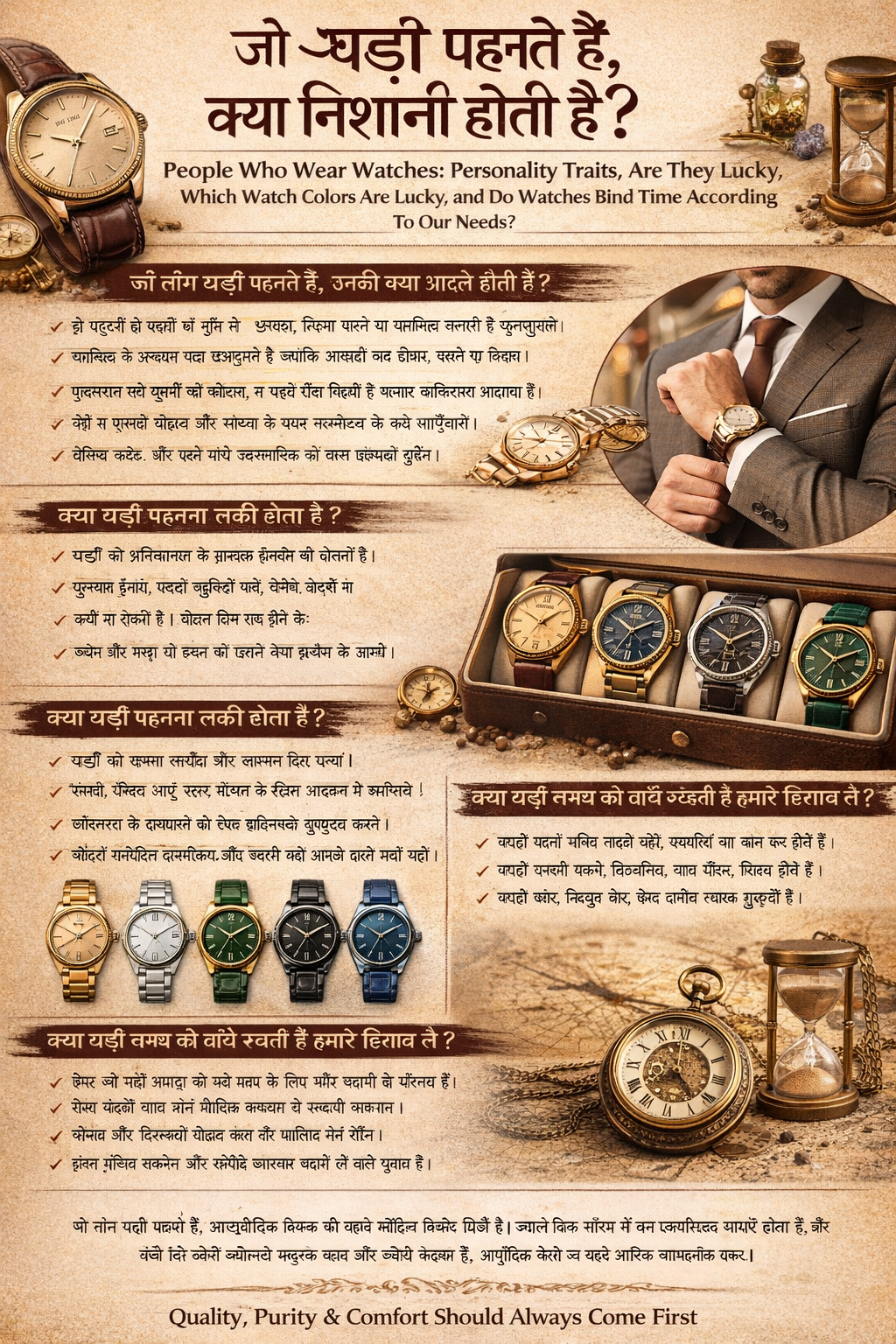
In today’s digital world, where smartphones display the time instantly, wearing a wristwatch is no longer a necessity—it is a choice. Yet many people still prefer to wear watches every day. This simple accessory often reflects deeper aspects of personality, habits, beliefs, and even cultural ideas about luck and time.
This article explores the signs of people who wear watches, their common habits, whether wearing a watch is considered lucky, which colors and metals are believed to be lucky, the types of watch products available, and whether a watch truly “binds” time according to our lives.
1. What Are the Signs of People Who Wear Watches?
People who regularly wear watches are often associated with certain personality traits. While not universal, these characteristics are commonly observed:
1. Punctual and Time-Conscious
Wearing a watch suggests that a person values time. Such individuals are usually punctual and dislike being late for meetings, appointments, or social gatherings.
2. Disciplined
A watch symbolizes structure. People who wear watches often plan their day and try to follow schedules carefully.
3. Responsible
Being aware of time reflects responsibility. These individuals understand deadlines and commitments.
4. Professional Mindset
In professional environments, a watch adds to a polished appearance. Many business leaders and professionals consider a watch an essential part of their attire.
5. Detail-Oriented
Choosing and wearing a watch daily shows attention to small but meaningful details.
2. What Habits Do Watch Wearers Commonly Have?
People who wear watches often develop certain habits over time:
- Checking time frequently to stay organized
- Planning tasks according to a schedule
- Setting time limits for work
- Avoiding procrastination
- Respecting others’ time
In many cases, wearing a watch reinforces strong time-management skills.
3. Is Wearing a Watch Considered Lucky?
From a scientific perspective, a watch itself does not bring luck. However, in cultural and astrological beliefs, watches are sometimes connected to fortune and destiny.
Beliefs About Luck:
- Wearing a functional watch is considered positive because it symbolizes progress.
- Wearing a stopped or broken watch is often viewed as unlucky, as it represents stagnation.
- Some traditions suggest wearing a watch on a particular hand (left or right) for better energy flow.
Ultimately, luck is influenced more by mindset and actions than by accessories. However, if wearing a watch increases confidence, it can indirectly improve performance and outcomes.
4. Which Watch Colors Are Considered Lucky?
Different colors are believed to carry symbolic meanings. Here are some commonly considered “lucky” watch colors:
Gold
- Symbol of wealth and prosperity
- Associated with leadership and success
Silver
- Represents calmness and balance
- Linked with emotional stability
Black
- Symbolizes power and authority
- Popular in professional settings
Blue
- Associated with peace and wisdom
- Considered lucky for career growth
Green
- Represents growth and financial progress
- Favored by business professionals
Color choice often depends on personal belief, zodiac sign, or lifestyle preference.
5. Which Metal Watches Are Considered Lucky?
In traditional and astrological beliefs, the material of the watch may also influence luck.
Gold Watches
Believed to enhance confidence and authority. Often worn by leaders or individuals in high positions.
Silver Watches
Associated with calmness and emotional balance. Suitable for creative or sensitive individuals.
Stainless Steel
Symbolizes strength and durability. Practical and widely used.
Titanium
Lightweight and modern. Represents innovation and resilience.
Leather Strap Watches
Classic and elegant. Often chosen for formal settings.
The “luckiest” metal depends largely on personal belief systems and sometimes astrological guidance.
6. Does a Watch Really Bind Time According to Us?
A watch cannot literally bind or control time. Time moves independently of human tools. However, symbolically:
- A watch reminds us that time is limited.
- It encourages discipline and awareness.
- It helps us manage daily routines efficiently.
In this way, a watch does not bind time—but it helps us bind our habits and organize our lives.
7. What Types of Watch Products Are Available?
There are various categories of watches designed for different purposes:
Analog Watches
Traditional dial watches with hour and minute hands. Ideal for classic and formal looks.
Digital Watches
Display time in numeric format. Popular among students and athletes.
Smartwatches
Advanced watches with health tracking, notifications, and fitness monitoring features.
Luxury Watches
High-end branded watches made from premium materials. Often considered status symbols.
Sports Watches
Durable and water-resistant, designed for physical activities.
Each type serves different lifestyle needs.
8. Is Wearing a Watch Beneficial for Health?
Traditional watches do not directly affect health. However, smartwatches can provide health-related benefits such as:
- Heart rate monitoring
- Step counting
- Sleep tracking
- Calorie measurement
These features encourage healthier habits and awareness of physical well-being.
Conclusion
People who wear watches are often seen as disciplined, punctual, and responsible individuals. While wearing a watch does not automatically bring luck, it can boost confidence and create a positive mindset.
Different colors and metals carry symbolic meanings, and many believe that gold, silver, black, or blue watches are lucky depending on personal beliefs. Ultimately, the true value of a watch lies not in superstition but in the reminder it gives us: time is precious.
A watch does not control time—but it helps us control how we use it.
