Introduction
William Shakespeare is one of the greatest writers in the history of world literature. Known as the “Bard of Avon,” Shakespeare was an English playwright, poet, and actor whose works have influenced literature, education, theater, and culture across the globe. His. plays, poems, and stories are studied in school and universities in almost every country. Even after more than 400 years, his writings remain relevant, powerful, and. inspiring.
This article explores who Shakespeare was, his awards and recognition, his novels (commonly referred to as plays), poems, stories, his personality, his contribution to education, and the history of the publication of his books around the word .
Who Was william Shakespeare?
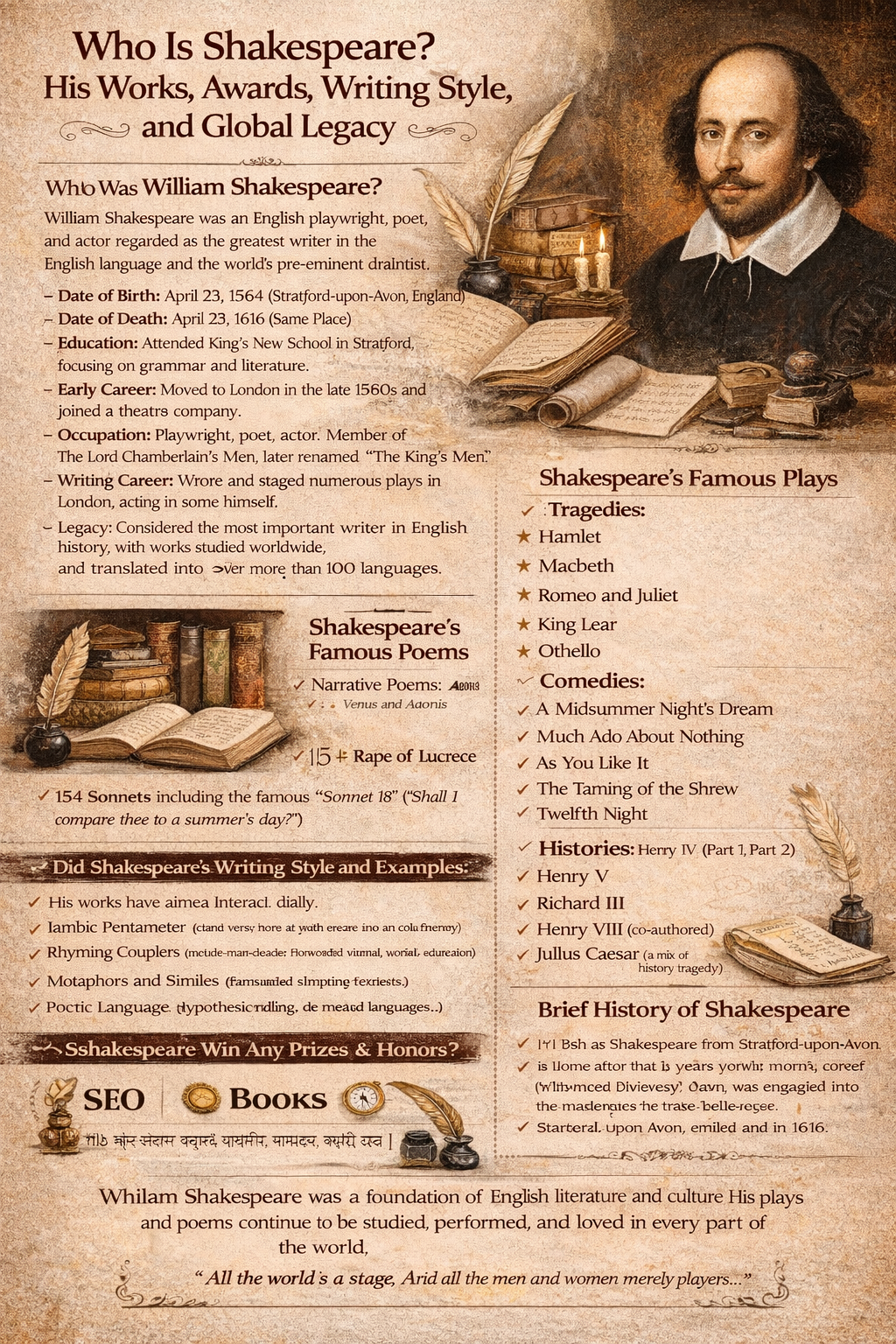
William Shakespeare was born on April 23, 1564, in Stratford-upon-Avon, England. He was th son of John Shakespeare, a glove-maker and local politician, and Mary Arden, a landowner’s daughter.
He was baptized on April 26, 1564, and is believed to have died on April 23, 1616, at the age of 52 .
Education
Shakespeare likely attended King’s New school in Stratford. Although there is no official university record, he received a strong education in:
- Latin grammar
- Classical literature
- Rhetoric
- Roman history
- Poetry
His deep knowledge of classical mythology, history, and language shows the strength of his education.
Shakespeare’s Writing career
Shakespeare moved to London in the late 1580s or early 1590s. He become:
- A playwright
- An actor
- A shareholder in a theatre company called The Lord Chamberlain’s Men, later known as The King’s Men.
He wrote approximately 39 plays, 154 sonnets, and 2 long narrative poems.
Shakespeare’s Major Works (Plays)
Although Shakespeare did not write novels in the morden sense, his plays are often considered dramatic stories similar to novels.
His plays are divided into three main categories:
1. Tragedies
These plays deal with serious themes like ambition, betrayal, love , jealousy, and death.
- Hemlet
- Macbeth
- Othello
- King lear
- Romeo and Juliet
- Julius Caesar
- Antony and Cleopatra
- Coriolanus
- Titus Andronicus
- Timon of Athens
- Troilus and Cressida
Example:
In Hamlet, the famous line is:
“To be, or not to be: that’s is the question.”
2. Comedies
These plays focus on love, misunderstandings, humor, and happy endings.
- A Midsummer Night’s Dream
- As You Like It
- Twelfth Night
- Much Ado About Nothing
- The Merchant of Venice
- The Taming of the Shrew
- The Comedy of Errors
- Love’s Labour’s Lost
- Measure for Measure
- The Merry Wives of Windsor
- All’s Well That Ends well
Example:
In As You Like It, Shakespeare wrote:
“All the world’s a stage, and all the men and women merely players.”
3. Histories
These plays are based on English kings and historical events.
- Richard II
- Richard III
- Henry IV (Part 1 & 2)
- Henry V
- Henry VI (Part 1, 2 & 3)
- King John
- Henry VIII
These works helped people understand English history and leadership.
4. Late Romances (Problem Plays)
Some of his later works combine tragedy and comedy.
- The Templat
- The Winter’s Tale
- Cymbeline
- Pericles
Shakespeare’s Poetry
Shakespeare was also a great poet.
Narrative Poems:
- Venus and Adonis
- The Rape of Lucrece
Sonnets:
He wrote 154 Sonnets, exploring:
- Love
- Time
- Beauty
- Death
- Immortality
Famous Sonnet Example (Sonnet 18):
“shall I compare thee to a summer’s day?”
His sonnets are studied worldwide in poetry courses.
Did Shakespeare Win Any Awards?
During Shakespeare’s lifetime, there were no formal literary awards like today (such as the Noble Prize). However, he received:
- Royal support from Queen Elizabeth I
- Patronage from King James I
- Great popularity during his life
After his death, he has received:
- Statues in many countries
- Memorials
- Global recognition as the greatest English writer
- His image on British currency
- Schools and theaters named after him worldwide
He did not win modern awards, but his legacy is greater than any prize.
Shakespeare’s Personality
Though historical records are limited, scholars believe Shakespeare was:
- Intelligent and observant
- Creative and imaginative
- Emotionally sensitive
- Deeply thoughtful
- Business-minded (he invested in property and theater)
His writings show that he deeply understood:
- Human psychology
- Emotions
- Political power
- Love and jealousy
- Greed and ambition
He was also practical and financially smart, buying property in Stratford.
Shakespeare’s Writing Style
Shakespeare used:
1. Iambic Pentameter
A rhythmic pattern in poetry.
2. Blank Verse
Unrhymed poetic lines.
3. Metaphors and Similes
He used creative comparisons.
4. Rich Vocabulary
He introduced more than 1,700 words into English.
Examples of words he created:
- Lonely
- Majestic
- Radiance
- Gossip
- Addiction
Contribution to Education
Shakespeare’s works are part of:
- School textbooks
- University courses
- Literature programs worldwide
Countries where Shakespeare is widely studied:
- United Kingdom
- United States
- India
- Canada
- Australia
- France
- Germany
- Japan
- China
- Russia
In India, Shakespeare has been included in English literature studies since the British colonial period. His plays are performed in Hindi, Bengali, Marathi, and other Indian languages.
Shakespeare’s Global Impact
His works have been translated into over 100 languages.
His plays are performed in:
- Europe
- Asia
- Africa
- America
- Middle East
Many films are based on his stories:
- Romeo and Juliet (many versions)
- Hamlet adaptations
- Macbeth adaptations
- Indian films like Maqbool and Omkara
History of Shakespeare’s Publications
First Folio (1623)
After Shakespeare’s death, his friends published his plays in a book called:
“Mr. William Shakespeare’s Comedies, Histories, & Tragedies”
This is known as the First Folio.
Without the First Folio, many of his plays would have been lost.
Global Printing History
- 17th century: Printed in England.
- 18th century: Spread across Europe.
- 19th century: Translated into Indian, Russian, and Asian languages.
- 20th century: Became part of world literature.
- 21st century: Available in digital formats worldwide.
His books are now printed in almost every country.
Shakespeare in Other Countries
India
Introduced during British rule. Now part of school and college curriculum.
Germany
Highly respected. Many famous German writers admired him.
Japan
His plays are adapted into Kabuki theatre.
Russia
Russian writers like Tolstoy studied his works.
America
Major influence on American drama and cinema.
Why Is Shakespeare Still Important Today?
- His themes are universal.
- His characters feel real.
- His language is powerful.
- His stories are timeless.
He wrote about:
- Love (Romeo and Juliet)
- Power (Macbeth)
- Jealousy (Othello)
- Madness (Hamlet)
- Leadership (Henry V)
These topics are still relevant today.
Conclusion
William Shakespeare was not just a writer; he was a literary genius whose works changed the world of literature forever. Though he did not win modern awards, his recognition is greater than any prize. His plays, poems, and stories are studied in every part of the world. His contribution to education, language, and culture is unmatched.
From England to India, from America to Japan, Shakespeare’s books continue to inspire millions. More than four centuries later, his words still live on:
“The pen is mightier than the sword” may not be his line, but Shakespeare proved that literature can shape the world.
William Shakespeare remains eternal — a writer for all times and all nations.
