



Midday Meal, Free Scheme and the Reality of Government Schools
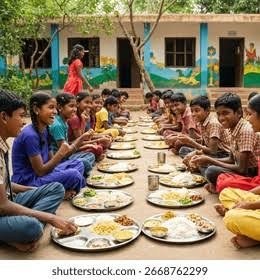
Are the right of poor childrens really safe?
The midday meal provided in government primary schools in India is not just food for millions of poor children, but a major plan for their education, health, and future. But whenever news surfaces of snakes or worms found in the food, or children hospitalized due to spoiled food, people’s trust is shaken. Many parents fear that their children’s lives could be in danger at the very school they attend.
Even today, children in many villages and small towns rely on government schools. The purpose of the Midday Meal was to encourage children from poor families to attend school without going hungry. However, when negligence, corruption, and a lack of accountability pervade the system, this very scheme comes under scrutiny.
When did the Midday Meal Scheme start?
The concept of providing meals to children in schools in India is quite old, but the Midday Meal Scheme was launched at the national level in 1995. Its main objective was:
Providing nutrition to poor children
reducing school dropouts
Attracting children to education
reducing malnutrition
Later, this scheme was expanded and is now known in many places as the PM POSHAN Scheme . Under this scheme, children are provided with lentils, rice, bread, vegetables, eggs, or other locally sourced nutritious food.
Where does the ration come from and who prepares the food?
Rations in government schools come through several levels:
Grain from government warehouses
Local supply system
Panchayat or Block level monitoring
School Management Committee
Anganwadi or cook women
Most schools employ one or two women to cook. However, in many places, the system is poor. In some places, there’s no clean water, in others, the kitchen is in a bad condition, in others, there’s no gas, and in others, the storage is inadequate. This situation leads to poor food quality.
Is there theft and distribution of ration?
There’s often talk among people that in some places, children’s rations end up with relatives or neighbors. This isn’t the case everywhere, but where oversight is weak, complaints of irregularities persist.
If a child’s share is eaten by someone else, or if the school does not provide the full meal, it is not only a violation of rules but also an injustice to the rights of children.
Sometimes people say:
Rations are taken home
The quantity is reduced
Poor quality goods are purchased
Records are one thing, reality is another.
If this happens then it is serious corruption and strict action should be taken against it.
Is just giving away free stuff the solution?
Promises often made during elections in India include:
free ration
Free electricity
loan waiver
Free gas
free stuff
Providing relief to the poor may be the government’s responsibility, but relying solely on freebies doesn’t build a strong society in the long run. The real need is:
employment
good education
Better hospital
Safe Schools
Skill Development
If every family has a stable, stable income, people can run their households with dignity. Then they won’t have to rely on free food or rations.
Do free plans make people dependent?
This topic is very sensitive. Some believe that constant freebies can discourage people from working hard. On the other hand, for very poor families, these schemes can be life-saving.
The real question is:
Should the government just provide free things or also increase employment?
Should there be a plan to make the poor self-reliant with assistance?
Shouldn’t the condition of government schools be better than that of private schools?
Unless education and employment are strengthened, people will remain dependent on government assistance.
Why is the condition of government schools a matter of concern?
Even today in many government schools:
children sit on the ground
No fans and clean toilets
Water supply is weak
Teachers are less
Buildings are dilapidated
These children are the future of the country. If the foundation is weak, how will the future be strong?
Governments must focus on monitoring the scheme beyond simply launching it. CCTV, regular inspections, clean kitchens, quality testing, and local monitoring are essential.
When will corruption stop?
Corruption is a chronic problem in India. Sometimes, the rules are good, but enforcement is poor.
Accountability will not be fixed
There will be no strict action
There will be no honest monitoring
The public will not raise their voice
Till then it will be difficult for the full benefits of the schemes to reach the right people.
What could be the solution?
The solution lies not in criticism but in reform:
Regular inspection of schools
Food Quality Test
Strict rules on child safety
Digital records and monitoring
employment-enhancing policies
Modernization of government schools
swift action against corruption
India needs a system where the poor are respected, children are safe and education becomes truly strong.
Midday Meal, Cleanliness and Child Health
In government schools, along with nutrition, safety is also necessary.
Millions of children in India still attend government schools. Many poor families cannot afford to educate their children in private schools, making government schools their primary support system. Our country’s ancient system, village culture, and the education of ordinary people are largely tied to government schools.
This is why the midday meal provided in schools is considered so important. Its purpose is to protect children from hunger, provide nutrition, and encourage them to study. But whenever news comes that snakes, insects, or children fall ill due to the filth in the food, it becomes a very serious and tragic matter. Because if the food becomes harmful instead of nourishing, it can directly threaten children’s lives.
Therefore, it’s crucial to have strict rules and a clean system for the midday meal. Where the food will be prepared, how it will be prepared, who will prepare it, what kind of water will be used, and how the utensils will be cleaned—all these things must be considered.
Some important rules should be followed in the food preparation area in schools:
The kitchen should be completely clean and covered.
Food items should be kept in closed containers.
The water should be pure and potable.
The people who cook food should be checked regularly.
Gloves, caps and clean clothes should be used in the kitchen.
Do not use spoiled or old grains.
Many people also believe that it’s not necessary to prepare cooked food everywhere. If the government wishes, it can also distribute some dried and nutritious foods to children, such as:
nutritious biscuits
Peanuts and Jaggery
roasted chickpeas
Dry Fruit Mix
Protein and vitamin packets
Milk powder or health drink
Such items have a longer shelf life and are less susceptible to contamination or spoilage. This can also reduce the need for large kitchens, more workers, and the hassle of daily cooking. Furthermore, children will still be well-nourished.
Additionally, monitoring the quality of food is crucial. Simply launching a program isn’t enough; it’s also crucial to ensure it’s running smoothly. Officials should periodically inspect schools and monitor the health of children.
Another important point is that the benefits of free programs reach the truly poor and needy. It is often seen that even those who do not necessarily need assistance take advantage of free services. Therefore, the government should strengthen the proper verification and identification system so that the poor can receive their full benefits.
While providing free services isn’t wrong, responsibility and quality are paramount. Especially when it comes to children’s food and health, any negligence can cause significant harm. Government schools are not just about education, but the foundation of the nation’s future. Therefore, the food provided there must be safe, clean, and nutritious.
Free Scheme, Poverty and Responsibility
Correct use of government aid and people’s thinking
In a large country like India, the number of poor and working class people is quite high. Whether in villages or cities, there are people everywhere who work day and night to make ends meet. It’s also true that when a government is formed, it garners significant support from the poor, as they expect the government to improve their lives, provide employment, affordable food, and provide housing.
In India, laborers are readily available and inexpensive, as the population is large and everyone needs work. But society should never forget that charity is always for the needy, not for the promotion of laziness. Feeding the hungry is considered a virtue, but giving alms is not always considered right, as it encourages some people to abandon hard work and take the easy path.
Not everyone who begs on the streets has the same story. Some are truly compelled to do so, but in many places, begging has become a profession. However, the government and numerous organizations already work for the poor. They offer various benefits, including housing schemes, free or subsidized rations, gas connections, scholarships, free medical treatment, and electricity bill relief.
It’s often seen that the government provides homes to the poor, but some people sell them or rent them out and return to slum living. This defeats the true purpose of the scheme. Similarly, even when receiving free rations, some people waste them. Therefore, it’s crucial to treat free things with responsibility and prudence.
The question also arises: will providing everything for free be a long-term solution? If freebies continue to be provided and people begin to work less, it won’t bode well for the future. Freebies can be a source of support in times of need, but if they become a permanent habit, they impact both society and the economy.
Government-provided rations, gas, electricity, or stipends are meant to help people. It’s important to use them properly.
Some precautions should always be taken:
Free ration should not be wasted.
Gas should be used safely.
Even if electricity is free or cheap, it should be used only as per need.
The scholarship received for children’s education should be used for the right purpose.
Government aid should be considered a support, not a substitute for hard work.
The best way to eradicate poverty isn’t just by distributing free things, but by providing people with employment, education, and skills. Only w kihen a person stands on his own two feet can his future be strengthened. Government schemes are important, but the responsibility and honesty of individuals are equally crucial.
Society progresses when helpfulness is combined with hard work. Freebies should be respected, as they come from the nation’s taxes and public funds.
conclusion
Schemes like the Midday Meal are essential for poor children, but honesty and quality are paramount. If children become ill due to negligence, it becomes the responsibility of the entire society.
The country will only progress when government schools receive the same respect and facilities as large private schools. Along with free programs, employment, education, and accountability are equally important. Only then will society become self-reliant and strong.