
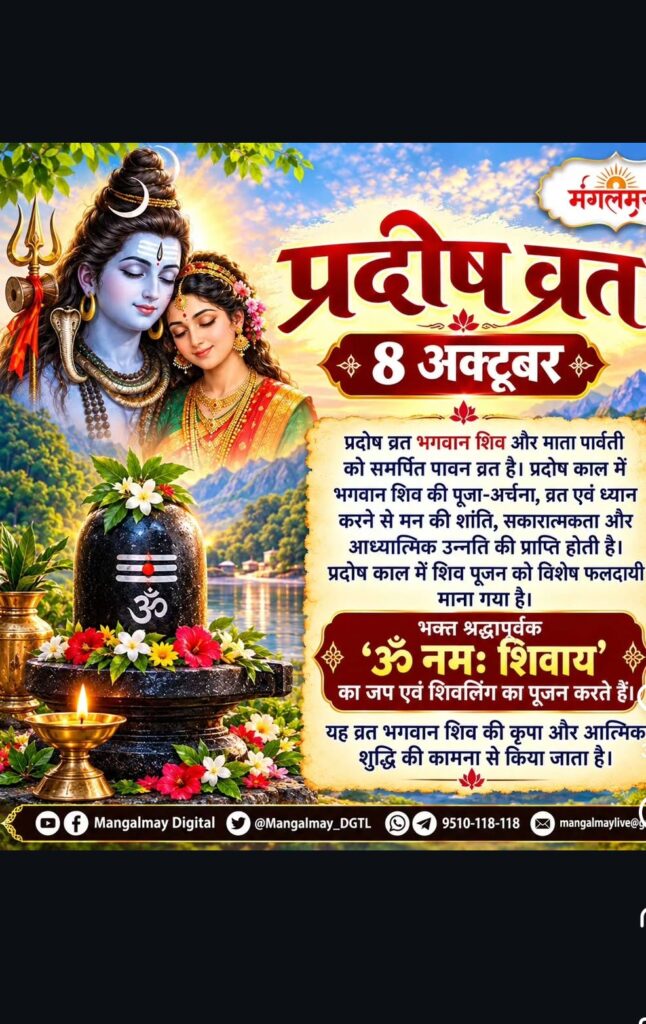



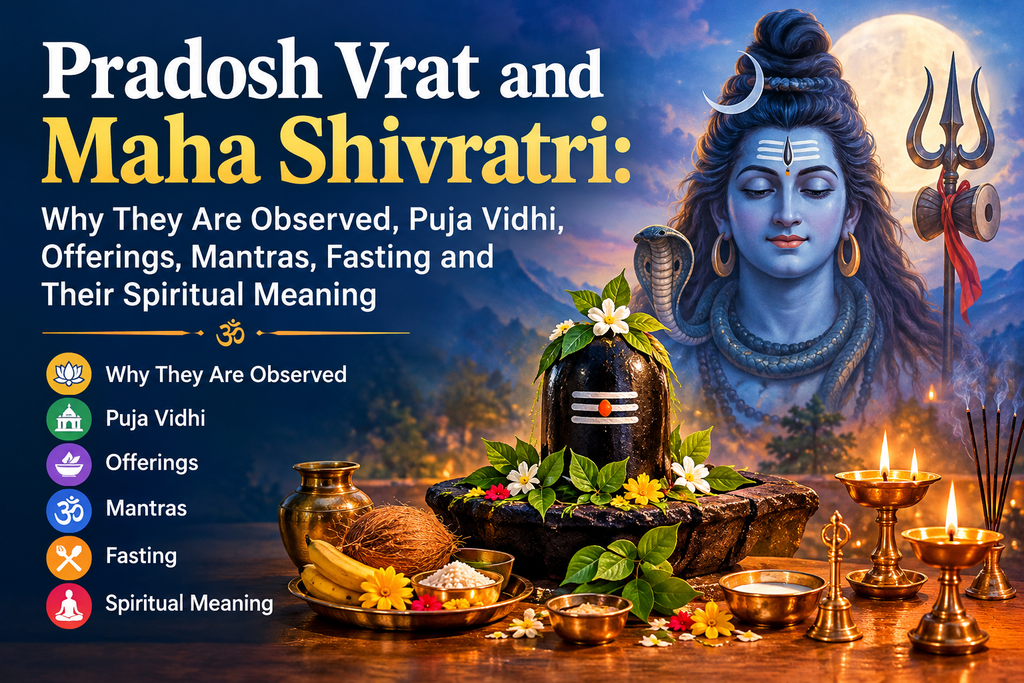
Pradosh Vrat and Maha Shivratri: puja vidhi
Pradosh Vrat and Maha Shivratri are both important occasions dedicated to Lord Shiva, but they are not the same vrat. Pradosh Vrat is observed on Trayodashi when it overlaps with the evening Pradosh Kaal, and it generally occurs twice in a lunar month. Maha Shivratri is the major annual Shivaratri associated with Krishna Paksha Chaturdashi.
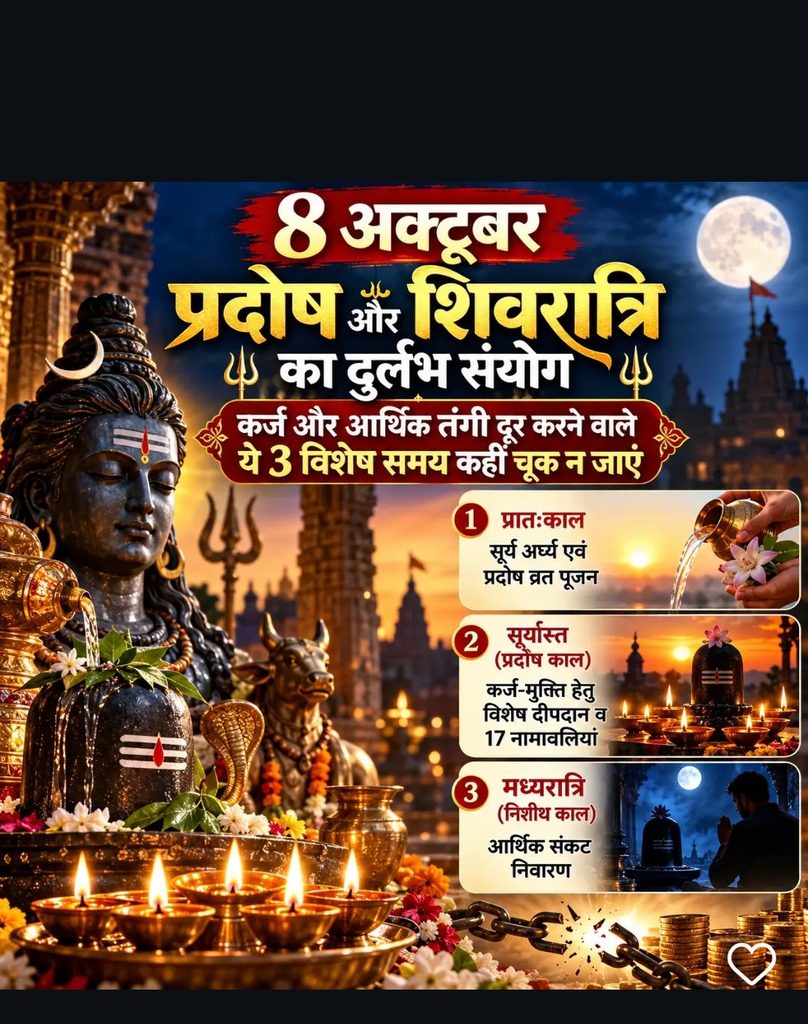
Why They Are Observed, Puja Vidhi, Offerings, Mantras, Fasting and Their Spiritual Meaning
People observe these vrats with different levels of fasting, puja and night worship according to their family tradition, sampradaya and local temple practice. Therefore, every ritual seen in a temple or household should not automatically be considered compulsory for everyone.
Why Is Pradosh Vrat Observed?
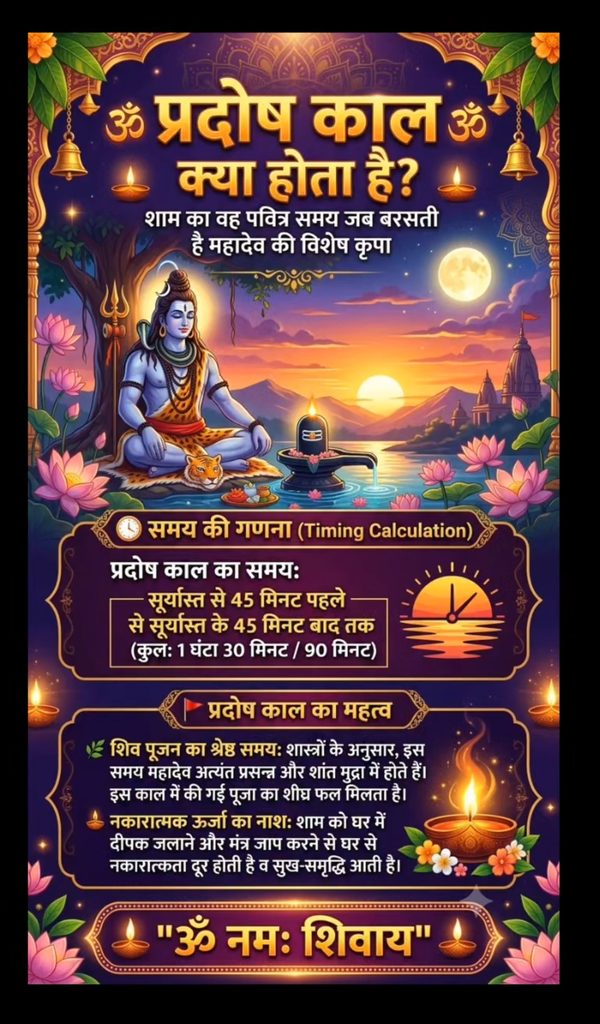
The word Pradosh is connected with the evening period around sunset. On Pradosh Vrat, devotees worship Shiva during the Pradosh Kaal when Trayodashi is prevailing.
There are different Pradosh traditions according to the weekday. For example:
Monday Pradosh — Soma Pradosh
Tuesday Pradosh — Bhauma Pradosh
Saturday Pradosh — Shani Pradosh
Traditional Pradosh stories vary according to the particular Pradosh. There are separate vrat kathas associated with different weekdays.
The basic spiritual idea is to control the senses, keep the mind focused on Shiva and spend the important evening period in prayer rather than ordinary distractions.
Why Is Maha Shivratri Considered So Important?
Maha Shivratri is regarded as one of the most important Shiva festivals. It is associated with the worship of Shiva and Shakti and with fasting, night vigil and Shiva Puja.
One well-known traditional story found in Shiva-related literature is the story of a hunter named Guru-Druha. According to the story, he unknowingly remained awake during the night, and water and Bilva leaves fell upon a Shiva Linga while he was waiting in a Bilva tree. In this way, without deliberately planning a formal puja, he performed elements of Shivaratri worship. The story emphasizes the transforming power traditionally attributed to devotion, fasting, wakefulness and Shiva worship.
This story is not simply about performing rituals mechanically. Its deeper message can be understood as awakening, compassion, self-control and turning the mind toward Shiva.
What Is Offered on the Shiva Linga?
Common offerings include:
Clean water
Milk, according to one’s tradition
Curd
Honey
Ghee
Sugar
Bilva leaves
Bilva fruit
Dhatura
Aak/Madar flowers
Chandan
Vibhuti
Incense and lamp
Different traditions use different combinations. Religious sources describing Maha Shivratri Puja include water and several other Abhishek materials, followed by Bilva leaves and other offerings.
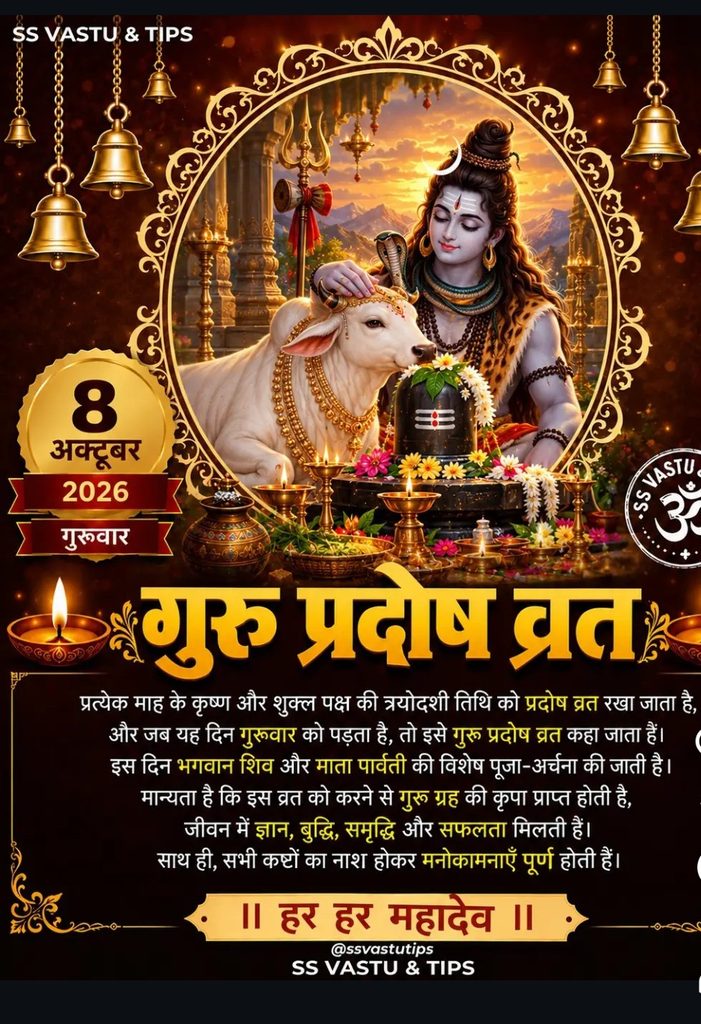
Why Is Bilva Patra So Important?
Bilva Patra is one of the most familiar offerings to Lord Shiva. The three-leaflet form is traditionally associated with Shiva and is offered with devotion.
A simple offering can therefore be:
Bilva Patra + clean water + “Om Namah Shivaya.”
There is no need to make the puja complicated if a person is sincerely worshipping according to his or her family tradition.
Can Sindoor Be Put on Bilva Patra?
This is an area where people should distinguish between local/family tradition and universally prescribed Shiva Puja rules.
Sindoor or kumkum is not a compulsory offering to Shiva in every tradition. Some households may use kumkum or other auspicious materials in their particular puja, while others do not.
Therefore, saying that every Bilva leaf must have sindoor on it would be incorrect.
If your family tradition specifically follows this practice, you can follow it respectfully. Otherwise, simple Bilva Patra and water are completely sufficient for a simple Shiva worship.
What About One Grain of Rice?
Rice is commonly used as Akshata in Hindu puja. However, there is no universal rule that exactly one grain of rice must be placed on every Bilva leaf.
Some devotees use a small quantity of Akshata as an auspicious offering. The important point is devotion and cleanliness rather than counting one particular grain.
If your family has followed the one-grain practice for generations, there is nothing wrong with continuing it as a family tradition.
What Is the Connection With Ashok Sundari?
Ashok Sundari is traditionally described in Hindu mythology as a daughter associated with Lord Shiva and Goddess Parvati. She is particularly known in certain regional traditions.
If by “Ashok Sundari ka phool” you mean a particular flower used in your household worship, its use should be understood as a regional or family practice rather than a compulsory rule of every Shiva Puja.
It is always better to know exactly which flower is being offered rather than assuming that every flower called “Ashok Sundari” has the same ritual significance.
Why Do People Offer Water Three Times?
Many devotees perform Abhishek with water repeatedly, sometimes three times, according to their family or temple practice.
The number three also has a strong symbolic presence in Shaiva tradition—such as the three aspects represented in various Shiva-related interpretations and the three-leaf Bilva Patra.
However, three water offerings are not a universal compulsory rule for every devotee.
You can offer water once with devotion, or perform a more elaborate Abhishek according to your puja tradition.
The important thing is that the water should be clean and the offering should be respectful.
Which Mantra Should Be Chanted?
The simplest and most widely used Shiva mantra is:
ॐ नमः शिवाय
Om Namah Shivaya
It can be chanted slowly and peacefully while offering water or Bilva Patra.
Other devotees may recite:
Mahamrityunjaya Mantra
ॐ त्र्यम्बकं यजामहे सुगन्धिं पुष्टिवर्धनम्।
उर्वारुकमिव बन्धनान्मृत्योर्मुक्षीय मामृतात्॥
Devotees may also recite Shiva Sahasranama, Shiva Ashtakam or other Shiva stotras according to their tradition. Maha Shivratri puja traditions specifically include chanting Om Namah Shivaya.
Can Shiva Chalisa Be Read?
Yes.
A devotee can read Shiva Chalisa during Pradosh Vrat or Maha Shivratri if that is part of his or her devotional practice.
One does not have to perform every possible mantra, chalisa, stotra and ritual in one sitting. Even a simple prayer performed with concentration can be meaningful.
A practical sequence can be:
Dhyan → Sankalp → Abhishek → Bilva Patra → Mantra → Shiva Chalisa → Aarti → Prasad.
More elaborate Maha Shivratri puja traditions may include many additional steps.
What Can Be Eaten During the Vrat?
Fasting practices vary greatly.
Some people take only water, while others take fruits, milk or a fasting meal. Common vrat foods include:
Fruits
Milk and curd
Coconut
Makhana
Sabudana
Singhara flour
Rajgira
Potatoes
Nuts and dry fruits
The purpose of fasting is traditionally connected with discipline and devotion, not simply staying hungry.
A person who has a medical condition, takes regular medicines, is elderly, pregnant, or has another dietary requirement should not undertake a difficult fast without appropriate medical guidance.
What Should Not Be Eaten?
Depending on the fasting tradition, devotees generally avoid regular grains, pulses and ordinary meals during the vrat.
But rules differ between communities. Some people observe a strict nirjala fast, while others follow a fruit-based or phalahari fast.
Therefore, there is no need to criticize another devotee because their fasting method is different.
How Long Does Pradosh Vrat Last?
Pradosh Vrat is connected particularly with the Pradosh Kaal around sunset, when Trayodashi overlaps with that period. The exact puja window varies according to location and date.
The fasting itself may be observed from the beginning of the day until the appropriate time for breaking the fast, depending on the tradition being followed.
So Pradosh Vrat is not simply a fixed “two-hour vrat.” The important Shiva Puja period is the local Pradosh Kaal.
How Long Is Maha Shivratri Puja?
Maha Shivratri is especially associated with night worship.
The night can traditionally be divided into four Prahar, and devotees may perform Shiva Puja during each Prahar. A devotee who cannot perform four pujas may perform one night puja, particularly around the Nishita period, according to local timing and tradition.
This is why Maha Shivratri is different from an ordinary daily Shiva Puja: the night itself becomes an important part of the observance.
What Clothes Should Be Worn?
There is no single compulsory colour for everyone.
Clean, comfortable and modest traditional clothing is a good choice. Many devotees wear:
White
Light-coloured clothes
Dhoti-kurta
Kurta-pajama
Saree
Salwar suit
The important principle is cleanliness and respect, rather than expensive clothing.
What Should Not Be Offered?
There are many popular beliefs about what should or should not be offered to Shiva. Practices can vary by tradition.
A devotee should avoid blindly mixing rituals from different traditions. It is better to follow:
your family tradition + your temple tradition + the guidance of a knowledgeable priest or guru.
For example, if a particular temple does not allow a certain offering, devotees should respect that temple’s rules.
What Is the Spiritual Benefit of the Vrat?
Traditionally, devotees believe that Pradosh Vrat and Maha Shivratri worship can bring:
Shiva’s blessings
purification of the mind
peace and concentration
removal of negative tendencies
spiritual discipline
devotion and inner strength
a feeling of protection and surrender
Traditional texts also associate Shiva Vrat with spiritual merit and ultimately liberation.
These are religious and spiritual beliefs, not a guarantee that a particular worldly result will automatically happen.
The real value of a vrat can also be seen in what changes inside a person—less anger, more discipline, more compassion and greater control over one’s habits.
Pradosh Vrat and Maha Shivratri: The Simple Difference
Pradosh Vrat Maha Shivratri
Observed on Trayodashi Observed on the major Shivaratri
Generally occurs twice a lunar month Major annual Shiva festival
Evening Pradosh Kaal is especially important Night worship is especially important
Shiva Abhishek and prayer Fasting, Abhishek, night vigil and Shiva Puja
Different Pradosh stories exist Several traditional Maha Shivratri stories exist
Soma, Bhauma, Shani etc. depending on weekday Maha Shivratri is the principal annual Shivaratri
A Simple Shiva Puja Anyone Can Follow
If someone wants to keep the worship simple, there is no need to collect dozens of items.
Take a bath, wear clean clothes and sit peacefully before Shiva.
Then:
- Take a simple sankalp.
- Offer clean water to the Shiva Linga.
- Offer Bilva Patra.
- Chant Om Namah Shivaya.
- Read Shiva Chalisa if you wish.
- Light a diya and incense.
- Offer your prayer.
- Complete the puja with Aarti and Prasad.
This simple practice can be performed with sincerity.
The Deeper Meaning of Shiva Vrat
The most important thing about Pradosh Vrat and Maha Shivratri is not how many litres of milk are poured, how many flowers are offered or how many rituals are completed.
The deeper idea is self-control, devotion and awakening of consciousness.
If a person fasts but spends the entire day angry, insulting others or harming living beings, the spiritual purpose of the vrat becomes weaker.
On the other hand, if someone observes the day with cleanliness, compassion, prayer, discipline and a peaceful mind, the vrat can become a meaningful spiritual practice.
Shiva does not have to be understood only through a long list of rituals. Shiva can also be remembered through a disciplined life, truth, compassion, meditation and control over one’s own mind.
Har Har Mahadev. 🙏