



AI Governance, AI Strategy and AI Policy: What They Mean
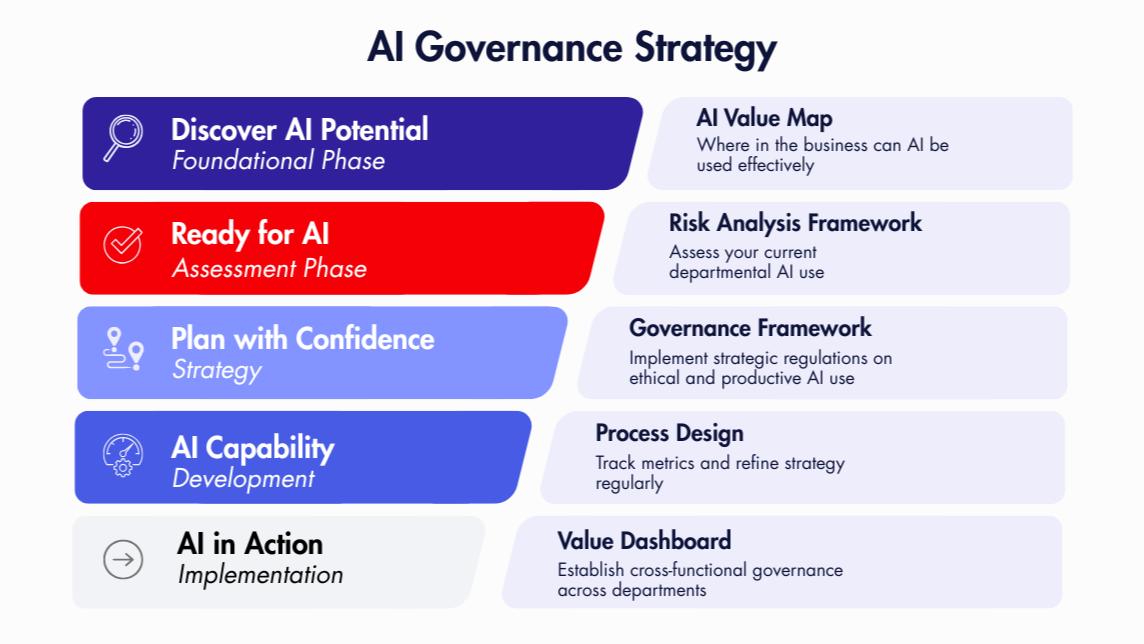
Artificial Intelligence is becoming part of almost every sector, from business and education to healthcare, banking, government and transportation. But using AI successfully is not only about buying software or building a chatbot. Organizations also need to decide who controls AI, what they want to achieve with it, and what rules everyone must follow.
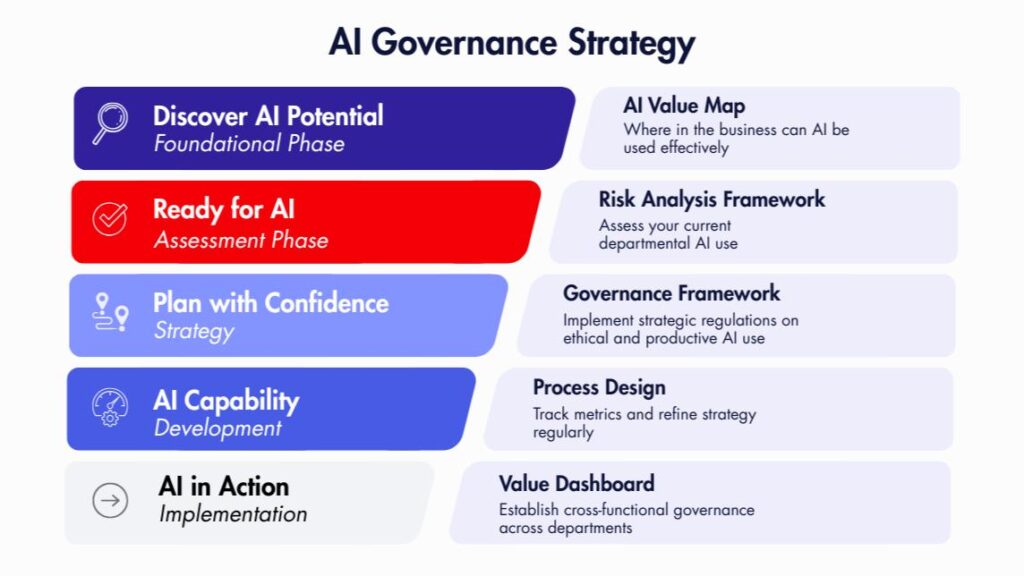
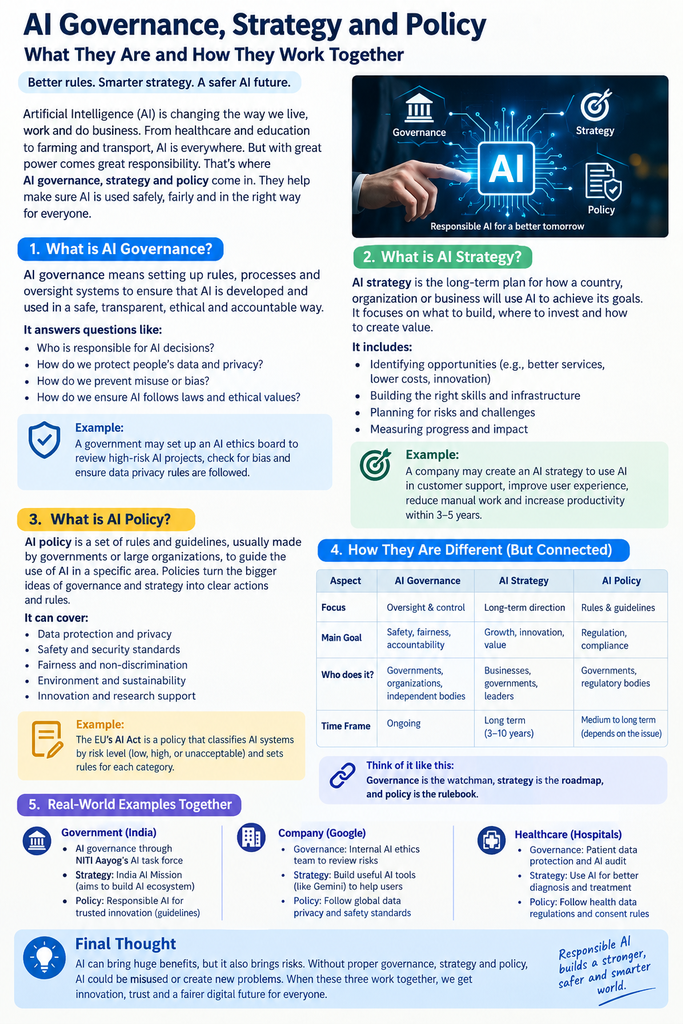
This is where three important terms come in: AI governance, AI strategy and AI policy.
- What Is AI Governance?
AI governance is the system used to manage, supervise and control how AI is developed and used.
In simple human words, governance answers:
Who is responsible for an AI system?
What risks can it create?
Who can use the system?
How will people’s data be protected?
How will mistakes be identified?
How will bias or unfair decisions be handled?
Who will investigate an AI-related problem?
For example, imagine a bank uses AI to help assess loan applications. Governance would establish who is responsible for the system, how its decisions are checked, how customer data is protected and what happens if the AI makes an incorrect or unfair recommendation.
Governance is mainly about responsibility, oversight and accountability.
- What Is AI Strategy?
An AI strategy is the long-term plan for using artificial intelligence.
A company might ask:
“Where can AI actually help our business, and what should we build or buy first?”
For example, a small business could create an AI strategy around three goals:
Use AI to answer common customer questions.
Use AI to analyse sales information.
Automate repetitive administrative work.
The company may then decide how much money to invest, what employees need to learn, which AI tools to use and how success will be measured.
So, strategy is the roadmap.
It explains where an organization wants to go with AI and how it plans to get there.
- What Is AI Policy?
An AI policy is a specific set of rules and guidelines for using AI.
For example, a company may create a policy saying:
Employees must not enter confidential customer information into an unapproved AI tool.
AI-generated information must be checked before being sent to customers.
Employees must disclose the use of AI in certain types of content.
High-risk AI applications require additional approval.
Personal data must be handled according to applicable privacy requirements.
A policy converts broad intentions into clear rules for everyday use.
- AI Governance vs AI Strategy vs AI Policy
Area AI Governance AI Strategy AI Policy
Main focus Oversight and responsibility Long-term direction Rules and guidelines
Main question “Who is responsible?” “Where are we going?” “What is allowed?”
Purpose Control risks and accountability Create value from AI Guide everyday AI use
Example AI review committee 3-year AI adoption plan Employee AI-use rules
A simple way to remember it is:
Governance = Watch and manage
Strategy = Plan and move forward
Policy = Set the rules
- A Simple Business Example
Suppose a restaurant wants to introduce AI.
AI Strategy
The restaurant decides:
“Over the next three years, we will use AI to improve customer service, understand demand and reduce repetitive office work.”
That is the strategy.
AI Governance
The restaurant decides who can approve AI systems, who checks their performance and who handles customer-data risks.
That is governance.
AI Policy
The restaurant creates rules such as:
“Employees cannot upload customers’ private information into an unapproved AI application.”
That is the policy.
All three work together.
- Why Is AI Governance Important?
AI can make mistakes just like other technologies. Some AI systems can also create risks involving privacy, security, discrimination, misinformation or incorrect decisions.
Good governance helps an organization identify these risks before they become bigger problems.
For example, before deploying an AI recruitment system, an organization might test whether the system produces unfair results for particular groups and establish a human-review process for important decisions.
Governance does not mean stopping AI. Its purpose is to help organizations use AI with appropriate control and accountability.
- Why Does a Company Need an AI Strategy?
Buying many AI tools does not automatically make a business successful.
A company may spend money on AI but achieve very little if it does not know what problem it is trying to solve.
A good strategy starts with questions such as:
What business problem are we solving?
How much can AI realistically improve the process?
What skills do employees need?
What data is available?
What will implementation cost?
How will we measure results?
For example, a small company might discover that AI can save employees several hours every week by handling repetitive customer-support questions. That could become one part of its AI strategy.
- Why Do We Need AI Policies?
Without clear rules, different employees may use AI in completely different ways.
One employee may upload confidential information to an AI service. Another may publish AI-generated information without checking it.
A simple AI policy can establish boundaries.
For example:
Allowed:
Using an approved AI tool to create a first draft of a general marketing article.
Requires caution:
Using AI to analyse customer information.
Not allowed:
Uploading confidential business or personal information to an AI service that has not been approved by the organization.
The exact rules should depend on the organization’s activities, applicable laws and risk level.
- AI Governance in Government
Governments also need governance systems when they use AI.
For example, if a government department uses AI to help process applications, it may need procedures covering:
data protection,
transparency,
human oversight,
security,
accuracy,
accountability,
complaints and appeals.
The basic principle is that an AI system should not become a mysterious decision-maker with nobody responsible for its consequences.
- AI Governance in Healthcare
Healthcare is another area where governance becomes particularly important.
Imagine a hospital uses AI to assist doctors in analysing medical images.
The hospital could establish:
Strategy:
Use AI to improve diagnostic support and reduce workload.
Governance:
Determine who approves the system, monitors performance and investigates errors.
Policy:
Establish rules for patient-data protection, appropriate use and human review.
The AI can assist healthcare professionals, but important medical decisions may still require appropriate professional judgment and oversight.
- AI Governance and Employees
AI governance is not only about technology. People are an important part of the system.
Employees need to understand:
what AI tools they can use,
what information they can provide,
how to verify AI-generated information,
when human approval is required,
how to report problems.
Training therefore becomes an important part of an organization’s AI program.
- What Happens Without Governance, Strategy and Policy?
Imagine a company where everyone starts using different AI tools without coordination.
One department buys one tool. Another department uses another. Employees may share sensitive information without realizing the risk. Nobody knows who is responsible when an AI system produces an incorrect result.
The company may then face:
unnecessary costs,
security problems,
inconsistent results,
privacy risks,
employee confusion,
compliance problems,
loss of customer trust.
This is why AI adoption needs more than technology.
- The Relationship Between the Three
Think of building a house.
AI Strategy is the blueprint.
It says what you want to build and why.
AI Governance is the management system.
It decides who is responsible for making sure the work is done properly.
AI Policy is the rulebook.
It tells people what they can and cannot do.
Without a blueprint, there may be no clear direction.
Without management, work can become uncontrolled.
Without rules, people may make inconsistent decisions.
- AI Governance Is Not About Stopping Innovation
Sometimes people hear the word governance and think it means too many restrictions.
That does not have to be the case.
Good governance can actually make responsible innovation easier because employees know the boundaries.
For example, instead of telling employees:
“Don’t use AI.”
an organization can say:
“Use these approved tools, don’t upload confidential information, verify important outputs and follow the review process.”
This creates a more practical environment where innovation and responsibility can exist together.
- Final Thought
AI is becoming a powerful part of modern business and society, but technology alone is not enough.
AI strategy tells us where we want to go.
AI governance helps ensure that someone is responsible for how we get there.
AI policy establishes the rules people follow along the way.
When these three elements work together, organizations can approach AI in a more organized and responsible way while still leaving room for innovation.
The goal is not simply to use more AI. The real goal is to use AI for the right reasons, with appropriate safeguards, clear responsibility and measurable benefits.