Why Bandhani Fabric I


परिचय
Bandhani Fabric – The Timeless Trend of Indian Textiles
Image Placeholder 1 – “Traditional Bandhani Saree Display”
(Insert a high-quality image of a Bandhani saree, preferably red or yellow with dotted patterns)
बी फाइबर2फैशन+2विकिपीडिया+2
Here’s an article breaking down why bandhani is always in trend, why its colours are so trendy, and how it compares to other fabrics—so you can use this for your blog, promoter or styling piece.
Why It’s Always in Trend
Why Bandhani Fabric Is Always in Trend
1. Deep Cultural Roots & Emotional Value
Unlike printed or machine-made fabrics, Bandhani is handmade by skilled artisans, often passed down through generations. People feel emotionally connected to Bandhani because:
✔ It is linked to weddings, festivals, and auspicious rituals
✔ In Gujarat, the bride receives a Ghar chhola Bandhani saree as a blessing
✔ In Rajasthan, Bandhani odhni s symbolise prosperity and grace
Fashion may change, but culture never goes out of style — and that’s why Bandhani stays timeless.
2. Unique Patterns That Cannot Be Replicated by Machines
Image Placeholder 2 – “Close-up of Bandhani dots tied by hand”
Every dot in Bandhani is tied by hand. That makes each piece one-of-a-kind, unlike printed fabrics that look exactly the same.
The most popular Bandhani patterns are:
| Pattern Name | Look |
|---|---|
| Leheriya | Wavy lines |
| Ekdali | Single dot patterns |
| Trikunti | Three-dot triangles |
| Shikari | Big patterns with motifs |
| Chandrokhani | Circle-shaped dotted motifs |
When a fabric has human touch + artistry, it gains value and always feels special.
3. Always Bright, Happy, Festival-Friendly Colours
One of the biggest reasons Bandhani remains trendy is its colour vibrance.
Bandhani colours are not soft or dull — they are bold, cheerful, and eye-catching.
Most used Bandhani colours:
❤️ Red – marriage & happiness
💛 Yellow – celebration & sunshine
💚 Green – prosperity & new beginnings
💙 Indigo / Royal blue – richness & depth
🖤 Black – modern & fusion styles
🧡 Orange – energy & tradition
💜 Purple – luxury & youth appeal
Colours are scientifically proven to influence emotions — and Bandhani represents positivity, festivity, and joy.
That’s why people wear Bandhani during:
- Navratri
- Tej
- Raksha Bandhan
- Ganesh Chaturthi
- Durga Puja
- Weddings / Haldi / Mehendi
- Garba nights
- Even college ethnic day!
Bandhani fashion is like celebration in cloth form — and celebrations never go out of fashion.
4. Adaptable for Modern, Western, Fusion, and Luxury Wear
Bandhani is no longer restricted to sarees and dupattas. Designers have now turned it into:
✔ Bandhani shararas & anarkalis
✔ Bandhani gowns & long dresses
✔ Bandhani jackets & blazers
✔ Bandhani co-ord sets
✔ Bandhani scarves & handbags
✔ Bandhani shirts & crop tops
✔ Bandhani Lehenga with belt dupatta
Even luxury fashion houses and Bollywood celebrities are wearing Bandhani in red-carpet shows, movies, music videos, and Instagram promotions.
So Bandhani is not outdated — it is reborn every season in a new style.
Why Bandhani Colours stay Trendy
✅ Because They Represent Indian Identity
In India, colourful clothing is not fashion, it is emotion + culture. Bandhani is the true reflection of that.
✅ Because Designers Use New Shade Combinations
Earlier, Bandhani was mostly red and yellow.
Now we see:
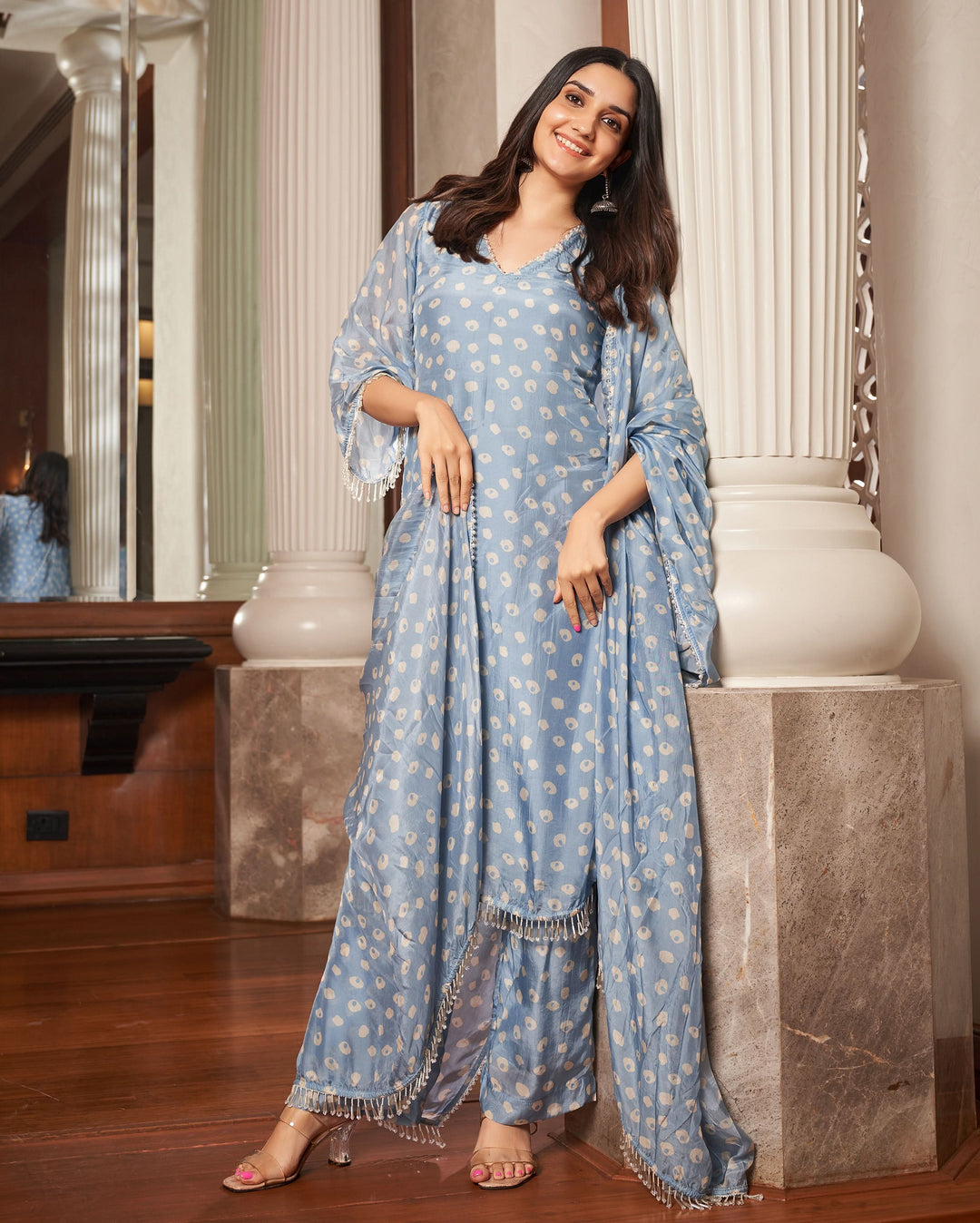
- Pastel lilac Bandhani sarees
- Black + white Bandhej Indo-western outfits
- Bandhani on silk organza
- Neon Bandhani dupattas
- Baby pink bridal Bandhani lehengas
So Bandhani does not remain stuck — it evolves with colour trends.
✅ Because Youth Loves Colourful, Instagram-Friendly Fashion
Bold prints, ethnic fusion, and unique textures perform well on social media — that keeps Bandhani alive among younger buyers.
Comparison: Bandhani vs Other Fabrics
| Feature | Bandhani | Printed Georgette | Silk | Banarasi | Ikat | Cotton |
|---|---|---|---|---|---|---|
| Handmade Craft | ✅ Yes | ❌ No | ✅ Yes | ✅ Yes | ✅ Yes | Depends |
| Colour Vibrance | ⭐⭐⭐⭐⭐ | ⭐⭐ | ⭐⭐⭐ | ⭐⭐⭐⭐ | ⭐⭐⭐ | ⭐⭐⭐ |
| Trend Factor | High (ethnic+fusion) | Medium | Classic | Festive | Artistic | Casual |
| Price Range | Medium to premium | Cheap to medium | Premium | Premium | Medium | Affordable |
| Uniqueness | Every piece different | Mass printed | Depends | Same pattern possible | Unique | Plain |
| Popular among youth | Increasing fast | Yes | Medium | Occasion only | Niche | High |
✅ Who is more popular now (2024-25 trend)?
✔ For casual ethnic & fusion – Bandhani wins
✔ For bridal or luxury – Banarasi & Silk win
✔ For everyday cottonwear – Cotton & Rayon win
✔ For printed fast fashion – Georgette prints win
But Bandhni has the strongest balance of tradition + trend + colour.
That is why it has huge demand today in India and also foreign exports.
Who Wears Bandhani Most Today?
✅ College girls (ethnic days, farewell, festivals)
✅ Brides (mehendi, haldi, sangeet dresses)
✅ NRI women (wedding & festive wear abroad)
✅ Fashion influencers (Indo-western styling)
✅ Women aged 30+ for elegant sarees & suits
✅ Designers using Bandhani in luxury collections
Even Bollywood stars like Alia Bhatt, Deepika Padukone, Kiara Advani, Janhvi Kapoor, Sonam Kapoor have worn Bandhani outfits.
Bandhani in Global Fashion Market
Image Placeholder 3 – “Bandhani garments in international boutique display”
- Bandhani outfits are sold in USA, UK, Canada, UAE, Australia as “Indian handcrafted tie-dye luxury wear”
- Foreign designers call it “heritage luxury textile”
- Many people abroad buy Bandhani for Navratri, Diwali, Baby showers, Bollywood nights, Garba events, Indian weddings
So Bandhani is not just an Indian trend — it is now a global trend.
Future of Bandhani Fashion
✅ Digital Bandhani prints will grow
✅ More pastel and earthy colours will enter
✅ Bandhani lehengas with modern silhouettes will trend
✅ Sustainable, organic Bandhani fabrics will gain demand
✅ Designer collaborations will make it mainstream in Western wear
Bandhani is not fading — it is evolving.
Conclusion
Bandhani fabric has survived centuries not because of luck — but because it has soul, story, and style.
✔ It is handmade, emotional, traditional, and artistic
✔ Its colours reflect joy, celebration, and culture
✔ It adapts to new fashion generations every decade
✔ It is wearable in casual, festive, and luxury categories
✔ And most importantly — it makes every person look unique
1. Heritage and craftsmanship
Bandhani is not just a print — it’s a craft with strong heritage. Evidence shows tie-dyeing techniques like Bandhani date back to the Indus Valley civilisation and the Ajanta cave paintings. The Craft Atlas+1 Many families and artisan communities still practise it today. Unnatisilks+1
Because of this cultural weight, garments in bandhani carry a story and authenticity, which appeals to modern consumers looking for more than just “fabric”.
2. Unique patterns and visual appeal
The tiny knot-tying produces distinctive dots, motifs and gradients. The look is both festive and elegant. As one description puts it: “Bandhani fabric is highly popular due to its unique patterns, vibrant colours, and cultural significance.” iTokri आई.टोकरी
This makes it ideal for occasions, weddings, ethnic wear, but also for more modern fusion styles.
3. Versatility across textiles & occasions
Although traditionally used in sarees and dupattas, today bandhani appears in cotton, silk, georgette, crepe, even digital-print versions. anyaonline+1
Thus it moves easily into everyday wear, party wear, casual wear — which keeps it relevant.
4. Colour and seasonal adaptability
Bandhani often features bright, bold hues (reds, yellows, blues, greens) as well as pastel/modern colour palettes. Its ability to adapt to colour trends (for example, soft pastels or muted versions) helps it remain trendy.
5. Emotional / ritual value
In many parts of India, bandhani garments are used in weddings, festivals and rituals. For example, in Gujarat and Rajasthan, brides often wear “gharchola” (a type oWikipedia
This link to meaningful occasions gives bandhani an enduring relevance rather than being purely fashion-driven.
Why Its Colours Are Trendy
Bandhani tends to stand out because of its colour-pattern interplay and regional significance of colours:
- Traditional colours: Yellow, red, green, black, maroon are commonly used and each has symbolic value (e.g., red for marriage, yellow for spring/childbirth) in bandhani craft. Wikipedia
- Colour contrast: The tie-dye technique means often you get a base colour, then tied spots that show up as lighter or contrasting dots—this visual texture is appealing.
- Modern palette shift: While traditional bandhani has strong bold colours, today we also see pastel, muted, contemporary colour combinations (e.g., very peri and white, baby-blue & white) being used. Fabcurate
- Print & digitalisation: With digital prints imitating bandhani patterns, the colourways expand further and appeal to younger markets. Fabcurate
So essentially: the craft invites vibrant and meaningful colour, and its adaptability to current colour trends means it stays “in trend”.
Comparing Bandhani With Other Fabrics
Here’s a comparison:
| Fabric / Technique | Key Traits | Trend-Worthiness of Bandhani vs This |
|---|---|---|
| Plain cotton / silk un-dye | Simple, elegant but minimal pattern | Bandhani offers more visual interest and story than plain fabric, making it more “noticed”. |
| Print fabrics (digital prints) | Mass-produced, many patterns | Bandhani has the advantage of craft/heritage, making it more premium and unique than many prints. |
| Other traditional Indian weaves (e.g., Ikat, Kalamkari) | Strong heritage, distinct looks | Bandhani competes favourably because it has very strong visual recognisability (dots, tie-dye look) and is widely used in ethnic wear—so it might be more mainstream. |
| Global fashion fabrics (e.g., chiffon, viscose plain) | Style-driven, flexible for modern fashion | Bandhani provides an ethnic fusion option—so for consumers looking for “ethnic-modern” it is trending more. |
Who is more popular now?
In the ethnic wear segment in India: bandhani continues to be very popular because:
- It hits the festive/occasion market strongly.
- It allows both traditional and modern interpretations (e.g., bandhani in gowns, dresses, fusion tops).
- Because of its craft-value and colourful look, it is easy to market as “premium/trending”.
Other fabrics (plain silks, pure cottons) will always be important, but bandhani has the “trend” edge because it feels seasonal, colourful and culturally rooted.
Why Use This in Your Blog / Promotion?
- Highlight the story: Talk about how bandhani is craft rooted, not just “pattern”.
- Show current colour trends: Show how pastels, metallics, muted tones are entering bandhani.
- Compare & suggest: For readers choosing fabric, show why bandhani might be a better pick for festive/trending usage.
- Call-to-action: If you’re promoting bandhani fabrics or outfits on your blog, emphasise the craft, the uniqueness, and the trendy colours.
Conclusion
Bandhani stays trendy because it blends heritage + distinct pattern + adaptable colours + modern usage. Whether you’re picking fabric for a traditional saree or a fusion outfit, bandhani’s flexibility and visual appeal give it a strong edge over many plain or generic fabrics.
