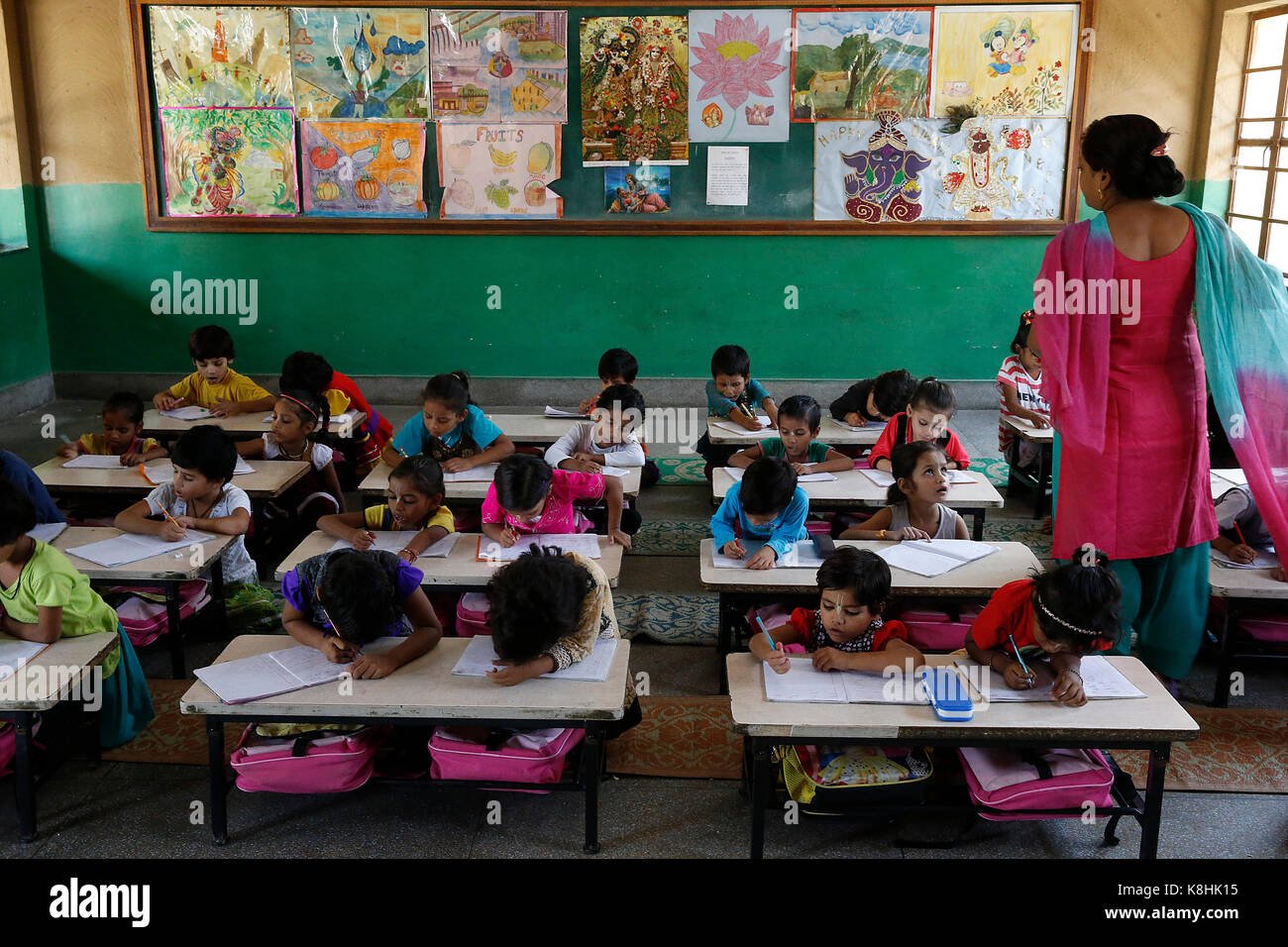

In recent years, cities and towns across India have seen a rapid rise in pre-nursery and play schools. From premium branded institutions to low-fee local centers, parents are faced with a wide range of choices. However, an important question arises: Are young children being given more academic load than they can truly understand?
What Should Be the Ideal Learning Level in Pre-Primary Classes?
Child development experts suggest that early education (Pre-Nursery, Nursery, LKG, UKG) should focus on basic cognitive, emotional, and social growth, not heavy academics.
Standard Learning Expectations
Pre-Nursery (2.5–3.5 years):
- पहचान (recognition) of colors, shapes, and objects
- Rhymes, storytelling, and play-based activities
- Basic social skills (sharing, speaking simple words)
Nursery (3.5–4.5 years):
- Alphabet recognition (A–Z)
- Numbers (1–10)
- Simple drawing and motor skills
- Learning through games, not books
LKG (4–5 years):
- Basic phonics (sounds of letters)
- Numbers up to 20
- Small words (2–3 letters)
- Introduction to writing (only basic)
UKG (5–6 years):
- Simple sentence formation
- Numbers up to 50 or 100
- Basic environmental awareness
- Preparing for Class 1
👉 At this stage, understanding matters more than memorization.
Reality Check: What Is Happening Today?
Many schools—especially high-brand institutions—introduce:
- Full spelling lists in Jr. KG
- Long writing tasks
- Homework pressure
- Early tuition culture
Parents often feel that more syllabus = better education, but this is not always true.
Survey Insight (General Trend in India)
While exact numbers vary, education reports and observations show:
- Around 60–70% of urban parents enroll children in tuition even before Class 1
- Nearly 50% of kids in LKG/UKG are given homework beyond recommended limits
- About 40% of children face stress or disinterest due to academic pressure at an early age
👉 Main reasons:
- Competition among schools
- Parents’ fear of “falling behind”
- Branding and marketing pressure
Understanding vs Rote Learning
There is a big difference between:
- Understanding (समझना) → long-term learning
- Rote learning (रटना) → short-term memory
A child in nursery may repeat spellings like “CAT, DOG,” but may not understand:
- What is a cat?
- Where do animals live?
👉 This creates fake learning satisfaction, not real education.
Risks of Overloading Young Children
Giving excessive academic pressure at an early age can lead to:
1. Mental Stress & Anxiety
Children may feel fear of school or studies.
2. Loss of Creativity
Instead of exploring, they focus only on completing tasks.
3. Behavioral Issues
Irritation, aggression, or unusual reactions may develop.
4. Physical Impact
- Eye strain (early use of books/screens)
- Fatigue and low energy
5. Dislike for Learning
Children may start hating studies before even Class 1.
Why Play-Based Learning Is Important
Before Class 1, the brain develops through:
- Play
- Interaction
- Observation
Not through heavy textbooks.
Experts say:
👉 “The foundation of intelligence is curiosity, not pressure.”
When Should Serious Academics Begin?
- Real structured academic learning should start after Class 1
- By this time:
- Brain development is stronger
- Attention span increases
- Logical thinking begins
What Should Parents Do?
- Avoid comparing schools only by syllabus
- Focus on teaching method, not quantity
- Do not rush into tuition at nursery level
- Encourage:
- Play
- Storytelling
- Real-life learning
Conclusion
Children are often called “forms of God,” but that does not mean we can teach them anything at any pace. Education must match their age, understanding, and mental development.
👉 A limited, well-designed syllabus in early years is not a weakness—it is a strength.
Overloading young minds for the sake of school ranking or branding can harm their natural growth. The goal should not be to finish the syllabus, but to ensure the child learns, understands, and enjoys the process of learning
