
Religion, Discipline, and Humanity in the Modern Age:

Religion, Discipline, and Humanity in the Modern Age: Which Matters Most?
Introduction
Today, the world is changing faster than ever. Artificial intelligence, Android phones, iPhones, and social media have become a part of daily life. Young people can learn almost anything with a single click. At the same time, another topic is discussed everywhere—religion, discipline, and humanity. Sometimes these discussions become healthy debates, but sometimes they turn into arguments that divide people.
The real question is not which religion is greater. The real question is: Can religion and discipline together make society better?
Every Religion Teaches Good Values
India is home to many religions, traditions, and cultures. Every religion teaches people to live honestly, respect others, help those in need, and avoid harming anyone.
For many people, Hinduism is one of the world’s oldest living traditions. Ancient Indian society developed systems of education, Gurukuls, respect for teachers, moral duties, and social responsibilities long before modern governments existed. At the same time, today’s Constitution and laws provide equal rights and justice for every citizen regardless of religion or caste.
Rather than comparing one with the other, both moral values and constitutional laws play important roles in society.
Discipline Comes Before Success
Think about daily life.
The sun rises every morning.
People wake up, bathe, eat, work, study, and sleep.
These are examples of discipline. They are not limited to any religion. They are habits that help people live healthy and organized lives.
A disciplined society usually has less crime, better education, cleaner surroundings, and stronger families.
Education Has Always Been Important
Ancient Gurukul education emphasized knowledge, hard work, self-control, respect for teachers, and moral character.
Today’s schools, colleges, and universities continue the journey of education through modern science, technology, medicine, and research.
Knowledge has never come easily. Whether someone studies ancient scriptures or modern engineering, success always requires dedication and hard work.
Humanity Is Greater Than Hatred
Religion should inspire kindness rather than conflict.
When people fight over religion, everyone loses.
Helping a hungry person, respecting parents, protecting women, caring for children, speaking the truth, and serving society are actions appreciated in almost every faith.
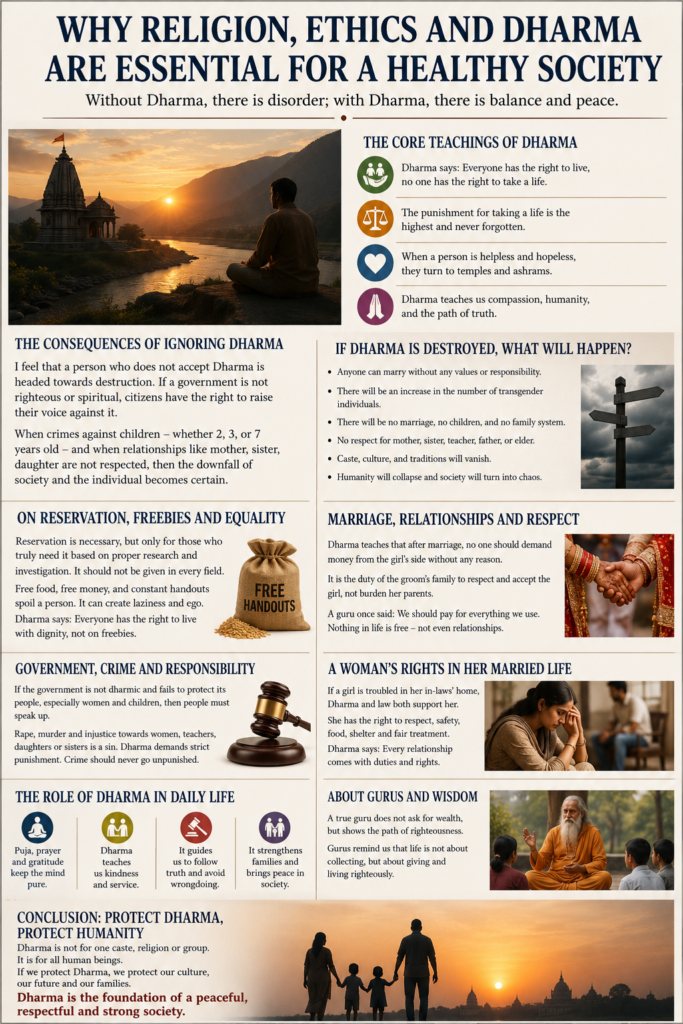
In my opinion, Dharma is not limited to rituals or visiting temples. It is a way of living that teaches honesty, compassion, discipline, respect, and responsibility. Every religion encourages people to live peacefully, respect others, and avoid harming innocent people. When these values become weak, society can face serious moral challenges.
Dharma and Human Values
I believe that a person who completely ignores moral values and responsibilities may lose direction in life. Dharma reminds us that every human being has the right to live with dignity. It teaches us to respect our parents, teachers, elders, women, children, and every member of society.
Crimes such as rape, murder, violence, and cruelty against children are among the worst acts a person can commit. Whether the victim is two years old, three years old, or seven years old, such crimes are unacceptable. Society and the justice system should ensure that criminals receive strict punishment according to the law.
Why Discipline Matters
Dharma teaches self-control and discipline. It encourages people to think before they act and to take responsibility for their actions. When people lose discipline, relationships, families, and communities can become weaker.
Many people turn to temples, mosques, churches, gurudwaras, or spiritual places when they feel helpless or hopeless. These places often provide emotional support, hope, and guidance during difficult times.
Respect for Family and Relationships
A healthy society is built on respect. Every person should respect their mother, father, sister, brother, teacher, spouse, and elders. Marriage should be based on mutual trust, consent, responsibility, and respect.
No family should demand unnecessary money or gifts from the bride’s family after marriage. Such practices create suffering and go against the values of fairness and dignity. Every daughter has the right to live safely and respectfully in her marital home. If she faces harassment or violence, she should receive protection and justice under the law.
Helping Others with Responsibility
Helping poor and needy people is a noble act. However, many people believe that long-term welfare policies should encourage education, employment, and self-reliance so that individuals can live with dignity. Different people have different opinions about government support, reservations, and welfare schemes, and these issues should be discussed fairly and based on evidence.
Protecting Humanity
Dharma is not only about worship. It is also about humanity, kindness, truth, forgiveness, and justice. A person who follows these values is more likely to contribute positively to society. Respect for women, children, teachers, and elders strengthens families and communities.
In my view, Dharma is a source of moral guidance that encourages discipline, compassion, honesty, and respect for human life. Regardless of one’s religion or beliefs, values such as kindness, justice, responsibility, and humanity help build a peaceful society. Protecting these values is the responsibility of every generation so that future generations inherit a safer, more respectful, and more compassionate world.
What Would Happen If a Country Had No Constitution? Understanding the Importance of Constitutional Law
The Constitution is one of the most important foundations of any democratic nation. It is a set of fundamental rules that explains how a country is governed, what powers different institutions have, and what rights and freedoms people enjoy. It also places limits on the power of governments and public authorities.
A question that sometimes arises is: What would happen if a country’s Constitution were suddenly abolished? While this is a hypothetical situation, thinking about it helps us understand why constitutions are considered essential in modern societies.
Why Does a Constitution Matter?
A constitution provides a framework for governing a nation. It:
Protects the rights and freedoms of citizens.
Defines the powers of the legislature, executive, and judiciary.
Ensures that everyone is equal before the law.
Provides peaceful methods for resolving disputes.
Prevents the misuse of power.
Without these guiding principles, governing a country would become far more difficult.
Would Laws Automatically Disappear?
Not necessarily.
In reality, if a constitution were removed, a country would still need a legal framework. Governments generally cannot function without laws. New temporary rules or another legal system would likely be introduced to maintain order. A nation cannot operate for long without some form of legal authority.
Could Crime Increase?
If there were no clear legal system or authority, crimes such as theft, fraud, corruption, assault, or murder could become harder to investigate and punish effectively. Uncertainty about the law could lead to confusion and instability.
However, exactly what would happen would depend on what legal system replaced the constitution.
Would Any Group Have Unlimited Power?
A constitution is designed to ensure that every person is equal before the law, regardless of caste, religion, wealth, gender, or social background.
Without constitutional protections, there could be a greater risk of unequal treatment or abuse of power. However, it would not automatically mean that any particular community or caste would gain complete control. That outcome would depend on the political and legal system in place.
What About Corruption?
Constitutions often establish independent institutions, courts, and oversight mechanisms that help fight corruption.
Without strong legal safeguards, corruption could become more difficult to control if there were no effective replacement system. On the other hand, a country with strong laws and institutions—even under a different constitutional arrangement—could still work to prevent corruption.
How Would Courts Function?
Courts rely on constitutional principles to interpret laws and protect citizens’ rights.
If there were no constitution, the judicial system would need a new legal foundation. Otherwise, judges would have no clear framework for deciding many important constitutional questions.
Would People Lose Their Rights?
Many basic rights—such as equality before the law, freedom of speech, freedom of religion, and legal protections—are guaranteed by constitutions in democratic countries.
If a constitution were abolished, those rights would depend on whatever legal system replaced it. Some rights might continue, while others could be weakened if they were no longer protected by law.
Could Anyone Do Whatever They Wanted?
No.
Even in a hypothetical situation where a constitution ended, no stable country could function if everyone were free to ignore all laws. Governments would almost certainly create emergency laws or adopt another legal framework to maintain public order and safety.
Why Is Equality Before the Law Important?
One of the greatest strengths of a constitutional democracy is the principle that every individual is entitled to equal legal protection. The law is intended to apply to everyone, regardless of social status or background. This principle helps reduce discrimination and promotes fairness.
The Importance of Checks and Balances
A constitution also creates checks and balances between different branches of government. These limits help prevent excessive concentration of power and encourage accountability.
Without such safeguards, there is a greater risk that decisions could become less transparent or less accountable.
Lessons from History
History shows that countries facing periods of legal uncertainty or weak institutions often experience political instability, economic challenges, and reduced public confidence. For this reason, most nations maintain a written or unwritten constitutional framework to guide governance and protect citizens.
A constitution is much more than a legal document—it is the foundation of a nation’s system of government. It protects individual rights, establishes the rule of law, defines the powers of public institutions, and provides peaceful ways to resolve disagreements.
Imagining a country without a constitution highlights how important stable laws and independent institutions are for maintaining justice, order, and equality. Regardless of political views, a functioning legal framework is essential for protecting both society and individual freedoms.
Humanity should always remain above hatred.
Caste and Modern Society
India has many communities and social groups that developed over centuries for different historical and occupational reasons.
Today, the Constitution guarantees equality before the law.
Many families still prefer marriages within their own community because of culture and tradition, while others choose inter-community marriages. Both choices exist in modern India.
Healthy relationships depend on mutual respect, trust, responsibility, and understanding—not only on caste or community.
Marriage Is About Responsibility
Marriage is not only a ceremony.
It is a lifelong commitment based on responsibility.
Husband and wife should respect each other, care for their children, support their families, and solve problems together.
No relationship becomes successful without patience, honesty, and sacrifice.
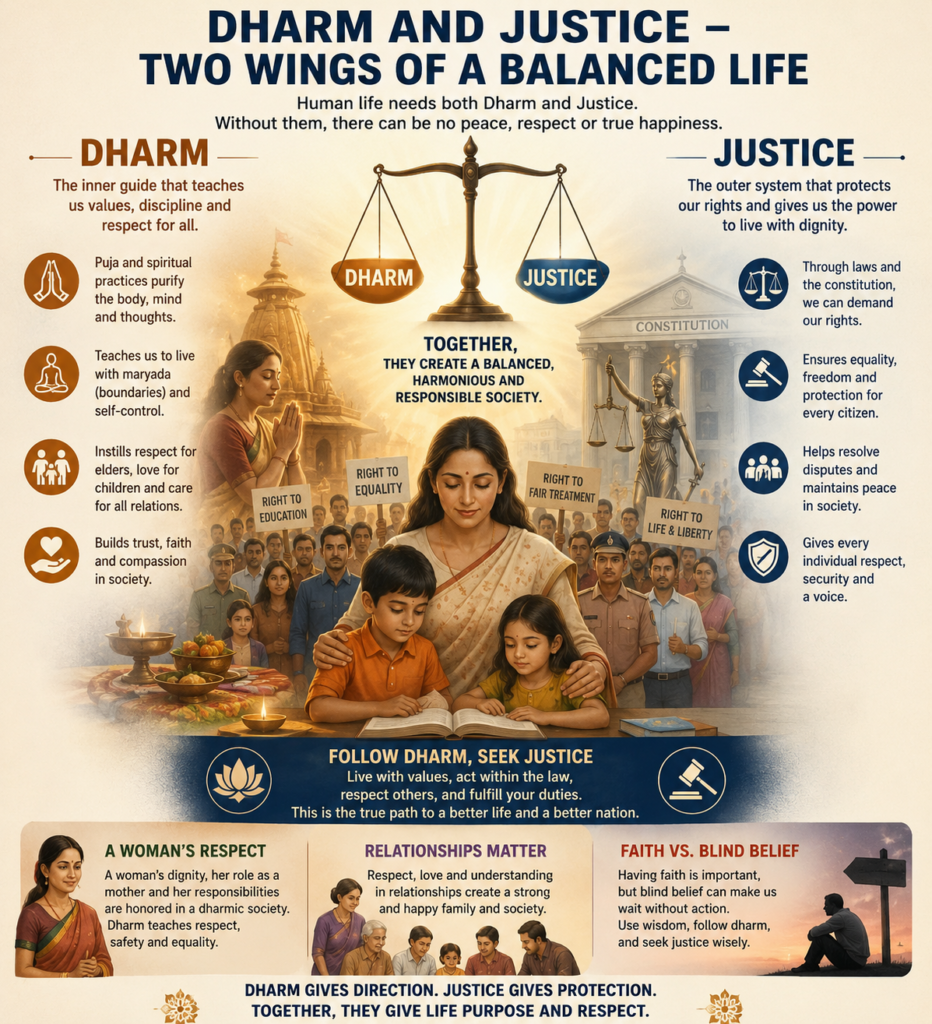
Religion and Law Can Work Together
Religion teaches moral values.
The Constitution provides equal rights.
The police, courts, and legal system maintain public order.
These are different systems, but all aim to create a peaceful society.
Breaking the law should have legal consequences, while religion encourages individuals to improve themselves through self-discipline and ethical living.
Crime Should Never Be Linked to Any Religion
Crimes such as theft, murder, kidnapping, corruption, or violence are committed by individuals, not by religions.
People from different backgrounds may commit crimes, and people from every background also work honestly to improve society.
Law enforcement should act fairly and firmly against anyone who breaks the law, regardless of religion, caste, or political affiliation.
Temples, Mosques, Gurudwaras, Churches, and Ashrams
Places of worship provide people with peace, hope, prayer, and self-reflection.
They remind people to control anger, reduce greed, forgive others, and improve their behavior.
However, simply visiting a religious place is not enough.
Real spirituality is shown through daily actions—truthfulness, honesty, compassion, and responsibility.
Government and Public Responsibility
Governments create laws, but citizens also have responsibilities.
If people follow traffic rules, respect women, keep public places clean, avoid corruption, and help others, society automatically becomes safer.
Good governance and responsible citizens must work together.
Discipline Is the Foundation of Civilization
Imagine a world without rules.
No traffic signals.
No schools.
No work schedules.
No courts.
No responsibilities.
Life would become chaotic.
Discipline is what allows families, schools, businesses, governments, and nations to function peacefully.
Conclusion
Technology will continue to change the world. Mobile phones, computers, and new inventions will become even more advanced.
But no technology can replace honesty, discipline, kindness, and humanity.
Religion can inspire moral values.
The Constitution protects justice and equality.
Families teach character.
Schools provide knowledge.
Governments enforce laws.
When these work together, society becomes stronger.
Instead of arguing about which religion is superior, people should focus on becoming better human beings. A disciplined life, respect for others, compassion, and responsibility create a happier family, a safer society, and a stronger Nation.