


Foreign Trees and Fruits in India:
When we hear about fruits such as kiwi, avocado, persimmon, cherry, walnut or dragon fruit, many people naturally think that these are foreign fruits and therefore they must grow only in foreign countries.
But this is not completely true.
A plant does not understand national borders. It responds mainly to temperature, sunlight, water, soil, humidity, altitude, chilling hours, rainfall and the length of the growing season.
That is why a plant that grows naturally in one country may sometimes be cultivated successfully in another country if suitable conditions are available.
India is a particularly interesting example because the country has almost every type of climate—from hot and dry regions to tropical areas and cold Himalayan mountains.
Research and farming experience have already shown that several fruits once considered “foreign” can be grown successfully in suitable parts of India. ICAR research, for example, reports successful cultivation of temperate fruits such as apple, walnut, kiwi, strawberry and persimmon in suitable parts of the Northeast Himalayan region. (Indian Agricultural Research Journals)
1. Does Every Foreign Plant Need a Foreign Climate?
No.
This is one of the biggest misunderstandings.
Suppose a fruit originally comes from a country where winters are cold. It does not necessarily mean the fruit can never grow in India.
India itself contains cold regions such as:
- Kashmir
- Himachal Pradesh
- Uttarakhand
- Sikkim
- Arunachal Pradesh
- parts of the northeastern hills
These areas can provide conditions similar to the climate required by some temperate fruits.
On the other hand, some foreign-origin crops prefer warm or tropical conditions. Those may be suitable for states in western, southern or central India.
So the real question is not:
“Is this a foreign plant?”
The better question is:
“Does this particular location provide the climate and soil conditions this plant requires?”
2. Kiwi: A Foreign Fruit That Is Now Grown in India
Kiwi is one of the best examples.
Kiwifruit originated in China and later became commercially important in countries such as New Zealand. Today, it is also cultivated in India.
ICAR reports that kiwi is being grown in places including Himachal Pradesh, Sikkim, Uttarakhand and Arunachal Pradesh. (Indian Council of Agricultural Research)
Kiwi prefers cooler conditions and sufficient winter chilling. Research on Indian cultivation indicates that altitude and local climate are important factors for successful production. (Springer)
Example
A farmer in a hot plain area cannot simply plant kiwi and expect the same result as a farmer in a suitable Himalayan location.
But in a cooler hill region, with the correct variety, soil drainage, irrigation and support structure, kiwi can become a commercial crop.
This is a good example of how climate matching can bring a foreign crop into Indian agriculture.
3. Avocado: From Central America to Indian Farms
Avocado is another fruit that was once strongly associated with foreign markets.
It originated in Central America, but today avocado cultivation is expanding in different parts of India.
Research indicates that avocado can perform well in suitable subtropical and mid-altitude environments, including parts of Karnataka, Tamil Nadu and Kerala, with other Himalayan and northeastern areas also being evaluated. (Springer)
There are also Indian research efforts to develop and maintain suitable avocado varieties. ICAR-IIHR’s fruit-crop collection includes avocado germplasm and research activities. (IIHR API Development)
Recent examples also show Indian farmers experimenting with commercial avocado production using improved cultivation methods and international farming knowledge. (The Economic Times)
Why does avocado need care?
Avocado does not like every type of soil and climate.
Good drainage is particularly important because excessive water around the roots can cause problems.
Therefore, simply importing an avocado plant is not enough.
The farmer needs the right variety + suitable climate + suitable soil + water management + orchard management.
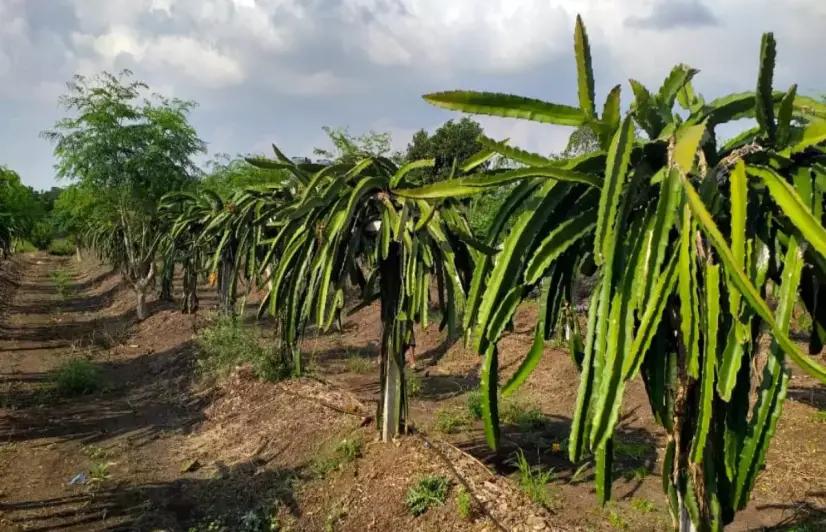
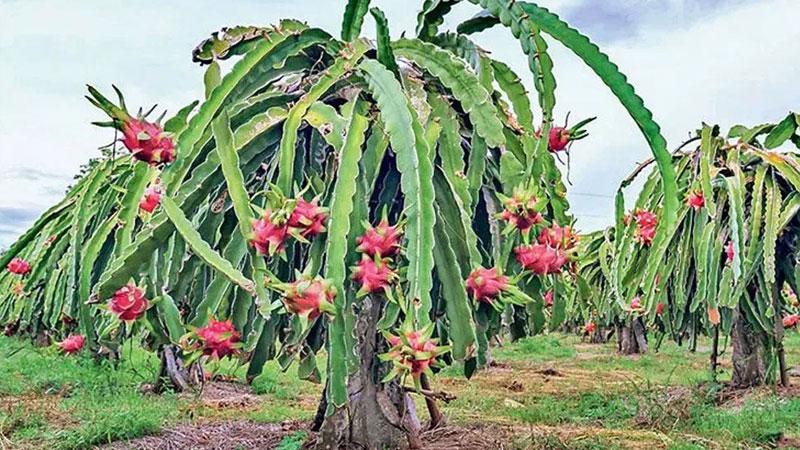
4. Dragon Fruit: A Foreign Crop That Found a Place in India
Dragon fruit is a particularly interesting example because people sometimes assume that exotic fruits require cold climates.
Dragon fruit is actually a cactus-like crop that can grow in warm regions.
It is now cultivated across several Indian states, including parts of Maharashtra, Gujarat, Karnataka, Tamil Nadu, Andhra Pradesh, Telangana and West Bengal. ICAR describes it as a high-value horticultural crop in hot and semi-arid as well as humid regions. (Indian Council of Agricultural Research)
Farmers commonly train dragon-fruit plants over concrete posts and support structures.


But even dragon fruit has challenges.
During very hot summers, excessive sunlight and heat can cause sunburn and reduce plant growth. ICAR is researching artificial shading and other methods to manage this problem. (Indian Council of Agricultural Research)
This is a perfect example of technology helping a plant adapt to local farming conditions.
5. Persimmon: A Fruit of Cooler Regions
Persimmon is another fruit that has a foreign origin but can be cultivated in selected Indian regions.
It can be grown in suitable Himalayan and hill environments.
ICAR research on northeastern India lists persimmon along with walnut, kiwi and other temperate fruits as crops that can grow successfully in appropriate mid-hill conditions. (Indian Agricultural Research Journals)
The important point is that farmers cannot treat all of India as one climate.
A plant that struggles in Delhi or Rajasthan may perform much better in a suitable hill environment.
6. Walnut: A Tree That Needs the Right Climate
Walnut is another excellent example.
Walnut trees require suitable winter conditions and are traditionally associated with colder regions.
India already has important walnut-growing areas, particularly in the Himalayan region.
Research is also looking at suitable varieties and new locations where temperate nut crops can be expanded.
This shows that a plant can be introduced into new areas when scientists understand its climatic requirements.
7. Cherry and Other Temperate Fruits
Cherry is another crop strongly associated with colder climates.
Its successful cultivation depends on factors such as:
- winter chilling
- spring temperature
- frost risk
- flowering time
- pollination
- soil
- water availability
This is why simply taking a cherry sapling from another country and planting it anywhere in India is unlikely to work.
The variety must be matched to the local climate.
This concept is becoming increasingly important as researchers develop and test low-chill varieties.
8. Not Every “Foreign” Fruit Needs a Mountain
This is equally important.
Some people think that if a fruit is foreign, it must be planted in the Himalayas.
That is also incorrect.
Dragon fruit, avocado and other exotic crops can be suitable for warmer regions depending on their variety and management.
India has such a large range of climates that different exotic crops can find different niches.
The Government of India has also supported the cultivation of exotic/foreign fruits such as dragon fruit, kiwi and passion fruit under horticulture-development programmes. (Press Information Bureau)
9. Can Artificial Methods Help Foreign Plants Grow in India?
Yes, but “artificial” does not mean that scientists can make every plant grow anywhere.
Instead, farmers and researchers can modify the growing environment.
For example:
Shade nets
A shade net can reduce excessive sunlight and heat.
This can be useful for crops that suffer from intense summer conditions.
Greenhouses and protected cultivation
A greenhouse can allow farmers to control temperature, humidity, sunlight and other conditions more carefully.
Protected cultivation is an established area of horticultural research in India. (Indian Agricultural Research Journals)
Drip irrigation
Instead of flooding an entire field, water can be delivered closer to plant roots.
Mulching
Mulching can help manage soil moisture and temperature and reduce weed growth.
Soil improvement
Organic matter, compost and suitable soil amendments can improve soil structure when used according to the crop’s requirements.
Wind protection
Some delicate fruit trees can be protected from strong winds through shelterbelts or suitable orchard design.
These techniques do not magically change the plant’s genetics. They simply help create a more suitable environment.
10. What Is Grafting and Why Is It Important?
One of the most interesting techniques used in fruit cultivation is grafting.
In simple language, grafting means joining part of one plant with another compatible plant so that they grow together.
A farmer or horticulturist may choose a rootstock because it has desirable characteristics such as:
- stronger roots
- disease tolerance
- adaptation to local soil
- tolerance to particular environmental conditions
The upper part, called the scion, may be selected for fruit quality or other desirable characteristics.
This is not limited to foreign fruits. Grafting is widely used in horticulture.
ICAR-IIHR, for example, conducts research on fruit-crop improvement, breeding, high-density planting and crop management. (IIHR API Development)
11. Can Scientists Change a Foreign Plant So It Grows Better in India?
Scientists can improve plants through breeding, selection, grafting, rootstock selection, tissue culture and other horticultural techniques.
But this does not mean that every plant can be transformed into a completely different plant.
For example, a cold-loving fruit cannot necessarily be converted into a heat-loving crop simply by adding fertilizer.
Researchers instead search for:
“Which variety is naturally better suited to this environment?”
That is a much more realistic approach.
12. Can Organic Fertilizer Make a Foreign Tree Grow?
Organic matter can certainly be useful.
Compost, farmyard manure and other properly prepared organic materials can improve soil structure and contribute nutrients.
But fertilizer is not magic.
If a plant needs winter chilling and the location is extremely hot throughout the year, simply adding more organic fertilizer will not create winter chilling.
Likewise, if a plant cannot tolerate waterlogged soil, adding manure alone will not solve the drainage problem.
Climate + soil + water + variety + management all matter.
13. Can Food or Special Nutrition Be Given to Plants?
Plants require nutrients such as nitrogen, phosphorus, potassium and several micronutrients.
Farmers may supply these through organic or mineral fertilizers according to soil and crop requirements.
But plants should not be treated like humans by randomly giving them kitchen food or supplements.
For example, throwing large quantities of food waste around a tree can attract pests and create sanitation problems.
Composted organic matter is a much more controlled approach.
So the idea should be:
Feed the soil properly rather than randomly feeding the plant.
14. Are Foreign Fruits Really Beneficial?
Many fruits have useful nutrients, but being foreign does not automatically make a fruit healthier.
A kiwi is not automatically better than a guava simply because it costs more.
An avocado is not automatically better than every Indian fruit.
India already has an enormous variety of nutritious fruits, including:
- Guava
- Papaya
- Amla
- Banana
- Orange
- Pomegranate
- Mango
- Jamun
- Custard apple
Foreign fruits can add variety to the diet, but nutrition should not become a competition between “Indian” and “foreign.”
15. What About Foreign Medicinal Plants?
The same principle applies to medicinal plants.
Some medicinal plants originating outside India can be cultivated in India when the climate is suitable.
But medicinal use requires more caution than simply growing a fruit tree.
A plant may contain biologically active compounds, and natural does not automatically mean harmless.
Before using a foreign medicinal plant as medicine, its identification, dosage, interactions and safety need to be understood.
Growing a plant and using it medicinally are two different things.
16. What About Foreign Timber Trees?
India has also introduced and cultivated several tree species from outside the country for forestry, timber, pulp, fuel or other purposes.
But introducing a tree is not always automatically beneficial.
Some introduced species can compete with native vegetation, consume large amounts of water in certain settings, or behave invasively.
Therefore, the question should not simply be:
“Can we grow this foreign tree?”
It should also be:
“Should we grow it here, and what will be its environmental impact?”
This is especially important near forests, wetlands and biodiversity-rich areas.
17. Why Research Is So Important
India has many different agricultural environments.
A variety that works in Kashmir may not work in Gujarat.
A crop that performs well in Karnataka may struggle in Himachal Pradesh.
This is why agricultural research stations, universities and ICAR institutions test varieties under different conditions.
ICAR’s fruit-crop research includes breeding, stress tolerance, productivity, quality, high-density planting and other methods of improving fruit production. (IIHR API Development)
The goal is not simply to copy another country.
The goal is to adapt useful technology and plant material to Indian conditions.
18. India Is Already Proving That Adaptation Is Possible
India’s experience with exotic fruits demonstrates that agricultural boundaries are not as simple as national borders.
Kiwi has found suitable Himalayan and northeastern locations.
Dragon fruit has expanded into several warm Indian states.
Avocado is being cultivated and researched in suitable subtropical areas.
Persimmon, walnut, strawberry and other temperate crops can be grown in appropriate hill environments.
Government horticulture programmes have specifically supported exotic fruit cultivation. (Press Information Bureau)
This does not mean every crop can be grown everywhere.
It means that India’s agricultural diversity gives farmers many opportunities to experiment intelligently.
19. What Is the Future of Foreign Crops in India?
The future may involve more scientific matching between crops and locations.
Instead of saying:
“This is a foreign fruit, so it cannot grow here,”
farmers may increasingly ask:
- What temperature does it require?
- How many chilling hours does it need?
- Which variety is suitable?
- What type of soil is required?
- How much water does it need?
- Does it require shade?
- Can grafting help?
- Is protected cultivation necessary?
- Is the market strong enough?
- Will cultivation be environmentally sustainable?
These are much better questions.
20. The Biggest Lesson: Nature Has Conditions, Not Borders
A tree does not know whether it is growing in India, China, New Zealand or America.
It responds to its environment.
If the environmental requirements are available naturally, the crop may grow.
If they are partly available, technology may help.
If they are completely unsuitable, forcing the crop may become expensive, inefficient or environmentally harmful.
That is why successful agriculture is not simply about bringing a foreign seed into India.
It is about understanding the plant and respecting nature.
Conclusion
The idea that some fruits and trees can grow only in foreign countries is too simple.
Some plants genuinely require very specific climatic conditions, but India has an extraordinary range of climates—from tropical plains to high Himalayan regions. Because of this diversity, several crops that originated outside India are now being successfully cultivated or researched in suitable Indian locations.
Kiwi, avocado, dragon fruit, persimmon, walnut, strawberry and several other crops provide examples.
Modern techniques such as grafting, improved varieties, protected cultivation, drip irrigation, shade management, soil improvement and scientific breeding can help farmers adapt crops to local conditions.
But technology has limits.
A foreign plant should not be planted simply because its fruit is expensive. Farmers need to consider climate, water, soil, cost, market demand, disease risk and environmental impact.
The most promising future is therefore not “foreign plants versus Indian plants.”
It is scientific farming + Indian conditions + suitable varieties + responsible technology.
India does not need to copy every foreign crop. Instead, it can study useful plants from around the world and discover where they genuinely fit within India’s own climate, soil, farming traditions and environment.
That is where agricultural research becomes valuable—not in defeating nature, but in understanding it better.