



Best AI Tools For Business

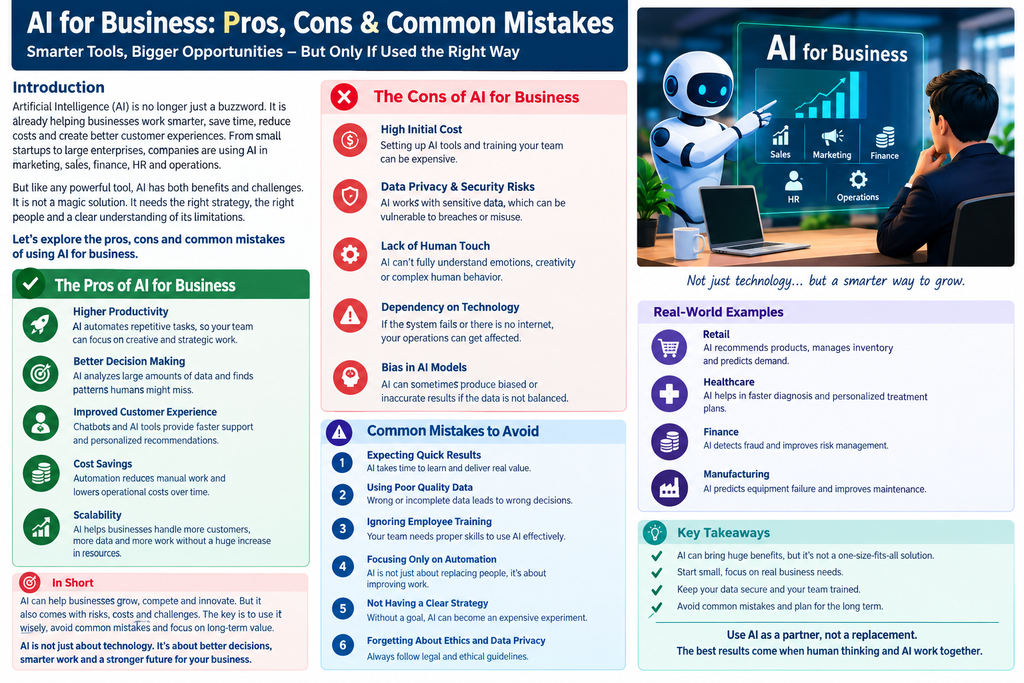
Artificial Intelligence, or AI, has become an important business tool. From a small online shop to a large company, businesses are using AI for marketing, customer service, data analysis, content creation, sales, finance and many other activities.
But AI is not a magic machine that automatically makes every business successful.
It is a powerful tool, and like any powerful tool, it can create good results when used properly and problems when used carelessly.
The real question for a business owner is not simply “Should I use AI?” It is:
“How can I use AI in a useful, safe and responsible way?”
1. The Pros of AI for Business
Faster Work and Higher Productivity
One of the biggest advantages of AI is speed.
A business employee may spend hours preparing a first draft of an email, advertisement, product description or report. AI can help create a starting point much faster.
For example, an online clothing business with 1,000 products can use AI to prepare initial product-description drafts. Employees can then check the information, correct mistakes and add the brand’s own style.
This can save time without removing the need for human checking.
Better Data Analysis
Modern businesses generate a huge amount of information.
They may have data about:
- Website visitors
- Sales
- Customer purchases
- Advertising
- Product returns
- Customer questions
- Inventory
- Revenue
AI can help identify patterns in this information.
For example, if a shop notices that a particular product sells much more during certain months, AI-assisted analysis may help identify that pattern.
The business owner can then make a better inventory decision.
Customer Service
AI-powered chatbots can answer simple questions at any time.
For example:
Customer: “What time does your store close?”
AI system: “The store closes at 8 PM.”
For common questions, this can save employees time.
However, complicated complaints should still be transferred to a human when necessary.
Personalized Marketing
Different customers have different interests.
Someone visiting a sports website may be interested in running shoes, while another customer may be more interested in fitness equipment.
AI can help businesses analyze customer behavior and provide more relevant recommendations.
When used responsibly, personalization can make marketing more useful rather than simply sending the same advertisement to everyone.
Cost Savings
AI can reduce some repetitive manual work.
For example, an employee may spend several hours organizing information into reports. An AI-assisted system may automate part of that process.
However, businesses should not assume that every AI system automatically reduces costs. Software subscriptions, implementation, training, maintenance and human supervision also have costs.
2. The Cons of AI for Business
AI has many advantages, but there are also genuine disadvantages.
Wrong Information Can Lead to Wrong Decisions
AI systems can sometimes produce incorrect information.
Imagine a business owner asks an AI system to analyze a market and accepts everything without checking it.
If the information is wrong, the business decision could also be wrong.
This is particularly serious when decisions involve money, contracts, legal matters, medical information or customer data.
AI output should be checked before important decisions are made.
Data Privacy and Security Risks
Businesses often handle sensitive information.
This could include:
- Customer information
- Employee information
- Financial records
- Business plans
- Passwords and credentials
- Sales information
Sending confidential information into an AI service without understanding its privacy and security arrangements can create unnecessary risk.
Companies should establish clear rules about what employees are allowed to put into AI systems.
AI Can Lack Human Understanding
AI can recognize patterns in data, but business is also about people.
A customer may be angry because of a previous bad experience. Another customer may simply need someone to listen.
A completely automated response may solve the technical question but fail to solve the human problem.
That is why human customer support remains important.
Employees May Become Too Dependent on AI
Another problem is overdependence.
If employees use AI for every small task, they may gradually stop developing their own research, writing, analytical and problem-solving skills.
AI should make employees more capable, not make them unable to work without it.
3. Common AI Mistakes Businesses Should Avoid
Mistake 1: Believing AI Is Always Correct
This is probably one of the biggest mistakes.
AI can sound confident even when its answer is incorrect.
For example, a business owner might ask AI about a regulation or tax matter and immediately act on the response.
That is risky.
For important matters, information should be verified using reliable sources and qualified professionals where appropriate.
Mistake 2: Using Poor-Quality Data
AI is heavily dependent on the information available to it.
If a company’s data is incomplete, outdated or inaccurate, the resulting analysis may also be unreliable.
Imagine a retailer has incorrect inventory records.
An AI system may recommend purchasing more of a product because it believes stock is low.
The problem may not be the AI itself.
The problem may be the original data.
Good AI requires good data.
Mistake 3: Trying to Automate Everything
Some businesses become excited about AI and try to automate every department immediately.
That can create confusion.
A better approach is to start with one specific problem.
For example:
Problem: Employees spend too much time answering repetitive customer questions.
Solution: Introduce an AI-assisted chatbot for basic questions.
Then measure whether it actually saves time and improves customer satisfaction.
If it works, the company can expand gradually.
Mistake 4: Removing Humans From Important Decisions
AI should not automatically become the final decision-maker for every business situation.
Hiring, firing, sensitive customer complaints, major financial decisions and ethical matters may require human judgment.
AI can provide information and recommendations, but accountability should remain with people.
Mistake 5: Publishing AI Content Without Checking It
Businesses sometimes use AI to create hundreds of articles, advertisements or social-media posts.
The problem is that AI-generated content can contain:
- Incorrect facts
- Repeated ideas
- Generic language
- Outdated information
- Incorrect product details
A human should review important content before publication.
A business’s reputation is ultimately connected to what it publishes.
4. AI and Human Employees Should Work Together
The best business model is not necessarily AI versus humans.
It can be:
AI + Human Skills
For example, AI can prepare a first analysis.
A human manager can review it.
AI can create an advertisement draft.
A human marketer can improve the message.
AI can answer basic customer questions.
A human employee can handle complicated problems.
This combination can be much more practical.
5. Example: A Small Indian Business
Imagine a small Indian furniture business.
The owner receives inquiries through WhatsApp, social media and the website.
The business could use AI to:
- Organize common customer questions.
- Prepare product-description drafts.
- Analyze which products receive the most interest.
- Generate advertising ideas.
- Summarize customer feedback.
- Help employees prepare reports.
But the owner should still personally check prices, product specifications, delivery promises and important customer complaints.
AI becomes an assistant rather than the boss.
6. Example: AI in Digital Marketing
Suppose a company spends ₹50,000 on online advertising.
AI-assisted analytics may help identify which advertisements generate more clicks or conversions.
But the business should not look only at clicks.
It should ask:
How many genuine customers came from the campaign?
A campaign with 10,000 clicks but very few purchases may be less useful than one with 2,000 clicks and many genuine customers.
AI can help analyze these numbers, but humans still need to understand the business goal.
7. Start Small Instead of Spending Too Much
A company does not necessarily need expensive AI technology from day one.
It can begin with a simple problem.
For example:
Step 1: Identify a repetitive task.
Step 2: Test whether AI can help.
Step 3: Check the accuracy.
Step 4: Train employees.
Step 5: Measure the result.
Step 6: Improve the process.
Step 7: Expand only if there is a genuine benefit.
This approach can prevent a business from wasting money on technology that it does not actually need.
8. Employees Need Training
Buying an AI tool is not enough.
Employees need to understand:
- What the tool can do
- What it cannot do
- How to check its output
- What information should not be entered
- How to protect customer data
- When a human should take over
Good training can make AI much more useful.
Without training, even an expensive system can be poorly used.
9. Do Not Forget Creativity
Business is not only about automation.
Brand identity, storytelling, customer relationships and creativity remain important.
A local business may have a unique story that no generic AI system can truly experience.
For example, a family restaurant that has operated for three generations has a real human story.
AI can help write that story, but it cannot replace the actual history and relationships behind the business.
10. The Biggest Mistake: Thinking AI Alone Will Grow the Business
This is perhaps the most important lesson.
AI cannot compensate for:
- A poor product
- Bad customer service
- Unreasonable prices
- Weak management
- Lack of trust
- Poor financial planning
- No understanding of customers
If a business has a bad product and simply adds AI, it still has a bad product.
Technology can improve a good process, but it cannot magically turn every bad business decision into a good one.
Conclusion
AI can be extremely useful for businesses.
It can save time, analyze information, assist employees, improve customer service, support marketing and automate repetitive work.
But it also brings risks.
Incorrect information, privacy problems, poor-quality data, overdependence, lack of human judgment and careless automation can create serious problems.
The smartest approach is therefore not to blindly follow AI and not to completely reject it.
Instead, businesses should use AI where it genuinely creates value, keep humans involved in important decisions, protect data, verify important information and train employees properly.
AI should be treated as a powerful business partner or assistant—not as a replacement for human thinking.
The future of successful business may not belong to companies that use the most AI. It may belong to companies that know where AI is useful, where human judgment is necessary, and how to make the two work together.