
Sur Sarovar Bird Sanctuary, Agra: Rare Species, Wildlife Care


India is home to many beautiful wetlands where birds find food, water, shelter and a safe place to rest during long journeys. Near Agra, Uttar Pradesh, there is a special natural destination where visitors can observe birds, learn about wildlife and understand the importance of protecting the environment.
This place is Sur Sarovar Bird Sanctuary, also known as Keetham Lake, situated near Agra. It is an important wetland for resident and migratory birds. Its lakes, vegetation and surrounding habitats make it valuable for nature lovers, birdwatchers and researchers.
A bird sanctuary is not simply a park where birds are kept and fed. It is a protected natural habitat where the main aim is to allow wildlife to survive with as little disturbance as possible. Understanding how birds arrive, find food, breed and raise their young helps us appreciate why these places need careful management.
1. Where Is Sur Sarovar Bird Sanctuary?
Location: Near Runakta, Agra district, Uttar Pradesh, along the Delhi–Agra highway.
Popular name: Keetham Lake.
Protected since: 1991.
International importance: Recognised as a Ramsar wetland in August 2020.
Area: The sanctuary covers approximately 8 square kilometres according to the Uttar Pradesh Eco-Tourism Development Board. The Ramsar wetland inventory records about 431 hectares for the wetland itself. These figures refer to different ways of defining the protected landscape.
The lake was originally developed as a water reservoir to help supply Agra. Over time, it became a valuable ecosystem for birds, fish, reptiles and other wildlife. The surrounding vegetation provides nesting sites and shelter.
2. How Many Bird Species Live Here?


Official and conservation sources report different bird totals because they may count different groups or use records from different years.
- More than 126 species: The Uttar Pradesh Eco-Tourism Development Board reports this number for resident and migratory waterfowl.
- More than 165 bird species: The sanctuary’s own website and Agra district tourism information report a broader total of resident and migratory birds.
- More than 30,000 waterbirds annually: The Ramsar information for the wetland reports this level of annual visitation. This is not a count of birds permanently living there at one time.
upecoboard.up.gov.in +3
The number visible to visitors changes with the season, weather, water level, food availability and bird migration. A bird may be present in the sanctuary without being visible from the visitor trail.
3. Which Countries Do the Migratory Birds Come From?


Many migratory waterbirds reach northern India through the Central Asian Flyway, a broad network of migration routes connecting northern breeding areas with warmer wintering regions.
Depending on the species, birds passing through or wintering in northern India may originate from areas of:
- Central Asia, including Kazakhstan and neighbouring regions.
- Mongolia and parts of Russia.
- Northern and eastern Europe.
- Other parts of Eurasia, including regions around the Caspian Sea.
These are possible origin regions for migratory birds in the wider flyway, not a verified list of the home countries of every bird at Keetham Lake. The route and destination vary from species to species.
The Convention on Wetlands
+1
Why do they come to India?
The main reasons are food, suitable water bodies and more favourable winter conditions.
- Temperatures in northern breeding areas become very cold.
- Some lakes and wetlands freeze, reducing access to food.
- Birds travel to areas where they can find fish, insects, aquatic plants, seeds and other food.
- They rest, feed and sometimes spend several months in Indian wetlands.
- When conditions improve in their breeding regions, many return north.
Not every migratory bird travels the same distance. Some move between nearby wetlands, while others make journeys across several countries.
4. Which Birds Are Seen Every Year, and Which Appear Only Occasionally?

Resident birds
Herons, egrets, kingfishers and other locally occurring species may be found throughout the year, although sightings still depend on habitat and conditions.

Seasonal winter visitors
Ducks and geese, including greylag geese, are among the waterbirds associated with winter wetlands in northern India. Many arrive in autumn or winter and leave during spring.

Uncommon or irregular visitors
Certain raptors and other less frequently recorded species may appear only occasionally. Their sightings depend on migration, prey availability and habitat conditions. An irregular visitor should not automatically be called a rare resident of the sanctuary.
Birds that return each year are following established migration patterns, but their exact arrival dates and numbers can change. A species seen in one winter may be much less visible the next year.
5. What Are the Most Remarkable and Rare Birds Here?
These are some of the most interesting birds to learn about when visiting the sanctuary. The pictures below show the species, not a guarantee that each will be present on your visit.

- Great White Pelican
A large waterbird with a long bill and a throat pouch used to catch fish. Pelicans are impressive to watch when they gather and feed together. Great White Pelicans have been documented among the wetland’s birdlife.

- Painted Stork
Recognised by its long legs, yellowish bill and patterned pink-and-white feathers. It feeds in shallow water, searching for fish and other aquatic animals.

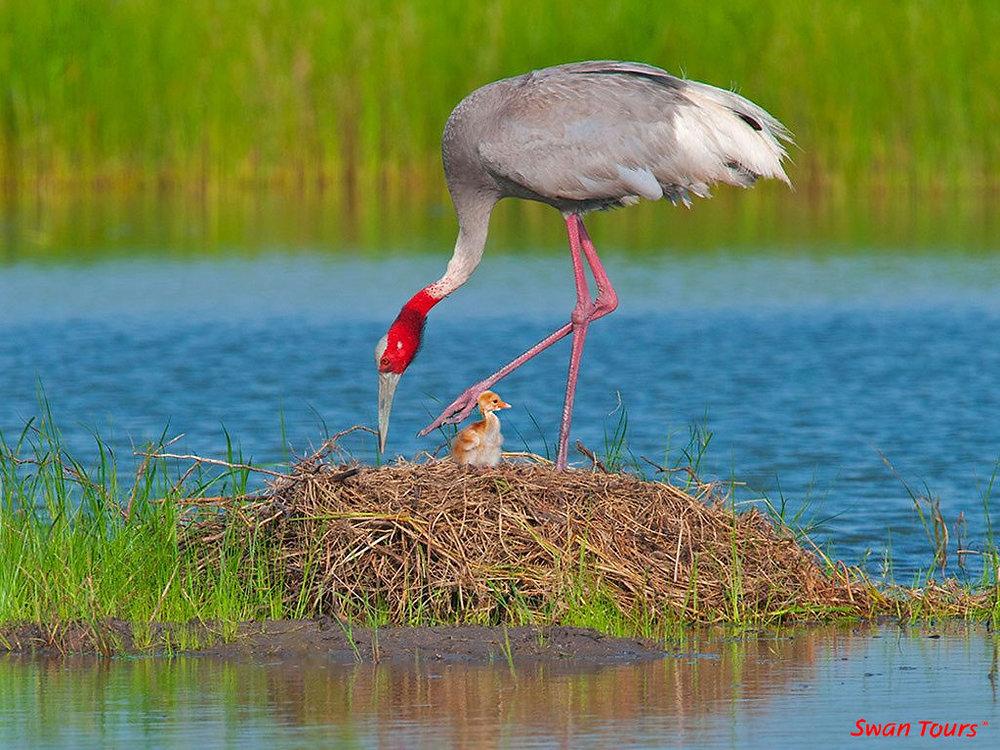
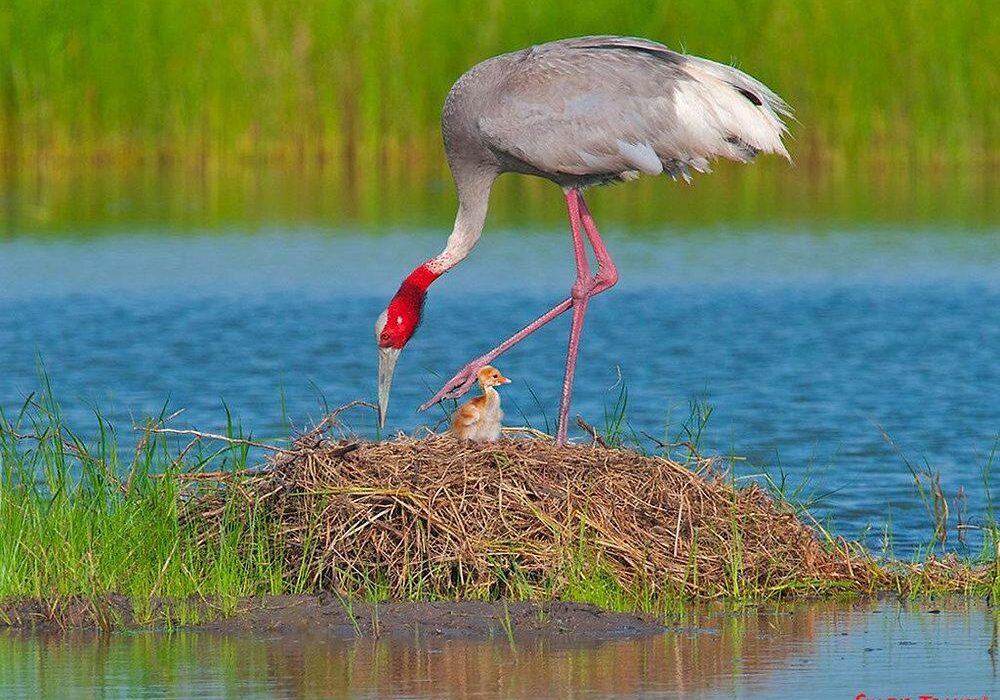
- Sarus Crane
The world’s tallest flying bird, known for its long legs, grey body and red head. It is a threatened species and is particularly important to wetland conservation. Its presence at the sanctuary should be checked against recent sightings.

- Greater Spotted Eagle
A powerful dark-brown bird of prey. It is classified as Vulnerable globally and is one of the threatened species associated with Sur Sarovar’s conservation importance. It is not guaranteed to be seen on an ordinary visit.

- Greylag Goose
A large grey goose that can form flocks on lakes and wetlands. Sur Sarovar is important for this species, with the Ramsar record noting a significant proportion of the South Asian regional population during the relevant period.

- Common Kingfisher
A small, colourful bird with bright blue upperparts and orange underparts. It watches from a perch before diving for small fish. It is a wonderful bird for photography, although spotting it requires patience.
The Ramsar wetland information specifically identifies the greater spotted eagle and sarus crane among the threatened species associated with the site.
The Convention on Wetlands
+1
6. Do All Birds Lay Eggs and Raise Their Babies Here?


7
Birds reproduce in different ways, and their breeding behaviour depends on the species.
Do all birds lay eggs? Yes. All living bird species reproduce by laying eggs. However, not every bird that visits a sanctuary lays eggs there.
There are three common situations:
- Birds that breed locally: Some resident birds build nests, lay eggs and raise their chicks in or around suitable sanctuary habitats.
- Migratory birds that breed elsewhere: Many winter visitors come mainly to feed and rest. They may return to their breeding grounds to lay eggs.
- Birds that use the sanctuary temporarily: Some stop for a short period before continuing their journey. They may not nest at all.
Do all eggs hatch, and do all chicks survive?
No. Even in a healthy natural habitat, not every egg hatches and not every chick survives.
Possible reasons include:
- Eggs that are infertile or fail to develop.
- Predators eating eggs or young chicks.
- Flooding, storms, extreme temperatures or other adverse weather.
- Shortages of food or disturbance near nests.
- Disease, injuries and other natural causes.
Parent birds often protect their nests, feed their chicks and help them develop until they can survive independently. The survival rate varies by species, season and local conditions.
Do birds lay eggs and then leave their chicks behind?
Some birds leave their nests to search for food while their partner continues caring for the eggs or chicks. Others take turns incubating eggs and feeding their young. Some species provide care for a long time, while others become independent relatively quickly.
This does not mean that migratory birds generally lay eggs at Keetham Lake and abandon their chicks before leaving. Breeding and migration are species-specific behaviours. A sanctuary’s exact nesting success must be established through field observations rather than assumptions.
7. Who Looks After the Birds? What Do They Eat?


One important difference between a bird sanctuary and a zoo is that most wild birds in a sanctuary find their own food. The authorities generally manage the habitat rather than feeding every bird individually.
What do the birds eat?
| Type of bird | Typical natural food |
|---|---|
| Pelicans | Fish |
| Kingfishers | Small fish and other aquatic prey |
| Herons and egrets | Fish, insects, frogs and other small animals |
| Ducks and geese | Aquatic plants, seeds and other foods depending on species |
| Birds of prey | Small animals and other prey |
| Insect-eating birds | Insects and other invertebrates |
What work do sanctuary staff perform?
Forest and wildlife personnel may undertake work such as:
- Monitoring bird numbers, habitats and nesting areas.
- Protecting wildlife against hunting, trapping and disturbance.
- Maintaining access routes, watchpoints and visitor facilities.
- Monitoring water conditions and aquatic vegetation.
- Removing harmful waste and responding to environmental problems.
- Recording unusual sightings, injured wildlife and possible disease outbreaks.
- Coordinating with wildlife veterinarians, researchers and rescue organisations when required.
Sur Sarovar also contains a rescued-sloth-bear facility operated by Wildlife SOS. The bear rescue work is a separate wildlife-care activity within the wider sanctuary landscape. Visits to that facility require arrangements through the organisation.
India
+1
How many workers are employed there?
An exact, current figure for all permanent employees, forest guards, maintenance workers, veterinary staff and contractual labourers specifically assigned to Sur Sarovar was not available in the official sources reviewed.
It would be misleading to invent a number. The workforce may also vary according to departmental staffing, seasonal duties and contracted services.
8. How Many Birds Are Present at One Time?
The annual figure of more than 30,000 visiting waterbirds shows the wetland’s importance, but it must not be treated as today’s bird count or as the number of birds permanently living there.
The Convention on Wetlands
+1
The total number changes because:
- Migratory birds arrive and leave at different times.
- Some birds move between nearby wetlands during the day.
- The availability of water and food changes.
- Some species breed locally, while others do not.
- Weather and habitat conditions influence where birds gather.
A proper population estimate requires systematic bird counts. Researchers may use fixed observation points, binoculars, photographs, field surveys and repeated counts at different times of the year.
For example, a flock of 500 geese might be counted at a particular lake on one morning. That would not establish the total number of geese using the sanctuary throughout the winter.
9. How Is the Sanctuary Protected and Maintained?
A wetland requires continuous care. It is not enough to protect the birds while allowing their feeding and breeding habitat to deteriorate.
Important conservation tasks include:
- Water management: Maintaining suitable water levels and monitoring water quality.
- Vegetation management: Supporting native aquatic plants and controlling invasive species where necessary.
- Habitat protection: Preserving nesting trees, shallow-water feeding areas and undisturbed resting places.
- Pollution control: Preventing plastic, sewage and other harmful waste from entering the wetland.
- Wildlife monitoring: Recording threatened species and changes in bird populations.
- Visitor management: Keeping people, vehicles and noise away from sensitive nesting areas.
BirdLife International has identified concerns at the site involving invasive aquatic plants, sediment accumulation and other pressures on the wetland. These illustrate why habitat management is just as important as counting birds.
BirdLife DataZone
+1
10. Do Researchers Visit More Often Than Tourists?

Researchers and birdwatchers
Researchers may visit to study migration, population changes, nesting, food chains, wetland ecology and the effects of pollution. They may need repeated visits over several weeks or months. Birdwatchers and wildlife photographers often visit to identify and photograph different species.

Tourists and nature lovers
Many visitors come for a peaceful natural outing, photography, wildlife observation or as part of a wider Agra trip. The sanctuary also attracts people interested in conservation and environmental education.
Both groups are important, but their needs differ. A tourist may spend a few hours enjoying the lake, while a researcher may revisit the same locations repeatedly to gather reliable data.
A verified, current breakdown of annual research visitors versus ordinary tourists was not available in the sources reviewed. Therefore, it is not possible to say accurately which group visits in greater numbers.
11. Can You Explore the Entire Sanctuary in One Day?
Yes, you can plan a visit of several hours or a full day, but seeing the entire protected landscape and spotting every bird species are two very different things.
The sanctuary’s website describes an area of about 7.97 square kilometres, including a lake of approximately 2.25 square kilometres. Some areas are accessible by vehicle, while other parts require walking along paths and trails.
Soorsarovar Bird Sanctuary
+1


![Keetham Lake Tickets [2026] - Promos, Prices, Reviews & Opening Hours | Trip.com](https://images.openai.com/static-rsc-4/5hjHY2SCCuQHe2jd-yle4zA01CCd6ixzPyLTlmg_IpufOPuYZf0XMVVqkFeE2oRVq-JD_XNfWtqiy8M3OHobTrRYBMwfLacVl9jg4tm4qIDeTz-PB8mXeqwnCGo3bt7-OFh8s-QUH-fPeFjUS8M9JiOig5-swBEwddrL5BPULOM?purpose=inline)
A practical one-day visiting plan
Early morning
Start with the lake
Early hours are a good time for quiet observation and photography. Look for waterbirds, ducks, geese and birds feeding near the water.
Morning
Walk slowly and observe
Use permitted paths and viewing points. Scan tree branches, reeds, open water and shallow edges. Carry binoculars if possible.
Midday
Review your sightings
Photograph birds from a respectful distance, record their names and rest when needed. Ask staff which areas are currently open to visitors.
Afternoon
Explore remaining permitted areas
Visit accessible woodland or viewing areas and finish before closing time. Avoid entering restricted nesting zones.
The time available will depend on the entrance arrangements, walking distance, seasonal restrictions and whether any additional guided activity has been booked.
Is a car better than walking?
A car can help cover the permitted access roads, especially for visitors who cannot walk long distances. However, cars cannot necessarily reach every part of the sanctuary, and some routes continue as walking paths.
Walking slowly is often better for observing small birds, kingfishers and birds hidden among vegetation. Driving faster does not guarantee more sightings.
How many birds can someone see in one day?
There is no fixed number. Someone may see several species in a short visit, while an experienced birdwatcher may identify many more after spending hours observing carefully.
It is also important to distinguish between individual birds and bird species. Seeing 100 individual ducks could mean seeing just one species. Seeing 20 different species may provide a much richer birdwatching record.
My recommendation is to allow around half a day to a full day for a relaxed first visit. If you want to study birds seriously, repeated visits in different seasons will be much more informative.
12. Can Visitors Stay Overnight Near the Sanctuary?
Yes. Visitors can stay in Agra and travel to the sanctuary for a morning visit.
The Uttar Pradesh Eco-Tourism Development Board lists forest rest houses and private accommodation in Agra. However, this does not mean that every visitor can stay inside the sanctuary itself. Availability, permissions and booking rules should be checked in advance.
upecoboard.up.gov.in
+1

Suggested arrangement
- Stay in Agra city for easier access to hotels, restaurants and transport.
- Leave early to reach the sanctuary during the morning.
- Carry drinking water, sun protection and binoculars.
- Check opening hours and entry fees before travelling.
- Arrange a separate booking if you also want to visit the Wildlife SOS bear rescue facility.
The sanctuary is roughly 20–30 km from Agra city, depending on the starting point and route. Agra Cantt railway station and Agra Airport are also listed as access points for the area.
upecoboard.up.gov.in
+1
13. What Is the Best Season to See Migratory Birds?
Add to Favorites


The best general period for migratory waterbirds is October to March, with winter months usually offering good opportunities to observe many seasonal visitors. The exact peak depends on the species, weather and water conditions.
India
+1
| Season | What you may experience |
|---|---|
| October–November | Arrival of many winter migrants |
| December–February | Good opportunities for winter waterbird watching |
| March | Some migrants begin returning to breeding grounds |
| April–September | Resident birds remain, while seasonal sightings and breeding activity vary |
For the most productive visit, check recent bird sightings before leaving home. Even in the peak season, a particular rare species may not appear on the day you visit.
14. How Can Visitors Help Protect the Birds?
Every visitor can contribute to wildlife conservation through simple actions.
- Do not throw food, plastic or other rubbish into the lake.
- Never feed bread or snacks to wild birds unless authorised wildlife staff specifically direct you to do so.
- Keep a respectful distance from nesting birds.
- Avoid loud music, shouting and sudden movements.
- Do not touch eggs, chicks, nests or injured birds.
- Use binoculars or a camera zoom instead of approaching wildlife.
- Follow the instructions of forest staff and stay on permitted routes.
A wetland remains healthy when birds can find food, rest and reproduce without unnecessary interference. Protecting the water, vegetation and surrounding habitat is one of the best ways to support them.
15. Final Thoughts: A Living Classroom for Nature
Sur Sarovar Bird Sanctuary is more than a tourist attraction near Agra. It is a living example of how a water reservoir can become an important habitat for birds and other wildlife.
Some birds stay throughout the year, while others travel long distances to spend the winter here. Some breed locally, while others use the lake only for food and rest. Their populations change naturally, which is why conservationists need reliable surveys rather than guesses about the total number of birds.
A single visit can introduce you to the beauty of the wetland. Several visits, especially in different seasons, can help you understand its wildlife much more deeply.
For families, students, photographers and researchers, the sanctuary offers an opportunity to learn that protecting nature requires patience, scientific observation and responsible human behaviour.
Official sources for further information
- Uttar Pradesh Eco-Tourism Development Board — Sanctuary overview, species and access information
- Agra District Administration — Visitor information for Sur Sarovar
- Ramsar Sites Information Service — International wetland conservation information
- BirdLife International — Bird conservation and site information
Note: Bird counts, staffing numbers, fees, opening hours and access arrangements can change. Check the relevant official authority before making travel plans. The bird images in this article are visual references for identification, not a guarantee that each species will be present during a visit.