
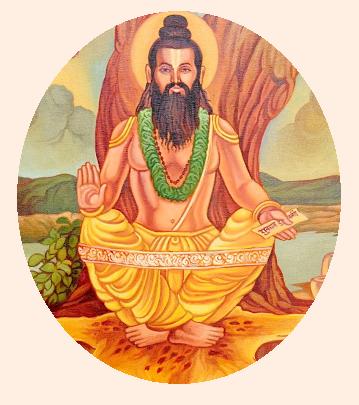



Yajnavalkya Rishi:the Meaning of “Neti, Neti”
His Life, Teachings, the Knowledge of the Soul, and the Meaning of “Neti, Neti”9Introduction: Who Was Yajnavalkya Rishi
Yajnavalkya Rishi was one of the most respected sages of ancient India. He is especially famous for his deep knowledge of the Vedas, his understanding of the soul (Atman), and his teachings about Brahman, the ultimate reality.
His teachings explore some of humanity’s biggest questions:
Who am I beyond my name, body, family, and social identity?
What is the soul, and what happens when the body dies?
Can wealth and material possessions give a person lasting peace?
What does it mean to know the ultimate truth?
Is spiritual liberation possible through knowledge?
Yajnavalkya’s teachings are mainly preserved in the Brihadaranyaka Upanishad and are associated with the Shukla Yajurveda. He is also connected with King Janaka of Videha, who is portrayed in ancient texts as a ruler deeply interested in spiritual wisdom.
His philosophy encourages people to look beyond the outer appearance of life and investigate the deeper reality of existence. However, his teachings should be understood in their original philosophical context rather than interpreted as a promise that a person can automatically remember every previous birth or know every hidden fact about the universe.
- Was Yajnavalkya Born, or Did He Manifest Himself?
Yajnavalkya is traditionally described as a sage who lived in ancient Vedic India. Hindu traditions preserve stories about his birth, education, teachers, spiritual achievements, and debates.
One traditional account connects him with the sage Vaishampayana. According to the story, Yajnavalkya was a brilliant but proud student. After a disagreement with his teacher, he was instructed to return the knowledge he had received. The story says that he did so, and the knowledge was later associated with the Taittiriya tradition.
Yajnavalkya then sought new knowledge through the grace of Surya, the Sun deity. In the traditional account, Surya revealed a distinct form of Yajurvedic knowledge to him, associated with the Shukla Yajurveda, also known as the White Yajurveda.
This story has great importance in the Vedic tradition because it explains the association between Yajnavalkya and a particular branch of Vedic learning.
Was he born naturally or divinely manifested? Traditional accounts treat him as a human sage who received extraordinary spiritual knowledge. There is no independently verified historical record that establishes the exact circumstances of his birth. Therefore, it is best to distinguish religious tradition from facts that historians can independently confirm.
- What Was His Role in the Vedas and Upanishads?
hua
Yajnavalkya is especially important in the following traditions:
Shukla Yajurveda: He is traditionally associated with the transmission of this Vedic tradition.
Shatapatha Brahmana: This Vedic text preserves teachings, rituals, and discussions associated with Yajnavalkya.
Brihadaranyaka Upanishad: One of the most important sources for his philosophical teachings about the soul, Brahman, death, knowledge, and liberation.
Traditional Dharma literature: The Yajnavalkya Smriti is attributed to him by tradition and discusses law, social duties, conduct, and religious practices. Its exact historical authorship and date are matters of scholarship.
Yajnavalkya is not known as a character in the main narrative of the Ramayana or the Mahabharata in the same central way that Rama, Krishna, or the Pandavas are. His best-known role is in Vedic and Upanishadic literature, where philosophical discussions are more important than epic battles and adventures.
- What Was the Story of Yajnavalkya and Surya Bhagwan?
ashtangayogastudio
One of the most famous traditional stories about Yajnavalkya concerns his search for deeper knowledge through Surya Bhagwan, the Sun deity.
According to the traditional account:
He wanted to learn more: Yajnavalkya sought knowledge beyond what he had already learned from his teacher.
He turned toward Surya: He worshipped the Sun deity with devotion and spiritual discipline.
He performed tapasya: The story describes intense prayer, concentration, and austerity.
Surya granted knowledge: In the traditional account, Surya appeared in the form of a horse and revealed the special Vedic knowledge associated with the Shukla Yajurveda.
A new Vedic tradition emerged: Yajnavalkya became closely associated with the Vajasaneyi Samhita, an important text of the Shukla Yajurveda.
vedicheritage.gov.in
+1
The story teaches that knowledge requires dedication, humility, discipline, and a willingness to continue learning. It also explains why Surya holds a special place in Yajnavalkya’s traditional story.
How many years did he worship Surya? The widely known account does not provide a historically verifiable number of years. Some later traditional narratives give more detailed descriptions of his austerities, but we should not present an exact duration as established historical fact.
- “Atman Is Brahman”: What Does This Deep Teaching Mean?
thegita
One of the deepest ideas associated with the Upanishadic tradition is the relationship between Atman and Brahman.
Atman means the innermost Self or spiritual essence.
Brahman means the ultimate reality underlying existence in the Upanishadic philosophical tradition.
The famous expression “Aham Brahmasmi” means “I am Brahman.” It appears in the Brihadaranyaka Upanishad (1.4.10).
This does not simply mean that the ordinary human ego, with its desires and pride, is God. It expresses a profound insight into the nature of the Self and its relationship with ultimate reality.
Understanding the teaching in simple English
Imagine that people identify themselves through many things:
Their names and family backgrounds
Their bodies and physical appearance
Their jobs, wealth, and social positions
Their successes, failures, and relationships
All these things influence a person’s life, but they change over time. A person may lose wealth, change occupations, grow older, or experience a change in social status.
The Upanishadic inquiry asks: Is there a deeper reality beyond these changing descriptions of who we are?
Yajnavalkya’s teachings direct the seeker toward this question. They encourage a person to examine the nature of the Self instead of assuming that the body, possessions, or social identity completely explain human existence.
Different Hindu philosophical schools interpret the relationship between Atman and Brahman in different ways. The non-dual interpretation associated with Advaita Vedanta emphasizes their ultimate identity, while other traditions understand the relationship differently.
- What Does “Neti, Neti” Mean?
The Sanskrit expression “Neti, Neti” means “Not this, not this.” It is one of the most famous teachings in the Brihadaranyaka Upanishad and is associated with Yajnavalkya’s explanation of the Self.
The Living Bread
+1
At first, the words may sound confusing. Why would a sage explain the truth by repeatedly saying what something is not?
The reason is that the ultimate Self cannot be completely described by ordinary labels.
For example:
You may say, “I am my body,” but your body changes throughout life.
You may say, “I am my thoughts,” but thoughts come and go.
You may say, “I am my emotions,” but happiness, sadness, fear, and anger change.
You may say, “I am my position or wealth,” but these things can also change.
The method of Neti, Neti invites the seeker to question whether any changing quality can fully define the deepest Self.
It is not simply a rejection of the world. It is a philosophical method of inquiry that helps a person avoid confusing the changing things they experience with the ultimate reality they are trying to understand.
A simple example
Suppose someone asks, “Who are you?”
You answer with your name. Then you are asked, “Were you the same age when you were born? Will your appearance remain the same forever?”
You answer with your profession. Then you are asked, “If you leave that profession, do you stop existing?”
You answer with your thoughts. Then you are asked, “If your thoughts change, does your entire identity disappear?”
These questions do not settle the philosophical debate, but they help explain why the Upanishads encourage deeper self-inquiry.
The central lesson: Do not assume that the most visible or changeable parts of your life reveal the whole truth about who you are.
- Did Yajnavalkya Say That Knowledge Leads to Liberation?
Yajnavalkya’s teachings give great importance to knowledge of the Self. In this context, knowledge is not merely the ability to memorise scriptures, recite verses, or win a debate.
It means a deeper understanding of reality, gained through listening, reflection, inquiry, and contemplation.
The Upanishadic tradition often uses the word moksha for spiritual liberation. In the context of Yajnavalkya’s teaching, liberation is associated with overcoming ignorance about the Self and understanding the deeper truth of existence.
Consider the difference between two kinds of knowledge:
Ordinary knowledge
Spiritual self-knowledge
Learning facts about the world
Investigating the nature of the Self
Acquiring a skill or qualification
Examining the roots of ignorance and attachment
Knowing the names of religious texts
Reflecting deeply on their meaning
Winning an argument
Seeking understanding and truth
Both kinds of learning can have value. Yajnavalkya’s philosophical teaching, however, focuses on the second kind.
The phrase “knowledge is liberation” is a useful summary of this emphasis, but it should not be treated as a complete verbatim quotation from him. His teachings are preserved in dialogues and passages, and their meaning depends on the context.
- Yajnavalkya and Maitreyi: The Famous Story About Wealth and Immortality
commons.wikimedia
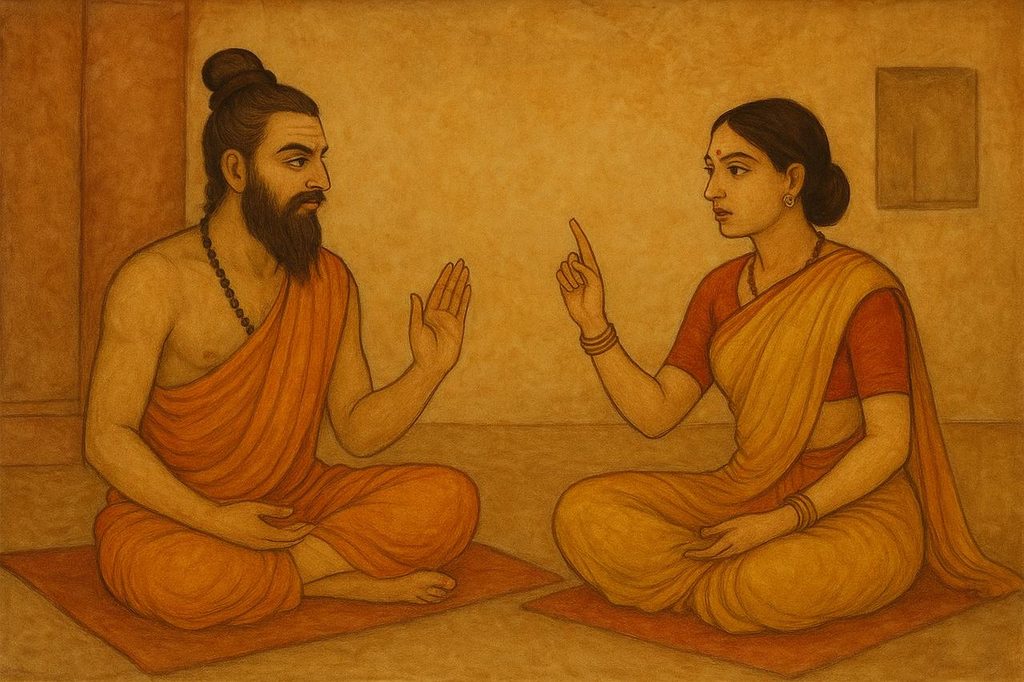
One of the most important episodes in the Brihadaranyaka Upanishad is the conversation between Yajnavalkya and his wife Maitreyi.
The story begins when Yajnavalkya prepares to leave household life and move toward a life devoted to spiritual pursuit. He discusses the division of his possessions with Maitreyi and another wife, Katyayani, according to the text.
Maitreyi then raises a profound question: If she possessed all the wealth in the world, would that make her immortal?
Yajnavalkya explains that wealth may provide comfort and material advantages, but it cannot by itself grant spiritual immortality.
Maitreyi wants to understand the truth rather than simply receive property. She asks Yajnavalkya to teach her what he knows about the Self.
What does this story teach us?
First, wealth has limits. Money can help people meet their needs, but it cannot answer every question about existence, death, or the purpose of life.
Second, questions are part of learning. Maitreyi is not portrayed as someone who blindly accepts an answer. She asks questions and seeks clarification.
Third, spiritual knowledge is not limited to men. Maitreyi is an important philosophical participant in one of the best-known Upanishadic dialogues. Her role shows that women also appear as serious seekers of spiritual knowledge in ancient Indian literature.
Fourth, relationships can lead to deeper inquiry. The conversation begins within a household but moves toward universal questions about love, identity, and the Self.
Sanskrit Documents
+1
- Why Did Yajnavalkya Say That We Love Others Through the Self?
A striking idea in the Maitreyi dialogue is that a husband, wife, children, wealth, and other things are dear to us in relation to the Self.
This teaching can be misunderstood if it is taken to mean that we should care only about ourselves.
A more careful reading is that Yajnavalkya is asking what makes anything meaningful or lovable to us. He directs Maitreyi to investigate the Self as the deeper basis of experience.
In everyday life, consider a family. People may love one another because of affection, trust, shared memories, care, and responsibility. But if they never examine the nature of love, identity, and attachment, they may assume that relationships are only about possession or control.
Yajnavalkya’s inquiry takes the question deeper: What is the source of the experience through which we know, value, and love?
This is a philosophical teaching, not a reason to neglect family duties or treat other people as unimportant. It invites deeper understanding of the Self and the meaning of relationships.
- Yajnavalkya and Gargi: The Great Debate at King Janaka’s Court
gujaratsamachar
Yajnavalkya is also famous for his philosophical debates at the court of King Janaka.
In the Brihadaranyaka Upanishad, King Janaka hosts learned discussions in which sages examine difficult questions about reality and spiritual knowledge.
One of the most memorable questioners is Gargi Vachaknavi, a learned woman who challenges Yajnavalkya with questions about the foundation of the universe.
Her questions investigate what the world is “woven on,” moving through layers of explanation toward the ultimate basis of existence.
The exchange is important because it presents philosophy as a serious examination of difficult questions. Gargi is not merely a listener; she challenges the sage in public debate.
Yajnavalkya also engages with other learned people, including Uddalaka Aruni, in discussions about knowledge and reality.
Sanskrit Documents
+1
What can we learn from this episode?
Knowledge should be examined through questions and reasoning.
A respected teacher should be able to explain difficult ideas.
Spiritual discussion is not limited to rituals; it can include the nature of reality itself.
Women such as Gargi and Maitreyi are significant figures in the philosophical literature of ancient India.
The text presents Yajnavalkya as an exceptionally confident debater. Readers can still appreciate the intellectual importance of the dialogue while examining the style and assumptions of ancient texts critically.
- What Was Yajnavalkya’s Relationship With King Janaka?
King Janaka of Videha is portrayed in the Upanishadic tradition as a ruler who seeks spiritual understanding.
Yajnavalkya visits Janaka’s court and takes part in discussions about Brahman, knowledge, and liberation. Janaka respects his wisdom, and their exchanges are among the most famous teacher-and-king dialogues in ancient Indian philosophy.
The relationship also challenges the idea that spiritual inquiry must belong only to people who live in forests or abandon all social responsibilities. In these stories, a king can pursue wisdom while living within a royal setting.
At the same time, Yajnavalkya’s own movement toward renunciation suggests that material responsibilities and spiritual pursuits can lead people toward different ways of life.
The broader lesson is that social position alone does not establish spiritual knowledge. A person must still ask questions, learn, reflect, and examine the nature of reality.
- Which Gods Did Yajnavalkya Worship?
Yajnavalkya is associated with Vedic religious practices and the pursuit of spiritual knowledge. Several deities appear in the traditions connected with his life and teachings.
Surya Bhagwan
Surya is central to the traditional account explaining how Yajnavalkya received the knowledge associated with the Shukla Yajurveda. The story emphasizes devotion and disciplined learning.
Aditya
Aditya is a name associated with the Sun in Vedic and Hindu traditions. Sun worship is an important part of the wider religious setting in which Yajnavalkya is remembered.
Vedic deities and sacrificial tradition
The Yajurveda is closely connected with Vedic ritual and contains mantras used in sacrificial ceremonies. Yajnavalkya’s tradition belongs to this broader religious world.
vedicheritage.gov.in
+1
It is important to distinguish the different sources. The Surya story is a traditional account of how Yajnavalkya obtained Vedic knowledge; the Upanishads preserve his philosophical teachings; and the wider Vedic literature includes prayers and rituals dedicated to various deities.
There is no reliable historical record establishing exactly how many years he worshipped a particular deity, how many times he repeated a mantra, or the precise length of every period of his spiritual practice.
- Which Mantras Are Associated With Yajnavalkya?
Yajnavalkya is best known for philosophical teachings rather than for a single personal mantra that can be historically verified as his own invention.
The following expressions are relevant to understanding his tradition.
- “Neti, Neti”
नेति नेति
Meaning: “Not this, not this.”
This is a philosophical expression used in the Brihadaranyaka Upanishad to explain why the ultimate Self cannot be fully captured by ordinary descriptions.
The Living Bread
+1
- “Aham Brahmasmi”
अहं ब्रह्मास्मि
Meaning: “I am Brahman.”
This famous Upanishadic statement expresses a profound insight about the Self and ultimate reality. It appears in the Brihadaranyaka Upanishad (1.4.10).
- “Asato Ma Sadgamaya”
असतो मा सद्गमय
Meaning: “Lead me from the unreal to the real.”
This prayer appears in the Brihadaranyaka Upanishad (1.3.28). It is widely recited in Hindu traditions as a prayer for truth, light, and spiritual understanding.
These are important expressions from the text or tradition associated with Yajnavalkya. They should not all be described as mantras personally composed by him.
The Gayatri Mantra is also important in Vedic tradition and is associated with Savitr, the divine solar power. However, it is not correct to claim without evidence that Yajnavalkya invented it.
- Did Yajnavalkya Write Any Books?
Yajnavalkya is associated with several important texts, but the historical question of authorship requires care.
Text
Main subject
Connection with Yajnavalkya
Shukla Yajurveda / Vajasaneyi Samhita
Vedic mantras and ritual traditions
Traditionally associated with his teaching lineage
Shatapatha Brahmana
Vedic ritual, symbolism, and religious explanations
Features Yajnavalkya in important discussions
Brihadaranyaka Upanishad
Atman, Brahman, knowledge, death, and liberation
Preserves his famous philosophical dialogues
Yajnavalkya Smriti
Conduct, legal matters, duties, and penance
Traditionally attributed to him, but its historical authorship is uncertain
The Yajnavalkya Smriti is particularly worth distinguishing from the much older Vedic and Upanishadic traditions. Scholars generally date the surviving work to a much later period than the ancient sage traditionally associated with it. It is a legal and religious text arranged into three main sections: conduct (achara), legal procedure (vyavahara), and penance (prayashchitta).
Wikipedia
+1
Thus, when we say “Yajnavalkya wrote this,” it is often more accurate to say “this text is traditionally attributed to Yajnavalkya” unless there is specific historical evidence for authorship.
- What Did Yajnavalkya Teach About Death and the Soul?
Yajnavalkya’s discussions of the Self include questions about death, consciousness, and what makes a person more than the physical body.
The Upanishadic view explores whether the deepest Self can be reduced to the things we ordinarily perceive: the body, the senses, thoughts, and changing experiences.
The text also discusses rebirth and the consequences of action within its broader religious and philosophical worldview. These are teachings of the Upanishadic tradition, not conclusions established by modern scientific methods.
A practical way to understand the inquiry is to ask:
Does a person’s identity consist only of physical appearance?
How much do memories, thoughts, and emotions change over time?
What is the relationship between consciousness and the body?
Can a person gain freedom from fear and attachment through deeper understanding?
Yajnavalkya’s teaching does not give us a scientifically verified method for identifying every past birth or discovering the complete history of a soul. Instead, the philosophical emphasis is on understanding the Self and the nature of reality.
- Can a Person See All Their Previous Births Through Knowledge of the Soul?
This question is related to ideas found in Hindu traditions about rebirth, karma, and spiritual knowledge.
However, Yajnavalkya’s best-known teachings do not establish that every person who understands the Self will automatically remember all previous births.
The emphasis is on liberation through knowledge, not on collecting information about past lives.
In spiritual practice, knowledge of the Self is generally understood as a transformation in understanding. A person may become less attached to status and possessions, more aware of the limitations of the ego, and more focused on truth and ethical living.
Claims about remembering previous births belong to religious and spiritual traditions and should not be presented as scientifically proven facts.
- How Long Did Yajnavalkya Live?
There is no reliable historical record that establishes Yajnavalkya’s exact birth year, death year, or lifespan.
He is associated with the ancient Vedic period, but dating figures from this period is difficult. The texts that preserve his teachings developed over time, and the date of a text is not necessarily the date of the person portrayed in it.
For the same reason, we cannot reliably state:
His exact age at birth or death
The exact number of years he lived in an ashram
The number of years he spent studying under each teacher
The exact number of years he practised meditation or worship
Traditional narratives may give additional details, but these should be labelled as traditional accounts rather than confirmed historical chronology.
- Was Yajnavalkya Part of the Ramayana or Mahabharata?
Yajnavalkya’s principal importance is in Vedic literature, the Brahmanas, and the Upanishads.
He is not a central character in the main stories of the Ramayana or the Mahabharata in the way that Rama, Sita, Krishna, Arjuna, or Bhishma are. His legacy is primarily philosophical and religious rather than epic.
It is also important to remember that ancient Indian literature includes many layers of tradition, later retellings, and texts attributed to revered sages. A name appearing in a later text would not by itself prove that the person was a central character in an earlier epic.
- How Can We Apply Yajnavalkya’s Teachings in Everyday Life?
Yajnavalkya’s philosophy can inspire practical reflection even for people who do not interpret every teaching in exactly the same way.
Do not judge yourself only by possessions. Wealth and status can change, so they should not become the only measure of a person’s worth.
Keep asking meaningful questions. Like Maitreyi and Gargi, be willing to investigate ideas rather than accept every claim without reflection.
Learn with humility. Knowledge becomes more valuable when it leads to understanding rather than pride.
Examine your thoughts and emotions. Notice that feelings and opinions can change, and avoid treating every passing thought as the whole truth.
Balance worldly duties with inner development. Spiritual inquiry does not have to mean neglecting family, work, or responsibility.
Respect sincere seekers of knowledge. The dialogues with Maitreyi and Gargi remind us of the importance of serious inquiry, including women’s participation in philosophical discussion.
Seek understanding, not just religious labels. Learning the meaning of a mantra or teaching can be more valuable than repeating words without understanding them.
- The Deeper Meaning of Yajnavalkya’s Philosophy
The most powerful aspect of Yajnavalkya’s legacy is the way he directs attention toward the questions beneath everyday life.
People spend years building their identities around work, family, wealth, reputation, and achievement. These things matter in ordinary life, but they do not necessarily answer every question about existence.
Yajnavalkya asks the seeker to look deeper.
Who is the one who experiences happiness and sorrow? What is the Self? What is the relationship between individual existence and the ultimate reality? Can the truth be fully expressed through words, or must it be investigated through direct understanding?
The teachings of Atman, Brahman, and Neti, Neti belong to a long philosophical tradition that continues to influence Hindu thought today.
They are not merely slogans. They invite reflection, careful study, and an honest examination of what we mean when we say, “I am.”
Conclusion: Yajnavalkya Rishi’s Lasting Message
Yajnavalkya Rishi is remembered as a great sage because his teachings reach beyond ritual and ask fundamental questions about the Self, knowledge, and liberation.
The story of Surya Bhagwan explains his traditional connection with the Shukla Yajurveda. His dialogue with Maitreyi explores why wealth alone cannot provide spiritual immortality. His debate with Gargi shows the importance of challenging questions. His teachings on Neti, Neti encourage seekers not to confuse the ultimate Self with changing descriptions of the world.
His legacy is preserved most clearly in the Brihadaranyaka Upanishad and the wider Vedic tradition. His exact lifespan and many details of his personal history remain uncertain, so it is important to distinguish traditional stories from verifiable history.
Perhaps the simplest way to understand his message is this: do not stop at the outer identity of a person or the surface appearance of life. Ask deeper questions, seek knowledge with humility, and examine the nature of the Self.
For readers interested in Hindu philosophy, Yajnavalkya remains an important guide to the enduring questions of consciousness, reality, and spiritual freedom.
Further reading
Vedic Heritage Portal — Yajurveda
: background on the Yajurveda and the traditional story connecting Yajnavalkya with the Shukla Yajurveda.
Brihadaranyaka Upanishad
: text and selected teachings, including the dialogues associated with Yajnavalkya and Maitreyi.
Brihadaranyaka Upanishad — study text
: a longer text for readers who want to explore the philosophical discussions in more detail.