
Eco-Friendly Navratri, Durga Puja and Ganesh Visarjan:
Introduction: Faith and Nature Should Go Together
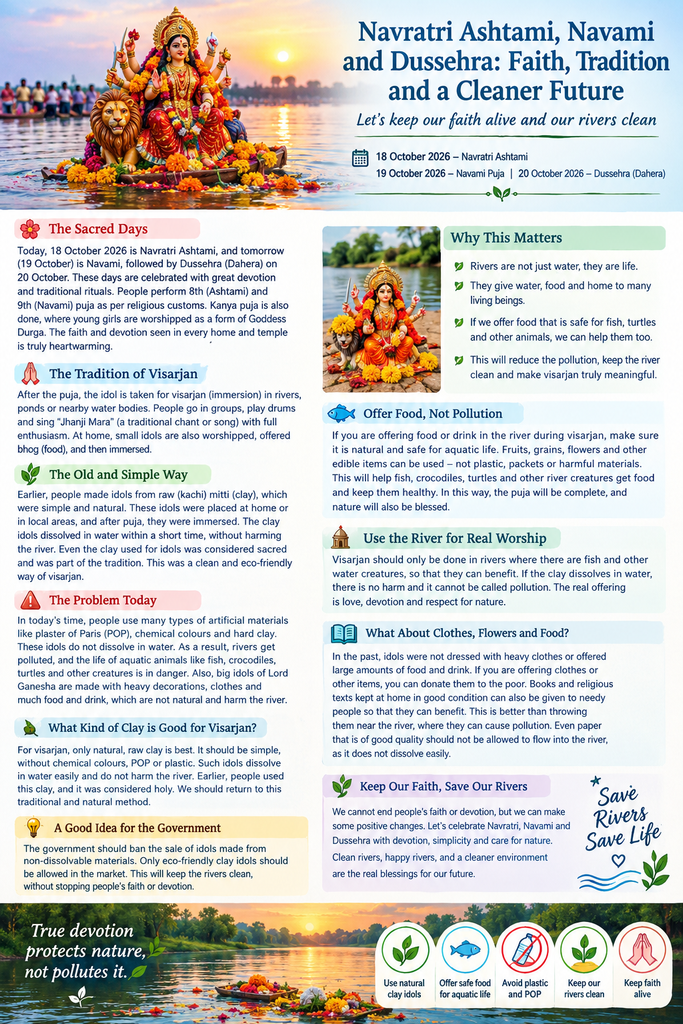
Today is October 18, 2026. During Navratri, devotees worship Goddess Durga with great devotion and follow their family traditions. Ashtami is observed on the eighth day, Navami on the ninth day, and Vijayadashami, also known as Dussehra, on the tenth day of the festival. Many families perform Ashtami and Navami puja, worship young girls as a form of the Goddess, offer bhog, and pray for the happiness and well-being of their families. Customs vary from region to region.
During these celebrations, many people also establish idols of Goddess Durga, Jhansi Mata, or Lord Ganesha in their homes and community pandals. After the worship is complete, the idols are immersed in water through a ritual known as visarjan.
However, we should also think about the rivers, ponds, fish, turtles, crocodiles, and other living creatures that depend on clean water. Religious faith is important, but protecting nature is also a responsibility. We should celebrate our festivals in ways that preserve both our traditions and the environment.
“Explain the meaning of visarjan (immersion). What kind of things should be offered into the river that can easily decompose and are biodegradable? Only clay that easily dissolves in water should be used. Idols made of Plaster of Paris (PoP) should not be worshipped as they are not truly sacred; clay is what is truly sacred. For making idols, different types of natural clay should be mixed together to ensure they are completely water-soluble, so the idol can be beautifully crafted and then safely immersed.”
Key Concepts Explained
- Meaning of Visarjan (Immerisom): Visarjan means the respectful farewell and return of the deity’s energy back into nature. In Hindu traditions, it symbolizes the eternal cycle of creation and dissolution—reminding us that everything comes from nature and must eventually return to it.
- Why Clay (Mitti) is Sacred: Natural clay represents the earth element (Prithvi). It holds spiritual purity because it can easily absorb water and melt back into the ground without leaving a trace, maintaining the cosmic balance.
- The Issue with Plaster of Paris (PoP): PoP is chemically processed, does not dissolve in water for months, and releases toxic chemicals that harm aquatic life. Worshipping and immersing PoP idols contradicts the core spiritual philosophy of respecting nature.
Eco-Friendly Materials for Visarjan
To ensure the offerings are 100% biodegradable and water-soluble, you can use:
- Shadu Mati / Clay: Traditional river mud that dissolves within hours.
- Natural Binder Ingredients: Adding cow dung (gobar), turmeric, and sandalwood paste helps strengthen the clay naturally.
- Plant Seeds: Embedding seeds inside the clay idol turns the immersion into a source of new plant life when dissolved in a pot at home.
Would you like some recipes or steps on how to mix different types of natural clay to make a strong, water-soluble idol at home?
1. How People Traditionally Made Idols for Visarjan
In earlier times, many families used simple, unbaked clay to make small idols for home worship. These idols were generally made from natural materials, with limited decoration. When immersed in water, the clay could gradually soften and disperse, depending on the type of soil and the water conditions.
People often used a small quantity of flowers and other offerings. They did not always need elaborate decorations, expensive materials, or large quantities of food to express their devotion.
The simplicity of these traditions offers an important lesson: the value of worship does not depend on how expensive or impressive an idol is. Faith, prayer, kindness, and responsible behaviour are also meaningful parts of religious life.
2. Why Modern Idols Can Cause Water Pollution
Today, some idols are made using plaster of Paris (POP), synthetic paints, chemical colours, plastic decorations, glitter, metal accessories, and other materials that do not break down easily in water.
These materials can create several problems:
- Plaster of Paris: It does not dissolve as readily as natural clay and may leave solid fragments in water.
- Chemical paints: Some paints may contain harmful substances, including certain heavy metals, that can contaminate aquatic environments.
- Plastic and glitter: These materials can persist in the environment and contribute to plastic pollution.
- Cloth, thermocol and decorative accessories: These can become waste that must be collected and removed after immersion.
- Excessive offerings: Large quantities of food, flowers, packaging, and other materials can increase the burden on rivers and ponds.
When many idols are immersed at the same location, the combined waste can make cleaning more difficult. The effects depend on the materials used, the number and size of the idols, and the condition of the water body.
This is why the choice of material matters. A beautiful idol should not become a source of long-lasting pollution.
3. Which Clay Is Best for Making an Eco-Friendly Idol?
For a traditional water-immersion ritual, natural, untreated, unbaked clay without synthetic additives is generally a better choice than plaster of Paris or a chemically coated idol.
Suitable materials may include locally sourced natural clay or clean clay-rich soil that is appropriate for idol-making. However, not every type of soil is automatically safe. Soil contaminated with industrial waste, sewage, pesticides, or other pollutants should not be used.
An environmentally responsible idol should ideally have the following features:
- It is made from natural, untreated clay.
- It contains no POP, plastic, thermocol, or synthetic glitter.
- Its colours are made from verified, non-toxic materials.
- Its decorations are minimal and biodegradable.
- It is small enough to be immersed safely in an authorised location.
- It is designed to break down naturally without leaving persistent waste.
Even natural clay does not necessarily disappear immediately. The speed of breakdown depends on the clay composition, the thickness of the idol, and the water conditions.
For this reason, buyers should ask sellers what the idol is made of instead of relying only on labels such as “natural,” “green,” or “eco-friendly.”
4. Why Small, Simple Idols Can Be a Better Choice
Some devotees commission very large idols of Lord Ganesha or Goddess Durga. Large idols can be beautiful expressions of art and devotion, but they may also require more material, paint, decoration, transport, and waste management.
A small clay idol can be equally meaningful for a family performing puja at home. Communities can also consider using appropriately sized idols that are easier to handle and immerse responsibly.
The aim should not be to discourage devotion or artistic creativity. Instead, we should encourage people to think about the environmental cost of the materials they choose.
There is no need to measure someone’s devotion by the size of an idol, the quantity of decorations, or the amount of money spent on offerings.
5. What Should We Do With Flowers, Food and Other Offerings?
Flowers, leaves, fruit, sweets, and other offerings are commonly used in religious ceremonies. However, placing large quantities of these materials into rivers can contribute to waste, especially when they are mixed with plastic, packaging, synthetic thread, or chemical decorations.
A more responsible approach is to separate offerings according to their material.
- Collect flowers and leaves separately for suitable composting where possible.
- Keep plastic wrappers, synthetic cloth, thermocol, and other non-biodegradable materials out of the water.
- Donate usable food to people in need through safe and appropriate channels.
- Avoid throwing large quantities of cooked food into rivers or ponds.
- Follow local rules for collecting and disposing of puja materials.
Some people believe that offerings should be placed in water because it is part of their tradition. Where that custom is followed, devotees should use designated immersion facilities and follow the guidance of local authorities.
We should remember that natural materials can also affect water quality when large quantities accumulate or decompose. Therefore, biodegradable does not automatically mean suitable for disposal in a river.
6. Should We Put Food Into Rivers to Feed Fish, Turtles and Crocodiles?
Fish, turtles, crocodiles, and many other aquatic creatures depend on healthy rivers and ponds. Protecting their habitat is a valuable responsibility.
However, throwing food into a river is not necessarily a good way to feed aquatic animals. Human food, sweets, oily dishes, and large quantities of cooked offerings can pollute water, disturb natural feeding patterns, and attract animals to unsafe places.
Crocodiles, in particular, are wild predators. People should never approach them or deliberately feed them. Feeding crocodiles can endanger both humans and animals.
The better approach is to protect aquatic habitats, prevent waste from entering the water, and allow wildlife to obtain its natural food. If feeding is part of an authorised conservation programme, it should be done only under the guidance of wildlife professionals.
Devotion should encourage compassion for living beings, not create new risks for them.
7. What About Clothes Offered to Idols?
Some devotees dress idols in beautiful garments, sarees, jewellery, and decorative fabrics. Such offerings can be an important expression of personal faith.
After the festival, usable clothes may be donated to people in need if they are clean, suitable, and offered respectfully. Communities can organise collection points for reusable garments and decorations.
However, synthetic fabric, plastic jewellery, and other non-biodegradable items should not be immersed in rivers. They should be collected and reused or disposed of through appropriate waste-management systems.
The same principle applies to other religious materials: what can be reused, donated, or recycled should be handled responsibly instead of being discarded in water.
8. Should Governments Ban Polluting Idol Materials?
Governments and local authorities have a legitimate role in protecting rivers, lakes, and public health. They can establish clear rules for idol-making, materials, immersion sites, and waste collection.
Instead of treating all religious idols in the same way, regulations can focus on materials that create persistent pollution.
Possible measures include:
- Restricting or prohibiting POP idols where required by applicable environmental rules.
- Establishing standards for natural clay and verified non-toxic paints.
- Requiring sellers to disclose the materials used in their idols.
- Providing designated immersion tanks or artificial ponds.
- Collecting leftover idol fragments and decorations after immersion.
- Encouraging reusable decorations and small, simple idols.
- Educating artisans, shopkeepers, devotees, and community organisers.
Any proposed ban should be based on environmental evidence and implemented under the applicable laws and official guidance. Authorities should also help traditional artisans shift towards safer materials instead of placing the entire burden on them.
The objective should be to reduce pollution while allowing people to continue their religious practices responsibly.
9. Why Religious Books and Paper Should Also Be Protected From Waste
During festivals and religious gatherings, people may distribute prayer books, pamphlets, calendars, and other printed materials. These items can spread knowledge and help future generations learn about religious traditions.
If people have extra books that are still in good condition, they can donate them to libraries, schools, community centres, or people who want to read them.
Damaged or unusable paper can be sent for recycling where facilities are available. Paper quality, coatings, binding, and contamination can affect whether it is recyclable.
Books should not be left beside rivers or thrown into water as a form of religious respect. Keeping religious literature clean, preserving it, and sharing its knowledge with others are practical ways to honour it.
10. How Can Families Celebrate Navratri and Dussehra Responsibly?
Every family can take a few simple steps without giving up its traditions.
Before the festival
- Choose an idol made from natural, untreated clay.
- Avoid plastic decorations, synthetic glitter, and unnecessary packaging.
- Use a reasonable quantity of flowers and other offerings.
- Find out where the local authority permits immersion.
During the festival
- Keep the worship area clean.
- Separate reusable materials from waste.
- Avoid wasting food and drinking water.
- Encourage children to learn about both religious traditions and environmental responsibility.
After the festival
- Immerse the idol at an authorised site.
- Do not leave clothes, plastic, or decorative materials in the river.
- Donate reusable garments, books, and household items where appropriate.
- Participate in community clean-up activities if they are organised safely.
These steps can help families celebrate with devotion while reducing unnecessary damage to nature.
11. A Shared Responsibility for Society
Environmental protection should not be the responsibility of the government alone. Idol makers, shopkeepers, festival committees, religious leaders, families, schools, and local communities all have a role to play.
Artisans can develop idols from safer materials. Sellers can provide honest information about their products. Festival committees can arrange waste collection and designated immersion facilities. Families can choose simpler decorations and avoid dumping waste into rivers.
Schools and community groups can also explain how pollution affects aquatic animals, drinking-water sources, and the wider environment.
The government should provide clear guidance and practical facilities so that people are not left wondering how to follow their traditions without harming nature.
Conclusion: Preserve Faith, Protect Rivers
Navratri, Durga Puja, Ganesh Chaturthi, and Dussehra hold deep meaning for millions of people. Their celebrations bring families and communities together through prayer, tradition, music, and devotion.
We do not need to abandon these festivals to protect the environment. We need to make thoughtful choices about the materials we use and the way we dispose of them.
Natural clay, safer colours, smaller idols, reusable decorations, responsible offerings, and authorised immersion facilities can all help reduce pollution. Donating usable clothes and books can also turn excess possessions into something useful for others.
The most important lesson is that faith and responsibility can go together. We can worship our deities with a sincere heart while also caring for the rivers, animals, trees, and people around us.
True devotion should inspire us to protect the world in which we live. If we want future generations to celebrate these festivals with the same joy and faith, we must also leave them cleaner rivers and a healthier environment.