…
Diwali 2026: The Festival of Lights, the Story of Lord Rama, and the Message of a Safe, Healthy and Pollution-Free Celebration
Celebrating Diwali with devotion, family, kindness, cultural values and environmental responsibility.


1. Introduction: Diwali Is More Than a Festival of Lights
Diwali is one of the biggest and most widely celebrated festivals in India. It is a festival of happiness, devotion, hope, new beginnings and togetherness. Every year, millions of families celebrate it with great enthusiasm. People clean and decorate their homes, light diyas, prepare sweets and traditional dishes, purchase new clothes, visit relatives and worship Goddess Lakshmi and Lord Ganesha.
In 2026, according to the dates mentioned for this celebration, Chhoti Diwali is on 7 November, Badi Diwali is on 8 November, and Govardhan Puja follows on 9 November. The festival brings several days of religious and cultural activities.
However, we should ask ourselves an important question: Does celebrating Diwali mean only buying expensive things, eating sweets and bursting firecrackers, or does it also mean understanding our history, respecting others and spreading happiness?
The real beauty of Diwali is not measured by how many firecrackers we burst or how much money we spend. It is reflected in the happiness we bring into other people’s lives.
2. The Story of Lord Rama and the Victory of Good Over Evil

Diwali is traditionally associated with the return of Lord Rama to Ayodhya after fourteen years of exile and his victory over Ravana.
According to the Ramayana, Lord Rama was the son of King Dasharatha of Ayodhya. He accepted exile to honour his father’s promise. His wife Sita and younger brother Lakshmana accompanied him into the forest.
Their life in exile was not easy. They faced many difficulties, travelled through forests, met sages and experienced several struggles.
The story took a dramatic turn when Ravana, the king of Lanka, abducted Sita. Lord Rama, with the help of Lakshmana, Hanuman and the Vanara army, travelled towards Lanka. A great battle followed, and Ravana was eventually defeated.
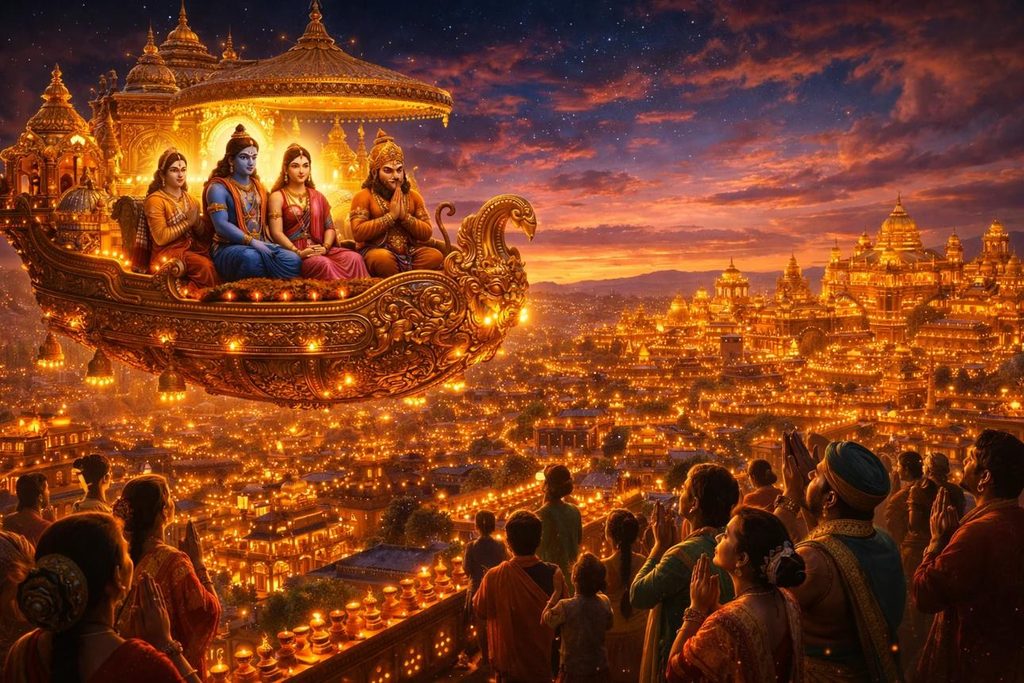
After completing his exile, Lord Rama returned to Ayodhya with Sita and Lakshmana. According to the traditional account, the people of Ayodhya welcomed them by lighting rows of earthen lamps.
That is why Diwali is remembered as a celebration of light overcoming darkness, truth overcoming falsehood and good overcoming evil.
The story also gives us a lesson: life is not always easy, but courage, patience, duty and truth help a person face difficult situations.
3. Ravana: A Great Scholar and Devotee of Lord Shiva

Ravana is an interesting and complex character in the Ramayana. He was traditionally described as a Brahmin, a learned scholar, a powerful king and a great devotee of Lord Shiva.
He had knowledge of the Vedas and several other subjects. His devotion to Mahadev is remembered in Hindu traditions, and the Shiva Tandava Stotram is traditionally associated with him.
According to popular religious accounts, Ravana offered intense penance to Lord Shiva. The story describes how he offered his heads during his devotion and eventually received divine blessings and powerful weapons.
There is an important distinction here: Ravana’s devotion and knowledge were remarkable, but his actions were not always righteous.
His abduction of Sita was wrong. No person’s devotion, scholarship, power or social position gives them the right to take away another person’s freedom or dignity.
This is one of the most meaningful lessons of the Ramayana.
A person may have great knowledge, wealth and religious devotion, but character is judged by how that person treats others.
Ravana is also remembered in some traditions for his ambition to improve the world. Stories about his imagined golden Lanka and other aspirations have become part of popular discussions about his character. We should distinguish these traditional and later stories from what the original Ramayana actually establishes.
His story reminds us that intelligence without self-control can become destructive.
4. What Should We Learn from Lord Rama and Ravana?
Both characters offer lessons that remain relevant today.
| Lord Rama | Ravana |
|---|---|
| Represents duty and righteousness | Represents scholarship and great power |
| Respected promises and responsibilities | Allowed pride to influence his decisions |
| Protected Sita’s dignity and freedom | Violated Sita’s freedom |
| Showed patience and courage | Shows the dangers of ego and uncontrolled ambition |
| Is remembered as Maryada Purushottam | Is remembered as a complex character |
We should not understand Diwali only as a story about burning an effigy. We should also understand the deeper message: remove dishonesty, arrogance, injustice, greed and cruelty from our own behaviour.
If someone lights hundreds of lamps but continues to hurt their family, exploit workers or disrespect women, that person has not understood the deeper message of Diwali.
5. Diwali Traditions: Diyas, Worship, Sweets and Family Celebrations


Diwali is celebrated differently across India’s regions, communities and families. Some common traditions include:
- Lighting clay diyas and decorating homes.
- Performing Lakshmi and Ganesha puja.
- Making rangoli with flowers and coloured powders.
- Preparing sweets and traditional food.
- Buying clothes, utensils, household items and gifts.
- Visiting relatives, friends and neighbours.
- Donating food, clothes and money to people in need.
- Sharing happiness with children and elderly family members.
People also celebrate Chhoti Diwali, Govardhan Puja and Bhai Dooj as part of the wider festive period.
Traditional games and activities
Children and adults enjoy games, family competitions, storytelling, singing, dancing and preparing festive decorations. These activities can make the festival memorable without putting anyone in danger.
The important thing is that everyone in the family should feel included.
6. Govardhan Puja: The Message of Nature and Gratitude

Govardhan Puja is associated with Lord Krishna and the Govardhan mountain.
According to the Bhagavata Purana tradition, Lord Krishna encouraged the people of Vrindavan to respect Govardhan, nature, cattle and the resources that supported their lives.
The story teaches us to recognise the importance of nature, soil, water, forests, animals and agriculture.
Today, this message is especially important. Human beings depend on nature for food, water, oxygen and survival. We should not worship nature on one day and destroy it throughout the rest of the year.
Taking care of cows and other animals, protecting trees, reducing waste and keeping rivers clean are also meaningful ways to respect the spirit of Govardhan Puja.
7. Firecrackers: The Hidden Cost Behind a Few Minutes of Celebration


Firecrackers have become a major part of modern Diwali celebrations. Some families spend thousands of rupees purchasing rockets, bombs, flowerpots, sparklers and other fireworks.
But have we ever thought about the people who manufacture these products?
A firecracker that burns for a few seconds may take considerable time and labour to manufacture. The process involves handling chemicals, preparing materials, filling fireworks, packaging and transporting them.
Many workers come from economically weaker families. For some, this seasonal employment is an important source of income. We should understand their economic difficulties while also asking whether their working conditions are safe.
Where are most Indian firecrackers manufactured?
Sivakasi in Tamil Nadu is India’s most important organised fireworks manufacturing centre.
A November 2026 Business Standard report estimates the Sivakasi fireworks industry’s annual turnover at approximately ₹7,000 crore.
The report also mentions:
- More than 1,070 licensed manufacturing units.
- Approximately 300,000 direct workers.
- Nearly 500,000 families supported by the wider industry.
- Around 85% of India’s organised fireworks trade associated with Sivakasi.
These figures are industry estimates, not a complete audited count of every fireworks manufacturer in India.
Industry News – Business Standard+1
How much money does the industry earn?
The fireworks business involves more than factory owners. It also provides work to:
- Raw-material suppliers.
- Packaging and printing businesses.
- Factory employees.
- Transport companies.
- Wholesale traders.
- Retail shopkeepers.
- Seasonal distributors.
According to the November 2026 report, nearly 80% of Sivakasi’s annual sales come from the Diwali market. The wider distribution and retail network also contributes substantially to the final selling price.
Industry News – Business Standard+1
India’s firecracker exports and imports
There is an interesting difference between domestic consumption and international trade.
According to a November 2026 Business Standard report, India’s recorded fireworks exports were approximately $757,000 annually, based on the trade data discussed in the report. More than 99% of Indian production is consumed domestically.
China dominates the international fireworks export market, while India has a much smaller share. Vietnam, Bulgaria and the United States are among the destinations mentioned for Indian exports.
Industry News – Business Standard
It is important not to confuse the value of the entire domestic fireworks business with the value of exports. They measure two different things.
Do people in other countries celebrate Diwali?
Yes. Diwali is celebrated by Indian-origin communities and Hindu, Jain, Sikh and other communities in many parts of the world.
Countries where Diwali celebrations take place include:
- Nepal
- Singapore
- Malaysia
- Mauritius
- Fiji
- United Kingdom
- United States
- Canada
- Australia
- South Africa
- Trinidad and Tobago
The style of celebration varies. Some people light diyas, organise community events, perform prayers, exchange sweets and decorate their homes. Fireworks are used in some places, but they are not compulsory everywhere.
Diwali’s message is much bigger than fireworks.
8. The Health Risks Faced by Firecracker Factory Workers

This is one of the most important issues that deserves attention.
Firework manufacturing involves potentially dangerous substances and processes. Workers can be exposed to chemical dust, fumes, accidental explosions and fire hazards.
Depending on the materials and level of exposure, possible health problems include:
1. Skin problems: Chemical contact can cause irritation, dermatitis, burns and allergic reactions.
2. Eye injuries: Dust and chemical particles can cause irritation, inflammation and serious eye damage.
3. Breathing problems: Repeated inhalation of dust and chemical fumes may irritate the respiratory system and contribute to chronic breathing difficulties.
4. Hearing damage: Exposure to repeated loud explosions can damage hearing.
5. Hand and finger injuries: Accidental explosions can cause severe burns, fractures and even permanent loss of fingers or hands.
6. Long-term occupational health problems: The effects depend on the particular chemicals, exposure levels, duration and working conditions. Workers should receive proper medical monitoring.
We should remember that not every worker will develop these illnesses. However, dangerous exposure must never be treated as a normal part of earning a living.
What safety arrangements should factories provide?
Factories must follow applicable explosives, occupational safety and environmental regulations.
Important protective measures include:
- Properly designed and licensed manufacturing facilities.
- Training before workers handle hazardous materials.
- Effective ventilation and dust-control systems.
- Appropriate chemical-resistant gloves.
- Protective clothing and suitable footwear.
- Safety goggles or face protection.
- Properly selected respiratory protection when required.
- Firefighting equipment and emergency exits.
- Regular health examinations.
- Safe chemical storage and handling.
- Adequate rest, sanitation and clean drinking water.
A simple cloth mask is not necessarily enough to protect someone from hazardous chemical dust or fumes. Respiratory protection must be selected according to the actual exposure, and it cannot replace proper ventilation and engineering controls.
Gloves also need to be appropriate for the particular chemical. Wearing an unsuitable glove may provide a false sense of security.
What about children working in firecracker factories?
Children should never be employed in hazardous fireworks manufacturing.
Their education, health and safety must come first. Poverty should not force a child to work in a dangerous environment.
Government authorities, factory owners and society must work together to prevent child labour, ensure lawful employment and protect workers’ rights.
The prosperity of a festival should never depend on the suffering of the people who manufacture its products.
9. Diwali Pollution: What Happens When Thousands of Firecrackers Are Burst?


A major concern about modern Diwali celebrations is air pollution.
When fireworks explode, they release smoke, fine particles and gases. Their composition varies according to the product and chemicals used.
Some pollutants associated with fireworks include:
- PM2.5 and PM10 particulate matter.
- Sulphur dioxide.
- Nitrogen oxides.
- Carbon monoxide.
- Metal particles and compounds.
- Other chemical residues.
These pollutants can affect the lungs, heart and respiratory system.
What does scientific research tell us?
A study published in the scientific journal Environmental Science and Pollution Research examined air quality during Diwali.
It reported that average PM10 concentrations during the festival period were 311 micrograms per cubic metre, around 81% higher than on other days in the study.
The research also found a 65% increase in noise levels and an increase in hospital admissions for respiratory symptoms during the observation period.
These are findings from a particular study, not a measurement of every Indian city or every Diwali.
PubMed
Research conducted in Delhi during 2006–2008 also recorded substantial increases in particulate pollution and noise levels on Diwali compared with the pre-festival period.
PubMed
How does pollution affect human health?
| Body part | Possible effects |
|---|---|
| Lungs | Coughing, irritation, asthma attacks and breathing difficulties |
| Heart | Increased strain, especially in vulnerable people |
| Eyes | Burning, redness and irritation |
| Nose and throat | Sneezing, discomfort and inflammation |
| Brain and nervous system | Headache and discomfort from smoke and noise exposure |
| Ears | Temporary or permanent hearing damage from loud explosions |
People with asthma, older adults, infants, children and those with heart or lung conditions can be especially vulnerable.
How many days does Diwali pollution take to disappear?
There is no fixed number of days.
It depends on:
- How many fireworks are used.
- The amount and type of pollutants released.
- Wind speed and direction.
- Temperature and atmospheric mixing.
- Rainfall and humidity.
- Traffic and industrial pollution already present.
Sometimes the smoke disperses relatively quickly. In other situations, especially when the weather is calm and pollutants become trapped close to the ground, poor air quality can continue for several days.
This is why we should not assume that pollution disappears automatically the next morning.
10. Noise Pollution: Are We Protecting Children’s Ears?
A firecracker may appear harmless because it explodes for only a moment. But a sudden loud sound can affect hearing.
The Government of India’s 2026 firecracker safety guidelines explain that extremely loud explosions can cause temporary or permanent hearing loss, ringing in the ears and damage to the eardrum.
The guidelines also warn that some loud crackers can produce sound levels above 150 decibels.
DGHS
Children have developing sensory systems, and loud sudden sounds can frighten them. Babies, older people, hospital patients and people with sensory sensitivities may also experience distress.
What about animals?

Animals do not understand why people are suddenly producing loud explosions.
Dogs may hide, tremble, bark or attempt to escape. Cats may hide for long periods. Birds may become frightened, leave their nests or fly into dangerous surroundings.
Even animals living far away from the fireworks can be disturbed by repeated explosions.
We should remember that animals also have a right to live without unnecessary fear.
How can families protect children and animals?
- Avoid loud firecrackers.
- Keep children away from fireworks.
- Never allow young children to light crackers.
- Keep pets indoors in a comfortable, secure room.
- Close windows when outside noise is high.
- Keep drinking water available for pets.
- Never throw fireworks towards animals.
- Do not leave burning crackers or debris where animals can touch them.
A festival that makes children happy but frightens helpless animals deserves a more thoughtful approach.
11. Green Crackers: Are They Completely Pollution-Free?

Green crackers were developed to reduce the environmental impact of conventional fireworks.
Some recognised formulations include:
- SWAS – Safe Water Releaser.
- STAR – Safe Thermite Cracker.
- SAFAL – Safe Minimal Aluminium.
These formulations are designed to reduce certain emissions compared with conventional fireworks.
Some formulations are designed to reduce particulate emissions by approximately 30–35%, although the actual reduction depends on the product and testing conditions.
Industry News – Business Standard+1
However, we must understand one thing:
Green crackers are less polluting by design, not pollution-free.
They still release emissions and create noise. Therefore, reducing their use is also important.
People should purchase only legally approved products from authorised sellers and check the required certification and QR-code details. A green-coloured package alone does not prove that a cracker is genuine.
12. Sweets and Food Safety: Do We Know What We Are Eating?


Diwali is incomplete for many families without sweets. People purchase laddoos, kaju katli, barfi, peda, gulab jamun, jalebi, gujiya and many other delicious items.
Sweet shops remain busy, and demand increases considerably during the festive season.
But increasing demand also creates opportunities for food adulteration and unsafe food preparation.
What problems can occur in sweets?
- Poor-quality or adulterated khoya.
- Substandard milk and milk products.
- Artificial colours used beyond permitted limits.
- Poor-quality edible oils and fats.
- Unhygienic preparation and storage.
- Expired or improperly stored ingredients.
- Excessive sugar and unsuitable food additives.
The Food Safety and Standards Authority of India (FSSAI) issued a special festive-season advisory on 29 September 2026, asking food safety authorities to increase inspections and sampling of sweets, milk products, ghee, edible oils and other high-demand foods.
Complied AI
How can consumers purchase sweets safely?
- Purchase from clean and reputable shops.
- Check manufacturing and expiry dates on packaged products.
- Check packaging and storage conditions.
- Avoid sweets with unusual smells or visible spoilage.
- Do not purchase products with suspicious colours or poor hygiene.
- Keep milk-based sweets refrigerated as required.
- Consume them within their recommended shelf life.
- Avoid purchasing more sweets than the family can reasonably consume.
Homemade sweets are another good option because families can select their ingredients and control cleanliness.
However, homemade food also needs proper hygiene and storage.
Are sweets healthy?
Sweets provide energy, but most traditional sweets contain substantial amounts of sugar and sometimes saturated fat.
Eating too many can contribute to weight gain and poor blood sugar control. People with diabetes should pay particular attention to portion sizes and their individual dietary advice.
We can celebrate with a small serving instead of turning every festive meal into a sugar-rich feast.
13. Shopping During Diwali: Happiness or Unnecessary Competition?

Diwali is also an important shopping season.
People purchase clothes, jewellery, utensils, electronic goods, furniture, sweets, decorations and gifts.
Shopping supports several businesses, including small shopkeepers, artisans, potters, garment workers, transporters and local manufacturers.
There is nothing wrong with purchasing new things when a family can afford them.
But sometimes shopping becomes a competition. People feel pressure to purchase expensive items because their neighbours or relatives are doing the same.
That is not necessary.
A family can celebrate Diwali beautifully with a few diyas, homemade food and time spent together.
Should we purchase from small businesses?
Yes, whenever possible and when the products meet our needs and budget.
We can support:
- Local potters selling clay diyas.
- Small sweet shops following food safety standards.
- Local tailors and clothing businesses.
- Women running small home-based businesses.
- Artisans making traditional decorations.
- Small farmers supplying flowers and other festive products.
This helps distribute the economic benefits of festivals among more people.
14. Diwali Is Also a Festival of Charity and Helping Others

One of the most meaningful ways to celebrate Diwali is to share our happiness.
There are people who cannot afford new clothes, sweets or even a proper meal. Some elderly people live alone, while many children grow up without adequate resources.
We can make their festival better through small acts of kindness.
For example:
- Donate clean clothes in usable condition.
- Distribute food to people who need it.
- Help elderly neighbours.
- Support children’s education.
- Donate to trustworthy organisations.
- Purchase useful items for economically weaker families.
- Visit relatives who may be lonely.
- Help workers and domestic staff celebrate with dignity.
Donation should not be an opportunity to humiliate anyone. It should be offered with respect.
True charity is not about showing how much money we have. It is about understanding another person’s difficulties.
15. What Should Parents Teach Children About Diwali?

Children learn a great deal by observing their parents.
If parents spend the festival fighting, showing off expensive purchases or bursting dangerous fireworks, children may consider these things normal.
Instead, Diwali can become an opportunity to teach them important values.
Teach children the history of the festival
Tell them the story of Lord Rama, Sita, Lakshmana, Hanuman and Ravana.
Explain why Lord Rama’s return to Ayodhya is remembered and why the victory of good over evil is important.
Children should also understand that religious stories contain moral lessons, not just exciting battles and miracles.
Teach them the importance of nature
Explain why trees, rivers, animals and clean air are important.
Let children decorate their homes using flowers, leaves, reusable materials and clay diyas.
Teach them the value of money
Children should understand that money comes from hard work.
They should not believe that Diwali is successful only when parents purchase expensive gifts.
Teach them respect for workers
Tell them that the clothes they wear, the sweets they eat and the decorations they purchase are made through the hard work of many people.
Every worker deserves respect, fair wages and safe working conditions.
Teach them family values
Encourage children to:
- Spend time with grandparents.
- Listen to family stories.
- Help with household decorations.
- Share food.
- Respect elderly people.
- Speak kindly to everyone.
- Care for animals and plants.
These habits can leave a much stronger impression than expensive fireworks.
16. What Does Diwali Mean for the Older Generation and the New Generation?
Diwali has different meanings for different generations, but its central message remains the same.
| Older generation | New generation |
|---|---|
| Religious traditions and rituals | Understanding the history behind traditions |
| Family gatherings | Strong relationships and communication |
| Traditional food and sweets | Healthy and responsible food choices |
| Diyas and decorations | Eco-friendly celebrations |
| Charity and blessings | Social responsibility |
| Respect for elders | Respect for everyone, including workers and animals |
| Spiritual reflection | Mental peace and responsible living |
We should not force the younger generation to abandon traditions. Instead, we should help them understand why those traditions developed and which values are worth carrying forward.
Similarly, younger people can introduce useful changes without disrespecting their elders.
Culture becomes stronger when knowledge and good values are passed from one generation to another.
17. How Should We Celebrate an Ideal Diwali in 2026?


A beautiful Diwali does not require unnecessary spending or harmful activities.
Here are some practical ideas.
| Activity | Why it matters |
|---|---|
| Light clay diyas | Supports traditional artisans |
| Decorate with flowers | Reduces dependence on disposable decorations |
| Prepare homemade sweets | Greater control over ingredients |
| Share food | Helps people in need |
| Visit family | Strengthens relationships |
| Donate clothes | Supports disadvantaged families |
| Avoid loud fireworks | Protects hearing and reduces distress |
| Plant and care for trees | Supports the environment |
| Keep streets clean | Reduces waste and pollution |
| Spend time with children | Builds memories and teaches values |
Some additional ideas for children
- Organise a Ramayana storytelling session.
- Hold a diya-decoration competition.
- Make rangoli using flowers and natural materials.
- Conduct a small cleanliness activity.
- Teach children how to separate recyclable waste.
- Organise a family cooking activity.
- Give children small responsibilities in preparing the celebration.
This way, children enjoy the festival and learn something useful at the same time.
18. Important Firecracker Safety Rules
If people choose to use fireworks, they must understand that safety is essential.
The Ministry of Health and Family Welfare published its Guidelines for Safe Handling and Use of Firecrackers in India in 2026.
DGHS
Some important precautions are:
- Buy only legally permitted fireworks from authorised sellers.
- Never purchase homemade or suspicious fireworks.
- Follow local government restrictions and permitted timings.
- Never allow children to light fireworks without adult supervision.
- Wear closed shoes and suitable cotton clothing.
- Keep water and sand nearby.
- Use fireworks only in open, designated spaces.
- Never hold explosive crackers in your hands.
- Never point rockets towards people, houses or animals.
- Never relight a failed firecracker.
- Never pick up an unexploded cracker.
- Keep fireworks away from petrol, gas cylinders and other flammable materials.
- Never use fireworks indoors or on balconies.
- Avoid fireworks near hospitals, schools and vulnerable people.
What should you do if someone gets burned?
- Move the person away from the danger.
- Cool the burn under clean, cool running water for around 20 minutes.
- Do not apply toothpaste, butter, oil, ink or household remedies.
- Do not break blisters.
- Cover the injury loosely with a clean, non-stick dressing.
- Seek medical assistance for serious injuries.
For eye injuries, serious burns, breathing difficulties or blast injuries, seek emergency medical care immediately. India’s emergency number is 112.
DGHS
19. The Role of Government and Society
A healthy Diwali cannot be achieved through individual responsibility alone.
Government authorities also have an important role.
They should:
- Enforce fireworks manufacturing and storage regulations.
- Inspect factories and retail outlets.
- Prevent illegal and unsafe fireworks production.
- Protect workers from hazardous exposure.
- Stop child labour.
- Monitor air and noise pollution.
- Enforce permitted fireworks timings.
- Take action against counterfeit products.
- Inspect sweets and other festive food items.
- Provide public awareness campaigns.
- Ensure emergency medical facilities are prepared.
Schools can organise environmental awareness activities. Resident welfare associations can encourage quieter celebrations. Religious organisations can promote the values of kindness, charity and environmental responsibility.
The message should not be that people must stop celebrating Diwali. It should be that celebrations should not unnecessarily harm other people.
20. What Does AI Say About the Meaning of Diwali?
Artificial intelligence can provide information, explain history, compare environmental data and help people understand the consequences of their actions.
But AI cannot replace human feelings, family relationships, faith or personal responsibility.
If we look at Diwali from the perspective of knowledge and humanity, its message can be understood in five ways:
Light in the mind: Remove ignorance and develop knowledge.
Light in relationships: Replace hatred with respect, understanding and affection.
Light in society: Help people who are struggling and treat everyone with dignity.
Light in nature: Protect animals, plants, rivers and the environment.
Light in character: Learn from Lord Rama’s commitment to duty and understand the consequences of Ravana’s pride and wrongful actions.
Technology can help us make better decisions, but people must take responsibility for their choices.
21. Conclusion: Let the Light of Diwali Remain in Our Lives
Diwali is not just one evening of celebration. It is an opportunity to remember our history, respect our culture, strengthen family relationships and bring happiness into other people’s lives.
Lord Rama’s story teaches us about duty, courage and righteousness. Ravana’s story reminds us that knowledge and power are not enough if a person loses control over pride and desires.
The tradition of lighting diyas teaches us that even a small light can make darkness less powerful.
But what is the value of lighting a thousand diyas if we create darkness in someone else’s life?
What is the happiness of bursting expensive fireworks if a child suffers an injury, an elderly person cannot sleep, an animal lives in fear or a worker’s health is damaged while manufacturing them?
We should also remember the people who work hard throughout the year to make our celebrations possible. Their safety, dignity and financial well-being deserve attention.
A good Diwali is one in which children learn something valuable, parents spend time with their families, elderly people feel respected, poor families receive support, workers are treated fairly and nature is protected.
We do not need to spend lakhs of rupees to celebrate a meaningful festival.
A few clay diyas, homemade food, prayers, family conversations, acts of charity and a clean environment can make Diwali beautiful.
This Diwali, let us light diyas in our homes and kindness in our hearts. Let us celebrate the victory of good over evil without creating unnecessary harm to human beings, animals or nature.

A message for every generation:
Celebrate with devotion, spend with responsibility, share with kindness, protect nature and leave behind good values for the next generation.
22. Important Dates and Research Notes for Diwali 2026
One calendar detail deserves clarification before publishing this article.
Different 2026 calendars list some observances differently because of the timing of the lunar tithis.
- 7 November: Some calendars list Chhoti Diwali-related observances.
- 8 November: Diwali and Lakshmi Puja; Naraka Chaturdashi is also listed on this date in several New Delhi calendars.
- 9 or 10 November: Govardhan Puja, depending on the calendar and regional observance.
- 11 November: Bhai Dooj in several published calendars.
The Government of India’s CAG holiday list records Diwali on 8 November and Govardhan Puja on 9 November, while a New Delhi Panchang lists Govardhan Puja on 10 November. Check the local Panchang for the correct puja observance.
Comptroller and Auditor General of India+2
Suggested SEO details for your article
SEO title
Diwali 2026: History of Lord Rama, Ravana, Firecracker Pollution and Eco-Friendly Celebration
Meta description
Discover the history and significance of Diwali 2026, Lord Rama and Ravana, firecracker pollution, worker safety, health risks, traditional celebrations and ways to celebrate an eco-friendly Diwali.
Suggested focus keywords
- Diwali 2026
- History of Diwali
- Lord Rama and Ravana
- Diwali pollution
- Firecracker health risks
- Eco-friendly Diwali
- Diwali celebration in India
- Safe Diwali for children
- Diwali environmental impact
Suggested image alt text
Eco-friendly Diwali celebration with traditional clay diyas, family prayers and environmental awareness.
Recommended sources for further reading
- Government of India – Guidelines for Safe Handling and Use of Firecrackers, 2026.
- Business Standard – India’s fireworks manufacturing industry, November 2026.
- Business Standard – India’s fireworks exports and international trade.
- FSSAI – Special festive food safety advisory, September 2026.
- Scientific research on Diwali pollution and health effects.