

India’s 80th Independence Day: Is India Truly Free,
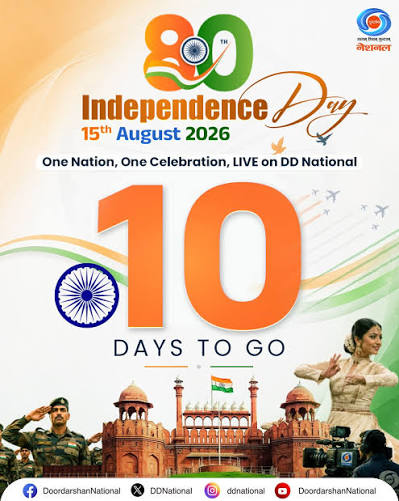
Today is Saturday, 8 August 2026. In just a few days, India will celebrate Independence Day on 15 August. This year is special because India will mark its 80th Independence Day. India became independent on 15 August 1947 after a long struggle against British colonial rule.
But Independence Day should not be only about flags, speeches, patriotic songs and celebrations. It should also be a day when we ask ourselves some difficult questions:
How far has India actually come? Where are we still behind? Are ordinary people truly free from poverty, corruption, unemployment and fear? Is technology improving people’s lives, or are we sometimes using technology only to create the appearance of progress? And what should India do during the next 10, 20 and 30 years?
These questions are not anti-national. In fact, asking honest questions about one’s country can be one of the strongest forms of patriotism.
What Happened on 15 August 1947?
On 15 August 1947, India became independent from British rule. The freedom movement had demanded not merely a change of rulers, but the right of Indians to determine their own future.
The freedom struggle involved famous leaders, but it was not carried by famous people alone. Millions of ordinary Indians participated, sacrificed, protested, went to prison and suffered enormous hardship.
Independence therefore gave India something fundamental: political freedom and the responsibility to decide its own future.
Later, the Constitution provided the framework for a democratic republic based on law, rights, duties and institutions. The Constitution came into force on 26 January 1950.
So the real question today is not whether India is politically independent.
India is.
The more difficult question is:
How much freedom has reached the daily life of every citizen?
Is India Truly Free Today?
India is free from foreign colonial rule, but freedom has many dimensions.
A poor person who cannot afford basic necessities may technically be free, but economic insecurity can severely restrict his choices.
A young person who has education but cannot find suitable employment may be legally free but economically frustrated.
A businessperson who faces corruption may have political freedom but still experience institutional barriers.
A woman who cannot safely move through public spaces does not experience freedom in the same way as someone who feels secure.
A child who receives poor-quality education may have constitutional rights but not the same opportunities as a child receiving excellent education.
Therefore, independence should not be measured only by whether another country controls India.
True independence also means freedom from poverty, fear, corruption, ignorance, unemployment, discrimination, crime and institutional weakness.
India Has Certainly Progressed
It would also be unfair to say that India has made no progress.
India today is dramatically different from India of 1947.
The country has developed major capabilities in:
space technology,
nuclear science,
defence technology,
pharmaceuticals,
digital payments,
telecommunications,
information technology,
manufacturing,
infrastructure,
scientific research,
higher education,
startups and entrepreneurship.
India’s space programme is now involved in increasingly sophisticated missions and research, including work involving artificial intelligence, robotics, human spaceflight and lunar and interplanetary exploration.
India’s economic growth has also been significant. The World Bank reported that India’s growth accelerated to 7.6% in FY2026, while projecting 6.6% growth for FY2027 under its April 2026 outlook.
So it would be wrong to say that India has achieved nothing.
But it would be equally wrong to say that India has solved everything.
Both realities can exist at the same time.
Android Phones and New Technology: Is This Progress?
Walk through an Indian city today and the difference from previous generations is obvious.
Android smartphones, iPhones, high-speed internet, digital payments, online education, online banking, digital government services, artificial intelligence and increasingly sophisticated software have changed everyday life.
A person sitting in a village can communicate with someone on another continent within seconds.
A small shopkeeper can receive digital payments.
A student can access lectures from universities around the world.
A farmer can obtain weather and market information through a phone.
A researcher can collaborate internationally.
This is real progress.
But there is an important warning:
A new phone is not automatically equal to a new society.
If a family owns an expensive smartphone but has poor education, insecure employment and no financial stability, technology alone has not solved its fundamental problems.
Technology is a tool.
Human development is the goal.
Artificial Intelligence: Where Does India Stand?
Artificial intelligence is becoming one of the most important technologies of the modern world.
It is already being used in areas such as:
education,
healthcare,
research,
software development,
translation,
banking,
agriculture,
manufacturing,
customer service,
scientific analysis,
defence,
space research and administration.
India is also building capabilities around AI and digital technology.
But AI should not become another slogan that we use without asking what it actually accomplishes.
The important question is not:
“How many people in India use AI?”
The better questions are:
How many Indian students are using it to learn?
How many researchers are using it to discover something new?
How many small businesses are becoming more productive?
How many government services are becoming faster and more transparent?
How many Indian-language users are getting useful access to knowledge?
That is how technological progress should ultimately be measured.
AI Cannot Decide India’s Future for India
Artificial intelligence can analyse information, compare data and identify patterns. It can help us understand strengths and weaknesses.
But AI cannot replace democratic responsibility.
It cannot decide which values Indians should live by.
It cannot replace elected representatives.
It cannot replace teachers, scientists, judges, entrepreneurs, workers or responsible citizens.
Most importantly, AI can be wrong.
Therefore, India should use AI as an analytical assistant, not as an unquestionable authority.
If we ask technology to tell us whether India is successful, we should still examine the evidence ourselves.
Is India Really Tension-Free?
No country in the world is completely tension-free.
India has major achievements, but it also faces serious challenges.
There are concerns involving:
unemployment and underemployment,
inequality,
corruption,
crime,
pollution,
pressure on natural resources,
educational inequality,
healthcare access,
regional disparities,
social tensions,
misinformation,
infrastructure gaps,
government capacity and implementation.
At the same time, other countries face their own problems: wars, economic crises, ageing populations, political divisions, unemployment, housing costs, inequality and social tensions.
Therefore, comparing India with another country only through one indicator is misleading.
India should compare itself with the best standards in the world, but it should also understand its own circumstances.
What Do the Employment Numbers Tell Us?
Employment is one of the most important tests of development.
According to World Bank reporting based on Indian government estimates, employment rose from about 452 million in 2017–18 to 604 million in 2023–24, while the unemployment rate in that series declined from 6.0% to 3.2%.
The World Bank’s latest country data also reports a modeled ILO unemployment estimate of 4.2% for 2025.
These numbers suggest that India’s employment situation has improved.
But numbers alone do not tell the entire story.
We also need to ask:
Are the jobs permanent or temporary?
Are wages sufficient?
Are workers receiving social security?
Are young graduates finding jobs matching their qualifications?
Are women getting enough opportunities?
Are rural workers receiving productive employment?
Are new technologies creating more jobs than they replace?
Are people moving from low-productivity work to high-productivity work?
Employment quality matters as much as employment quantity.
Has Poverty Really Declined?
There has also been substantial progress in poverty reduction.
The World Bank’s April 2026 India Development Update estimated that poverty under its lower-middle-income-country poverty line declined from 57.7% in 2011–12 to 16.1% in 2023–24.
That is a major change.
But poverty should not be understood only as the absence of extreme deprivation.
A family can move above a poverty threshold and still struggle with:
expensive education,
healthcare costs,
housing,
unstable employment,
inflation,
debt,
transportation,
children’s future.
Therefore, India’s next goal should be more ambitious than merely reducing poverty.
The goal should be to create broad economic security and upward mobility.
Is India’s Progress Only a Show?
This is another uncomfortable question.
Sometimes people see new highways, airports, smartphones, buildings, trains, defence systems or digital platforms and conclude that everything is progressing perfectly.
That conclusion is too simple.
Infrastructure and technology are important. But a country’s development must also be visible in:
the quality of schools, hospitals, courts, police, jobs, research institutions, local administration and everyday public services.
A beautiful building cannot compensate for a weak institution.
A new mobile phone cannot replace education.
A new road cannot replace honest administration.
A missile cannot solve unemployment.
A digital application cannot replace a functioning public-health system.
Development is not one product. It is an ecosystem.
Corruption: One of the Biggest Tests of Independence
Corruption can quietly weaken a country.
When citizens believe that a service requires influence, money or connections, trust in institutions decreases.
Corruption can also discourage honest businesses, delay projects, increase costs and make ordinary people feel powerless.
India needs stronger systems rather than merely stronger speeches.
That means:
transparent procurement,
digital tracking,
effective audits,
independent oversight,
faster investigation,
timely justice,
protection for honest officials,
accountability for wrongdoing,
simpler government procedures.
Technology can help reduce opportunities for corruption, but technology alone cannot eliminate it.
Ethics and accountability are still human responsibilities.
Crime and Safety Must Also Be Part of Development
A country cannot call itself completely developed simply because its economy is growing.
Citizens must feel safe.
Women must be able to travel safely.
Children must be protected.
Older people should not live in fear.
Businesses should not be threatened.
Citizens should be able to approach the police and courts without feeling powerless.
This requires better policing, quicker investigations, stronger evidence systems, judicial efficiency and social responsibility.
Crime cannot be solved by one government department alone.
Society, family, education, police, courts and citizens all have roles.
Religion: Faith Should Also Lead to Action
India has a deep spiritual and religious heritage.
Faith can give people discipline, compassion, courage, morality and hope.
But religion should not become limited to temples, priests, rituals or arguments.
A person may pray every day, but if he cheats people, exploits workers, insults others or refuses to help someone in need, then something important is missing.
The deeper message of religion should include:
truth, compassion, self-control, justice, duty and service.
Prayer and action should support each other.
Without good action, prayer alone cannot build a good society.
Faith should make human beings better, not merely louder.
Education May Be India’s Most Powerful Reform
If India wants to solve corruption, unemployment, poverty, misinformation and social division in the long term, education may be one of the most powerful tools available.
But education should not mean only memorising textbooks.
Students need:
critical thinking,
scientific reasoning,
communication skills,
mathematics,
digital literacy,
financial literacy,
practical skills,
creativity,
research ability,
ethical reasoning,
vocational training,
knowledge of the Constitution,
respect for different viewpoints.
Most importantly, children should learn how to ask:
“Why?”
A society that can ask intelligent questions is harder to deceive.
Should Politicians Be Better Educated?
Education can certainly help public representatives understand complicated subjects such as economics, science, technology, climate, international relations and research.
But formal degrees alone cannot guarantee good leadership.
A highly educated person can still make poor decisions.
A less formally educated person can possess excellent practical wisdom.
The ideal political leadership should combine:
education + experience + honesty + constitutional understanding + administrative ability + scientific thinking + empathy + accountability.
India does not simply need politicians who can speak well.
It needs leaders who can understand problems deeply and deliver measurable results.
Should We Always Say “Yes” to Our Leaders?
No.
Blind agreement is dangerous in any democracy.
If a leader does something good, citizens should appreciate it.
If a policy has weaknesses, citizens should question it.
If an opposition leader makes a good suggestion, that suggestion should not be rejected merely because of political identity.
Similarly, criticism should not become hatred.
A mature democracy needs the ability to say:
“This was good.”
and also:
“This needs improvement.”
Both statements can come from patriotism.
English, Indian Languages and the Future
English has become an important international language for science, business, technology, research and global communication.
India should not reject English.
At the same time, India should not make people feel that knowledge belongs only to those who speak English.
A strong system should allow people to ask questions in the language they understand best and receive accurate answers in that language.
At the same time, students who want international opportunities should have strong English skills.
The ideal approach is not:
English versus Indian languages.
It is:
Indian languages + English + multilingual ability.
A student should be able to understand mathematics in Hindi, discuss research in English, communicate locally in a regional language and still participate confidently in the global economy.
What Should India Build After Its 80th Independence Day?
The next stage of India’s development should be much more ambitious.
India should work towards:
- Better Schools
Every child should have access to genuinely good education, not merely a school building.
- Stronger Research
India needs greater investment in fundamental science, engineering, medicine, biotechnology, space, energy, agriculture and emerging technologies.
- More Productive Jobs
The country needs millions of productive jobs, especially for young people.
- Better Manufacturing
India should not only assemble products. It should design, research, manufacture and export high-value technologies.
- Stronger Healthcare
Quality healthcare should become accessible beyond major cities.
- Cleaner Cities and Villages
Economic development cannot come at the cost of air, water, soil and public health.
- Faster Justice
Justice delayed can destroy public confidence.
- Less Corruption
Government processes should become increasingly transparent and accountable.
- Scientific Thinking
Superstition should not replace evidence.
- Responsible Religion
Faith should encourage morality, service and compassion rather than unnecessary conflict.
- Stronger Women’s Participation
India cannot reach its full potential if half of its population does not receive equal opportunities.
- Better Governance
Good policies matter, but implementation matters even more.
What Should India Be Like by 2047?
The year 2047 will mark 100 years of Indian independence.
That should not merely be a date for another celebration.
It should be a measurable national target.
By 2047, India should aim for:
high-quality universal education,
strong public healthcare,
high-productivity employment,
world-class research,
advanced manufacturing,
clean energy,
modern agriculture,
safe cities,
efficient courts,
transparent government,
low corruption,
strong scientific institutions,
globally competitive universities,
advanced digital infrastructure,
responsible use of artificial intelligence,
social harmony,
strong environmental protection.
The question should not be:
“How many new products did India launch?”
It should be:
“How much better did the lives of ordinary Indians become?”
India Is One Part of One Planet
There is another thought that is important in the modern world.
India is one country, but Earth is one planet.
The Sun is one.
The Moon is one.
The atmosphere is shared.
Pollution crosses borders.
Climate change does not stop at national boundaries.
Diseases can travel across continents.
Economic crises can spread internationally.
Technology connects everyone.
Therefore, India should compete where competition is necessary, but cooperate wherever cooperation benefits humanity.
A strong India does not need to hate other countries.
A confident nation can learn from its neighbours, compete with advanced economies and cooperate with the world at the same time.
What Kind of Leaders Will India Need?
India’s future leaders will need to understand much more than politics.
They will need to understand:
science, technology, economics, education, international relations, defence, climate, agriculture, artificial intelligence, employment, public administration and human psychology.
They must be able to read research papers, understand data and listen to experts.
But expertise alone is not enough.
They also need integrity.
A brilliant policy in dishonest hands can become harmful.
A good policy in a weak administrative system can fail.
Therefore, India needs leaders who combine:
knowledge + character + competence + courage + accountability.
Is India Behind the World?
In some areas, India is ahead or highly competitive.
In other areas, India still has a long way to go.
It would be foolish to claim that India is the best at everything.
It would also be foolish to claim that India is incapable of becoming one of the world’s leading countries.
India has enormous advantages:
a large population,
a young workforce,
a huge domestic market,
entrepreneurial energy,
scientific talent,
a strong technology sector,
democratic institutions,
cultural diversity,
a growing economy.
But these advantages will produce results only if human capital, institutions and governance improve continuously.
The Real Meaning of “Viksit Bharat”
A developed India should not simply mean richer cities.
It should mean that a child from a poor family can become a scientist.
A village student can access excellent education.
A young person can find meaningful work.
A woman can travel safely.
A farmer can earn a dignified income.
A patient can receive quality healthcare.
A citizen can obtain government services without corruption.
A researcher can conduct world-class research.
A business can grow without unnecessary barriers.
A person can follow religion without hatred toward another religion.
And a citizen can criticise the government without being treated as an enemy of the nation.
That would be real development.
Independence Day Should Become a National Report Card
This 15 August should not be only a celebration.
It should be a report card.
We should ask:
What did we improve?
What did we fail to improve?
Where are we world-class?
Where are we still struggling?
Which government programmes actually worked?
Which ones need correction?
How many jobs were created?
How much poverty was reduced?
How much corruption was prevented?
How much research was produced?
How much did education improve?
How safe are our citizens?
How healthy are our children?
These questions are not signs of weakness.
They are signs of a country that wants to become stronger.
India’s Next Freedom Struggle
Perhaps India’s next great struggle will not be against a foreign ruler.
It will be against:
ignorance, corruption, poverty, unemployment, crime, environmental destruction, misinformation, institutional weakness and social hatred.
The first freedom struggle won political independence.
The next stage should win human freedom.
Freedom from hunger.
Freedom from extreme poverty.
Freedom from fear.
Freedom from corruption.
Freedom from ignorance.
Freedom from preventable disease.
Freedom from unemployment.
Freedom from discrimination.
Freedom from misinformation.
And freedom to dream of a better life.
Conclusion: 80 Years of Freedom, But the Journey Continues
India has travelled an enormous distance since 1947.
The country has built institutions, industries, scientific capabilities, universities, infrastructure, digital systems and strategic capabilities that were difficult to imagine at independence.
The economic numbers also show meaningful progress: the World Bank currently describes India as one of the world’s fastest-growing major economies, while its recent analysis shows substantial poverty reduction and improvements in employment indicators.
But progress does not mean perfection.
India still has serious problems involving jobs, inequality, corruption, crime, education quality, healthcare, environmental pressure and institutional efficiency.
Therefore, neither blind praise nor constant negativity is useful.
India needs honest assessment.
We should celebrate what has been achieved.
We should accept where we are behind.
We should learn from countries that are doing better.
We should protect what India does well.
We should reform what does not work.
We should use artificial intelligence and modern technology intelligently.
We should strengthen education and research.
We should expect accountability from leaders.
And ordinary citizens must also accept their own responsibilities.
On 15 August 2026, when the Tricolour rises, the most meaningful question may not be:
“Is India already the greatest country in the world?”
The better question is:
“What are we going to do tomorrow to make India better than it is today?”
Because independence is not a finished story.
It is a responsibility passed from one generation to the next.
India’s first 80 years created the foundation.
The next decades will decide how high that foundation can rise.