



India ‘s Technology Is Moving Fast, Is Society Moving Forward .
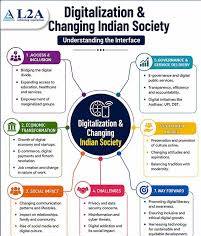

India has changed enormously in the 21st century. The country that once depended heavily on traditional systems is now surrounded by smartphones, Android devices, laptops, high-speed internet, digital payments, modern applications, advanced software and many technologies that were almost unimaginable a few decades ago.
Today, a person sitting in a small town can communicate with someone living thousands of kilometres away within seconds. Students can study online, businesses can reach customers across the world, and ordinary people can access information through a mobile phone.
India has certainly created an important position for itself in the modern world.
But there is another question that we cannot ignore:
Has our social system, administration and political thinking developed at the same speed as our technology?
Technology can make a country faster, but technology alone cannot remove corruption, poverty, crime, injustice or lack of awareness.
That is where the real challenge begins.
- How Much Has India Progressed in the 21st Century?
India’s progress is visible everywhere.
Smartphones have become common. Android and other mobile platforms have changed communication. Laptops and affordable internet have opened new opportunities for education and employment. Digital payments have changed the way people buy and sell things.
Technology has also entered:
Banking
Education
Healthcare
Agriculture
Transportation
Government services
Business
Entertainment
Communication
Scientific research
Defence
Space technology
India is no longer only a country that consumes technology. It is also developing technology, software, startups, digital infrastructure and scientific capabilities.
The coming years may bring even more powerful tools.
But progress should not be measured only by the number of smartphones, apps or buildings.
A truly developed country is one where technology and human dignity grow together.
- If Technology Is Growing, Why Are Social Problems Still There?
This is perhaps one of the biggest questions.
Technology can give people information, but it cannot automatically give them wisdom.
A country may have excellent internet connectivity while still facing:
Poverty
Unemployment
Corruption
Violence
Crimes against women
Child abuse
Inequality
Administrative failures
Lack of public awareness
Political polarisation
Therefore, technological progress and social progress are not always the same thing.
A smartphone can become a tool for education or a tool for spreading hatred.
The internet can help a student build a career, but it can also spread misinformation.
The same technology can create opportunity for one person and confusion for another.
The question is not simply, “How advanced is our technology?”
The deeper question is:
“How responsibly are we using it?”
- What About Corruption?
Corruption remains one of the issues that people discuss whenever governance is discussed.
But corruption should not be treated as a problem belonging only to one political party or one government.
It can exist at different levels of society and administration.
The solution requires:
Transparent systems
Digital records
Independent investigation
Strong accountability
Faster courts
Protection for whistleblowers
Public awareness
Honest political leadership
Responsible bureaucracy
Citizens refusing to participate in corrupt practices
Technology can reduce opportunities for certain forms of corruption by creating digital records and reducing unnecessary human interaction.
But technology cannot replace honesty.
- Are Crimes Increasing, or Are We Simply Hearing About Them More?
This question requires care.
Today, almost every major incident can reach millions of people through smartphones and social media.
A crime that might previously have appeared only in a local newspaper can now become national news within minutes.
Therefore, we should not automatically conclude that every crime has increased simply because we hear about more crimes.
To understand the actual situation, we need reliable statistics and comparisons across years.
At the same time, one fact remains important:
Even one serious crime against a woman or child is one too many for that victim and family.
The focus should therefore be on prevention, investigation, justice and victim support—not merely on political arguments about who is responsible.
- Why Do Crimes Against Women Create So Much Anger?
Crimes against women affect not only individual victims but also society’s sense of safety.
Women should be able to:
Travel
Study
Work
Start businesses
Visit other cities
Buy property
Travel abroad
Enjoy public spaces
Speak freely
Live independently
without constantly being told to restrict their lives because of fear.
The answer to crime cannot simply be:
“Don’t go there.”
“Don’t travel.”
“Don’t stay out late.”
“Don’t buy this.”
“Don’t wear that.”
These may sometimes be presented as safety advice, but they cannot become a substitute for effective law enforcement.
The better question is:
Why should criminals not be afraid of the law?
A strong society protects the innocent rather than continuously shrinking the freedom of the innocent.
- Why Does Political Debate Become So Negative?
One of the biggest problems of modern political discussion is that people sometimes become trapped between two extremes.
One side says everything is going wonderfully.
Another side says everything is terrible.
Reality is usually more complicated.
A government can do some things well and still make mistakes.
An opposition party can raise important questions and still make political mistakes.
Citizens should therefore be able to say:
“This policy is good, but this policy needs improvement.”
That is not anti-government.
Similarly:
“This criticism is valid, but this criticism is unfair.”
That is not necessarily pro-government.
Democracy becomes healthier when citizens are allowed to think independently.
- Who Is Responsible for Crime—Government or Opposition?
This question is often used politically, but the answer depends on the particular crime and the evidence.
The government has responsibility for:
Law and order where constitutionally assigned
Police administration
Public safety
Criminal investigation
Prosecution systems
Prevention policies
Protection of vulnerable people
The opposition has a different responsibility:
Question the government
Highlight failures
Demand accountability
Offer alternative policies
Represent citizens who disagree with the government
The opposition should not be blamed for every crime.
The government should not be blamed for every crime either.
Responsibility should be established through facts, evidence and law—not political slogans.
- What About Terrorism and National Security?
National security is too serious to become a political game.
When terrorism or organised violence occurs, society naturally wants to know:
Who planned it?
Who financed it?
Who supported it?
How did security agencies respond?
Could it have been prevented?
These questions should be investigated professionally.
Citizens deserve answers, but accusations should not be made without evidence.
National security requires intelligence, policing, international cooperation, technology, border security and strong institutions.
Most importantly, political disagreement should never weaken the country’s ability to protect ordinary citizens.
- Should Citizens Stop Buying Gold, Silver or Travelling?
This is another important social question.
Citizens should be able to make their own financial and travel decisions within the law.
There may be economic reasons for governments or experts to advise people about saving, investment, imports, foreign exchange or unnecessary expenditure.
But advice is different from fear.
A healthy economy should encourage people to:
Save
Invest
Travel responsibly
Build businesses
Purchase assets wisely
Develop skills
Spend according to their income
Telling everyone to stop travelling or stop purchasing something without explaining the economic reason can create confusion.
People need information, not unnecessary fear.
- Why Are Young People So Important?
India has a huge young population, and this can become one of the country’s greatest strengths.
Young people bring:
Energy
New ideas
Risk-taking ability
Creativity
Technology skills
Entrepreneurship
Scientific thinking
Global exposure
A young person may be willing to take a risk today that an older person may hesitate to take.
That does not mean experience has no value.
It means a country needs both:
Youthful energy + experienced guidance.
If young people are given education, skills, employment and freedom to experiment, they can create the next generation of businesses, inventions and institutions.
- Is Risk Important in Life?
Yes, but risk should not mean recklessness.
There is a difference between:
calculated risk and blind risk.
A young entrepreneur may risk money to start a company.
A scientist may risk years of effort on a new research project.
A student may move to another city for education.
An artist may leave a safe job to pursue creativity.
These decisions can change lives.
As people become older, they often become more cautious because responsibilities increase.
Therefore, young people should not be discouraged from taking reasonable risks.
They should instead be taught:
How to calculate risk, how to handle failure and how to start again.
- Does Age Decide Whether Someone Can Lead a Country?
Age alone should not decide leadership.
Experience matters.
Energy matters.
Education matters.
Judgement matters.
Understanding of technology matters.
Communication skills matter.
Health and ability to perform responsibilities matter.
A good system should allow capable people from different generations to contribute.
Older leaders can provide experience.
Younger leaders can provide new perspectives.
The real question should be:
Who is capable of performing the responsibility honestly, competently and constitutionally?
- Why Is Communication So Important for a Modern Government?
We live in an international environment.
English has become an important global language for science, business, diplomacy, technology and international communication.
At the same time, Indian languages are extremely important because millions of citizens understand and communicate most comfortably in them.
Therefore, India does not need to choose between Hindi, English and other Indian languages.
A modern government can communicate in multiple languages.
If a citizen asks a question in Hindi, the response should be understandable in Hindi.
If someone asks in English, the answer should be available in English.
Regional languages should also receive respect.
Technology now makes multilingual governance more practical than ever before.
- Can Technology Make Government More Transparent?
Yes, if it is designed properly.
Digital systems can help citizens track:
Applications
Payments
Government schemes
Public records
Complaints
Licences
Documents
Service delivery
But digitalisation alone does not guarantee transparency.
There must also be:
Data protection
Independent oversight
Clear rules
Accessible grievance systems
Human support for people who cannot use technology
A poor person should not be excluded simply because they do not understand an app.
Technology should make government easier—not make it harder.
- What About Scientists and Professionals Leaving Their Positions?
Whenever scientists, professors, doctors, engineers or other professionals leave important institutions, society naturally wants to understand why.
But every resignation has an individual reason.
It would be unfair to automatically assume that every resignation is caused by the government or by political pressure.
However, institutions should create an environment where professionals can:
Research freely
Question ideas
Disagree respectfully
Develop new technology
Receive fair opportunities
Work without unnecessary interference
A country cannot become a scientific power if its scientists are afraid to ask difficult questions.
- Why Is Public Awareness So Important?
Government cannot solve every problem alone.
Citizens also need awareness about:
Laws
Voting
Taxes
Health
Education
Digital fraud
Cybersecurity
Financial planning
Women’s rights
Children’s rights
Environmental protection
Government schemes
An informed citizen is harder to exploit.
A person who understands their rights is more capable of questioning an unfair decision.
Therefore, public awareness is itself a form of national development.
- Can One Person Do Everything While Everyone Else Watches?
No.
A country cannot depend permanently on one person.
A strong democracy requires:
Capable ministers
Honest civil servants
Independent institutions
Professional police
Efficient courts
Scientists
Teachers
Entrepreneurs
Farmers
Workers
Journalists
Responsible citizens
Leadership is important, but institutions are more important in the long term.
A country becomes stronger when systems continue to function even when individual leaders change.
- Should Governments Change From Time to Time?
Democracy is built around elections and peaceful transfers of political power.
If citizens believe a government is performing well, they can support it.
If they believe another party or candidate can perform better, they can choose another option.
The important thing is that the process should remain constitutional, peaceful and transparent.
The purpose of changing governments should not be change for the sake of change.
It should be about better governance, better accountability and better results.
- What Should India Do for Its Children and Youth?
This may be the most important question of all.
If we want India to progress in the next decades, we need to invest in:
Education
Good schools should not depend entirely on a family’s income.
Skills
Young people need practical skills alongside academic qualifications.
Employment
Education without employment opportunities creates frustration.
Entrepreneurship
Young people should be able to start businesses without unnecessary barriers.
Scientific Research
Research institutions need long-term support.
Sports
Children need opportunities to develop physical and competitive skills.
Digital Literacy
Every citizen should understand basic digital safety.
Women’s Education and Employment
A country cannot reach its full potential while restricting half of its population.
- What Kind of India Should We Want by the Future?
We should not want an India where people are simply told:
“Don’t go there.”
“Don’t buy this.”
“Don’t ask questions.”
“Don’t disagree.”
“Don’t take risks.”
We should want an India where people are told:
“Understand the risk.”
“Know your rights.”
“Follow the law.”
“Build your career.”
“Ask questions.”
“Respect others.”
“Work hard.”
“Think independently.”
That is a very different kind of society.
- The Real Meaning of Development
Development is not only a highway.
It is also a safe street for a woman.
Development is not only a smartphone.
It is also a child receiving a good education.
Development is not only a digital payment.
It is also a poor family receiving fair treatment.
Development is not only a space mission.
It is also a scientist being able to conduct meaningful research.
Development is not only economic growth.
It is also justice, dignity and freedom.
- What Should the Government, Opposition and Citizens Do?
Government should:
Improve governance
Fight corruption
Strengthen law enforcement
Protect women and children
Encourage scientific research
Create employment
Improve education
Communicate transparently
Opposition should:
Ask serious questions
Provide evidence
Offer alternatives
Avoid spreading misinformation
Hold the government accountable
Citizens should:
Verify information
Vote responsibly
Follow laws
Reject corruption
Protect vulnerable people
Encourage young people
Avoid unnecessary political hatred - The Biggest Question for 1 September 2026
Today is Tuesday, 1 September 2026.
India has entered a period where technology is changing extremely quickly.
The question is no longer whether technology will arrive.
It is already here.
The bigger question is:
Can our institutions, political culture and social thinking keep pace with it?
We have smartphones.
We have digital systems.
We have advanced applications.
We have modern scientific capabilities.
We have talented young people.
We have enormous economic potential.
Now we need stronger institutions, better education, safer communities, responsible politics and citizens who are willing to think beyond party lines.
Conclusion: India Does Not Need Fear; India Needs Confidence
India does not lack people.
India does not lack young talent.
India does not lack technology.
India does not lack ideas.
What India needs is an environment where people can use these strengths without unnecessary fear.
A young person should be able to dream.
A woman should be able to travel safely.
A scientist should be able to research.
A businessman should be able to build.
A farmer should be able to earn.
A student should be able to learn.
A citizen should be able to question the government respectfully.
And a government should be strong enough to hear criticism without treating every criticism as an attack.
The 21st century has already changed India.
The next challenge is to ensure that our governance, education, justice system and social thinking become as modern, confident and capable as our technology.
Because ultimately, the strength of a country is not measured by how many devices its citizens carry.
It is measured by how safely, freely and confidently those citizens can live.