
Ghee in India: How to Identify Pure Ghee,
1. Introduction: Why Is Ghee So Important in Indian Homes?
Ghee is one of the most important dairy products in India. It is used in everyday cooking, sweets, traditional food, religious ceremonies, havan, temple offerings and festivals. In many Indian households, people consider ghee a symbol of purity, prosperity and good health.
Understand Adulteration, Prices, Health Benefits and the Milk Economy
From a spoonful of ghee added to dal or roti to the large quantities used in making laddoos, halwa, barfi and other sweets, ghee has a special place in Indian food culture.
However, an important question arises today: Is all the ghee sold in the Indian market pure, and is it possible to identify the genuine product simply by looking at its colour, smell or price?
India has many dairy companies, cooperative brands, local dairies and small manufacturers. Imported dairy ingredients and edible fats also form part of the wider food industry. With so many products available, consumers need reliable information rather than advertisements or rumours.
This article explains what ghee is, how it is produced, which brands consumers can consider, what purity tests can and cannot tell us, how much milk India produces, and why adulteration can be dangerous.
2. What Is Ghee, and How Is It Made?


9
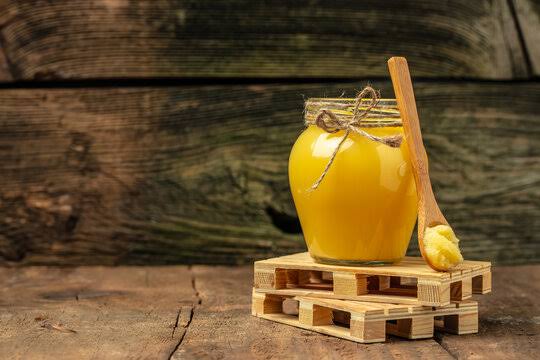
Ghee is a type of clarified milk fat. It is usually prepared from cow’s milk or buffalo’s milk, either directly through a cream or butter-making process or through traditional curd and butter methods.
The basic production process is as follows:
- Milk collection: Milk is collected from dairy farms, cooperatives or individual farmers.
- Cream separation: Cream is separated from milk using suitable equipment.
- Butter preparation: The cream is processed to make butter.
- Heating: Butter is heated so that water evaporates and milk solids separate.
- Clarification and filtration: The remaining fat is clarified and filtered to remove solid particles.
- Quality testing and packaging: Commercial manufacturers test the product, package it and distribute it to retailers.
Traditional households may prepare ghee from malai collected over several days. Others make it from curd-derived butter. Both can produce genuine ghee when the process is hygienic and the raw material is suitable.
Pure ghee consists predominantly of milk fat. It contains very little water and is rich in energy. It also provides fat-soluble vitamins, although the amounts vary with the milk, production process and storage conditions.
3. Cow Ghee vs Buffalo Ghee: What Is the Difference?


| Feature | Cow ghee | Buffalo ghee |
|---|---|---|
| Colour | Often yellowish or golden | Often pale yellow or cream-coloured |
| Colour variation | Depends on feed and milk composition | Depends on breed, feed and processing |
| Fat composition | Predominantly milk fat | Predominantly milk fat |
| Flavour | Can have a distinct, delicate aroma | Can have a richer or different aroma |
| Nutritional value | Energy-dense, with fat-soluble vitamins | Energy-dense, with fat-soluble vitamins |
| Purity identification | Colour alone is insufficient | Colour alone is insufficient |
Cow’s milk contains beta-carotene, which can contribute to the yellow colour of its fat. Buffalo milk generally contains less beta-carotene, so buffalo ghee can appear lighter.
However, yellow ghee is not automatically pure, and white ghee is not automatically adulterated. Feed, breed, season and manufacturing methods can all influence appearance.
Ghee made from goat’s milk is also possible, although it is much less common in the Indian market. Genuine ghee is defined by its milk-fat origin, not by a requirement that it must always come from cows.
4. Which Ghee Brands Can Consumers Consider in India?
There is no honest way to declare one company the producer of the purest ghee in every batch without independent laboratory testing. However, consumers can start with established dairy cooperatives and manufacturers that provide clear product labels, traceable packaging and accessible customer-service channels.
Some brands worth comparing include:

Amul
Offers regular ghee, cow ghee and other variants. Its official online shop listed Amul Pure Ghee at ₹660 per litre and Amul Cow Ghee at ₹705 per litre in the listings checked for this article.
Amul
+1
Official website: Amul online shop

Mother Dairy
A well-known Indian dairy brand that consumers can compare for availability, product labelling and price in their region.
Website: Mother Dairy official website

Nandini
A cooperative dairy brand associated with Karnataka Milk Federation. Check the product variant, batch details and current local price before purchasing.
Website: Nandini official website

Patanjali
Another option to compare for ingredients, declared milk-fat source, packaging and price. A brand name alone does not establish the purity of an individual batch.
Website: Patanjali official website
These are examples to investigate, not a laboratory-certified ranking of purity. A reputable company can still face a product-quality issue, which is why batch-level testing and regulatory compliance matter.
How much should genuine ghee cost?
Prices depend on the brand, location, pack size, milk source, production method and whether the product is ordinary ghee or a premium speciality product.
As a practical reference, the Amul listings checked above were around ₹660–₹705 per litre for regular products. Premium cow-ghee and speciality products may cost considerably more.
Amul
+2
Be cautious if a seller offers supposedly pure, branded ghee at an unusually low price without a credible explanation. But remember that a high price is not proof of purity either.
5. How Can You Check Whether Ghee Is Pure?


The most important point is that no single household test can confirm every kind of adulteration. Some home tests can identify particular substances, but a negative result does not prove that the entire sample is pure.
Step 1: Check the label and packaging
Before buying, examine the following:
- FSSAI licence details and manufacturer information.
- Ingredients and declared product type.
- Batch or lot number, manufacturing date and best-before date.
- Sealed packaging and tamper-evident features.
- Maximum retail price (MRP), net quantity and customer-care details.
You can check licensing information and report food-safety concerns through official FSSAI channels.
Step 2: Look at the colour, aroma and texture
Pure ghee often has a characteristic dairy aroma and a texture that changes with temperature. Cow ghee may be more yellow, while buffalo ghee may be paler.
However, vegetable fats and other adulterants can be chosen to imitate genuine ghee. Heating, cooling and smell tests are therefore only preliminary observations.
Step 3: Understand the iodine test
The Food Safety and Standards Authority of India (FSSAI) describes a household test for certain starch adulterants in ghee and butter.
A simple test for certain starches
- Place about half a teaspoon of ghee or butter in a transparent bowl.
- Add two or three drops of iodine tincture.
- Observe the colour.
No blue colour: This does not prove the sample is pure. Other adulterants may still be present.
Blue colour: This may indicate starch-containing material. The sample needs further investigation.
Source: FSSAI’s DART consumer-awareness guide.
Eat Right India
+1
Do not eat the tested sample. Keep iodine away from children and follow the product’s safety instructions.
Step 4: Why fridge and melting tests are not enough
Some online videos claim that pure ghee always freezes uniformly, melts completely or produces a particular smell. These observations are not reliable enough to identify every form of adulteration.
Different genuine milk fats naturally vary in texture, and some added fats may behave similarly to ghee. Laboratory analysis is more dependable.
Step 5: Get a laboratory test when purity matters
Qualified food laboratories can use methods to examine fatty-acid composition, sterols and other characteristics of milk fat. These analyses can help detect certain vegetable fats or other substances that should not be present.
For a consumer who suspects adulteration, the best approach is to preserve the sealed pack, bill and batch number, and contact the food-safety authority or a qualified laboratory. Do not use concentrated acids or other laboratory chemicals at home.
Official reference: FSSAI: Check Adulteration at Home.
FSSAI
+1
6. Has Any Ghee Company Faced an Official Ban in India in 2026?
This is an important question because consumers should know the difference between a verified government action and an unconfirmed social-media claim.
According to a Government of India press release dated 21 August 2026, the Food Safety and Standards Authority of India (FSSAI) prohibited the sale of all variants of ghee manufactured, stored or sold by SDP Industries Private Limited, Ringanwada, Daman, from its authorised premises, until further orders.
The action followed inspections and sampling conducted on 19 May 2026. Multiple samples were found non-compliant. Laboratory analysis detected beta-sitosterol, a plant sterol that should not be present in genuine ghee under the applicable standard, along with non-compliant fatty-acid composition. The findings indicated the presence of foreign or vegetable fats. The government release named brands including Shraddha, Shree Saras and Gokul among the affected products.
Press Information Bureau
What consumers should understand
- Check whether a product was manufactured by the named company at the affected premises.
- Do not assume that every product with a similar brand name, regardless of manufacturer, is covered by the order.
- Do not purchase affected products while the prohibition applies.
- Check official updates for any subsequent changes to the order.
This case demonstrates why laboratory testing matters. A familiar brand name, attractive packaging or a low price cannot replace scientific verification.
Official source: Government of India press release on the SDP Industries ghee prohibition.
7. How Much Milk Does India Produce, and Is It Enough for All These Products?


8
Add to Favorites
India has an enormous dairy industry. Millions of farmers supply milk to cooperatives, private dairies, sweet manufacturers, local shops and household consumers.
According to the Department of Animal Husbandry and Dairying’s Basic Animal Husbandry Statistics 2025, India’s estimated milk production in 2024–25 was 247.87 million tonnes, an increase of 3.58% over 2023–24. India ranked first in the world in total milk production.
Animal Husbandry and Dairying
+1
INDIA’S ANNUAL MILK PRODUCTION
247.87 million tonnes
Financial year 2024–25 · Official national estimate
Share
Chart options
Milk production over recent years
Annual production in million tonnes, based on official Indian livestock statistics.
Figures rounded for earlier years. Source: Department of Animal Husbandry and Dairying, BAHS 2025.
Animal Husbandry and Dairying
+1
This is a very large quantity, but we must understand what the figure means. Milk production is measured across an entire year. It is not the quantity of milk available for ghee alone.
Milk is used for drinking, tea, coffee, curd, buttermilk, paneer, cheese, butter, cream, milk powder, sweets, ice cream, yoghurt, chocolates and many other products.
The dairy industry must also account for processing losses, spoilage, transportation, storage and different product requirements.
Therefore, the existence of a large milk supply does not automatically prove that every dairy product is genuine. Equally, the number of dairy products on supermarket shelves does not, by itself, prove that adulteration is widespread.
There is no reliable basis for claiming that a particular percentage of all Indian ghee is fake without representative testing data. A sound estimate would require systematic sampling from different states, manufacturers, retail outlets and product categories.
8. How Much Milk Is Needed to Make Ghee?
Ghee production requires a substantial quantity of milk because only a fraction of milk is fat.
The exact yield depends on the milk’s fat content and the efficiency of cream separation and processing.
For example, consider a simplified calculation:
- Suppose a dairy collects 100 litres of milk.
- If the milk contains 4% fat, it contains approximately 4 kg of milk fat before processing losses.
- The quantity of ghee produced cannot exceed the available fat, and in practice it will be lower because some fat may be lost during processing.
- Milk with a higher fat percentage can yield more ghee than milk with a lower fat percentage.
This is only an illustrative calculation, not a universal production formula. Commercial dairies process milk with different fat contents and recover fat through multiple stages.
The central point is that producing ghee on a large scale requires a dependable supply of milk fat. Manufacturers also sell other dairy products, so the same milk supply cannot be counted independently for every product.
9. Which Animals Supply Milk for India’s Dairy Industry?
India obtains milk mainly from cattle and buffaloes, with smaller contributions from goats and other milk-producing animals.
The official 2024–25 statistics report the following shares of total milk production.
Animal Husbandry and Dairying
+1
| Milk source | Share of total milk production |
|---|---|
| Indigenous buffaloes | 31.18% |
| Crossbred cattle | 30.80% |
| Indigenous cattle | 11.20% |
| Non-descript buffaloes | 11.97% |
| Non-descript cattle | 9.64% |
| Goats | 3.32% |
| Exotic cattle | 1.89% |
These figures show why buffaloes are so important to India’s dairy economy. Buffalo milk generally has a higher fat content than cow milk, making it useful for products such as cream, butter, khoa and ghee.
Goat milk is also used for drinking and dairy processing in some areas, but goat ghee is a relatively uncommon commercial product.
Ghee may be made from the milk fat of different species, but the product should be correctly identified and labelled. Cow ghee should not be adulterated with cheaper fats and sold as pure cow ghee.
Is India importing milk to meet all its needs?
India produces a very large quantity of milk domestically, so imported milk is not the sole foundation of its dairy supply.
However, dairy trade includes specialised products and ingredients, and imports or exports may vary by year and product category. Milk powder, whey, butter, cheese, milk fats and other processed dairy goods are not interchangeable in every application.
India also exports dairy products. The Agricultural and Processed Food Products Export Development Authority (APEDA) reports that India exported approximately 97,525 metric tonnes of dairy products in financial year 2025–26, valued at about US$407 million.
APEDA
This figure covers dairy products as a category; it should not be interpreted as the export volume of ghee alone.
For accurate information about a specific product, it is necessary to check its trade classification, import or export quantity and reporting period.
10. If There Is Not Enough Milk Fat, What Might Be Used to Adulterate Ghee?
Adulteration can involve adding cheaper fats or substances that imitate some of the physical properties of genuine ghee.
Potential forms of adulteration include:
- Vegetable oils or fats.
- Certain hydrogenated vegetable fats, including vanaspati.
- Other non-milk fats.
- Starchy materials or other foreign substances.
- Artificial colours or flavouring agents intended to imitate the appearance or aroma of genuine ghee.
Not all of these substances pose the same risks, and their detection requires different methods. Some vegetable oils are safe foods in their proper form but are not acceptable substitutes when a product is represented as pure milk-fat ghee.
There is also an important distinction between legal food formulation and fraud. A clearly labelled product that complies with the applicable food standard is different from a product sold as pure ghee when it contains undeclared or prohibited ingredients.
Consumers should not assume that every local dairy or every small manufacturer adulterates ghee. Many small producers make genuine products. The issue is whether the product meets the required standard and is accurately labelled.
11. Is All the Ghee Used in Temples, Puja and Havan Pure?


Ghee has an important place in Hindu religious traditions. Devotees use it in diyas, havan, yajna, temple offerings and the preparation of prasad. Many families prefer cow ghee because of its traditional religious significance.
However, a question deserves attention: when large quantities of ghee are used for cooking, sweets, temples and religious ceremonies, how can we be certain that the supply is genuine?
The answer is to maintain the same food-quality standards for religious and household use.
- Purchase ghee from a reliable supplier.
- Check the label, manufacturer and batch details.
- For large religious events, ask the supplier for a proper invoice and product documentation.
- If the quality is doubtful, arrange independent laboratory testing.
- Do not assume that ghee used in a temple is automatically pure merely because it is being used for worship.
Religious devotion and food safety should support each other. Protecting devotees from adulterated products is also a form of responsibility.
For a large havan or community event, organisers can purchase traceable products from reputable suppliers rather than selecting ghee on price alone. There is no verified national figure establishing what percentage of ghee used in Indian puja and havan is adulterated.
12. How Much Ghee Is Made and Sold Every Day in India?
India’s annual milk production is officially estimated, but determining the precise amount of genuine ghee manufactured and sold each day is more complicated.
The dairy sector includes:
- Large cooperative manufacturers.
- Private dairy companies.
- Small local dairies.
- Traditional household producers.
- Sweet shops and restaurants.
- Informal sellers and regional manufacturers.
Some producers sell ghee directly to consumers. Others use milk fat in butter, cream and other products before making ghee. Milk collected by one dairy may also pass through several processing and distribution stages.
Consequently, milk production figures cannot be used alone to calculate the exact daily production of ghee.
Similarly, the total number of ghee packets sold does not tell us how many contain pure milk fat. That requires separate production, sales and food-quality data.
A useful national study would publish:
- Annual ghee production in tonnes.
- The quantities produced by cow milk, buffalo milk and other milk sources.
- Domestic sales and exports.
- Imports of ghee and other relevant milk fats.
- The number of samples tested by food-safety authorities.
- The number and percentage of samples found non-compliant.
- The outcomes of enforcement actions.
Without these figures, claims such as “20% of Indian ghee is fake” or “half the ghee sold in shops is adulterated” should not be repeated as established facts.
13. Milk Is Used for Far More Than Ghee


6
Milk is an essential raw material for a large food-processing industry. Ghee is only one part of it.
| Product | How milk is used |
|---|---|
| Drinking milk | Consumed directly after appropriate processing |
| Curd and yoghurt | Produced through controlled fermentation |
| Buttermilk and lassi | Made from curd or related dairy processes |
| Paneer | Made by coagulating milk |
| Cheese | Made through coagulation, fermentation and maturation |
| Butter and cream | Separated or processed from milk fat |
| Ghee | Produced by clarifying milk fat |
| Khoa and milk powder | Made by removing much of the water from milk |
| Sweets | Milk and milk solids are used in products such as peda, barfi and gulab jamun |
| Ice cream | May contain milk, cream and other permitted ingredients |
| Chocolate and biscuits | Some varieties use milk powder, butter, milk fat or other dairy ingredients |
| Soap and cosmetics | Certain products use milk-derived ingredients, while many use other fats or oils |
Not every biscuit, chocolate or soap contains milk. Recipes differ between manufacturers and product types.
The same milk supply also cannot be counted as though every litre produces a full quantity of drinking milk, cream, butter, cheese and ghee simultaneously. Dairy processing separates components and directs them into different products.
This is why India needs accurate data on milk procurement, processing, fat recovery and dairy-product production to assess whether supplies are sufficient.
14. What Are the Health Benefits of Pure Ghee?
Ghee is an energy-dense source of fat. It can be part of a balanced diet, but its benefits should not be exaggerated.

- Provides energy
Ghee supplies approximately 9 calories per gram. It can help meet energy needs, especially when used in moderate amounts as part of a varied diet.

- Helps the body absorb fat-soluble vitamins
Dietary fat supports the absorption of vitamins A, D, E and K from food. Ghee itself contains varying amounts of some fat-soluble vitamins, but it should not be relied upon as the sole source of these nutrients.

- Improves flavour and texture
Ghee adds aroma and richness to dal, roti, khichdi, sweets and many traditional dishes. Its taste can make simple meals more enjoyable.

- Traditional massage and skin use
Some traditional practices use ghee for topical applications or massage. Evidence for specific medicinal effects is limited, and applying ghee to wounds or irritated skin is not a substitute for appropriate medical care.
Does ghee improve eyesight?
Ghee is sometimes traditionally associated with good eyesight, but eating more ghee does not automatically improve vision.
Vitamin A is essential for normal vision, but ghee is not a treatment for refractive errors, cataracts, glaucoma or other eye diseases. Anyone experiencing poor eyesight should obtain an eye examination and follow appropriate treatment.
Can children drink milk and eat ghee for better growth?
Milk supplies protein, calcium and other nutrients needed for growth. Ghee provides energy and fat. Both can contribute to a balanced diet, but children’s growth depends on overall nutrition, sufficient protein, vitamins, minerals, sleep and physical activity.
Excessive ghee is not necessary for healthy development. For infants, feeding decisions should follow age-appropriate paediatric guidance.
15. What Are the Risks of Eating Too Much Ghee?
Pure ghee is not automatically healthy in unlimited quantities. It contains substantial amounts of saturated fat.
Excessive intake can contribute to an unbalanced diet and may raise LDL cholesterol in some people, increasing cardiovascular risk. The overall dietary pattern, existing health conditions and the types of fats consumed also matter.
People should be especially careful about excessive intake if they have been advised to limit saturated fat or manage cholesterol.
The risks of adulterated products depend on what they contain. Undeclared fats, unsuitable chemicals, contaminants or unhygienic processing can create additional health concerns.
Possible consequences vary according to the substance, dose and duration of exposure. Some adulterants may cause digestive problems or other toxic effects, while other risks may be less immediately noticeable.
It would be incorrect to claim that every adulterated ghee product causes the same disease. However, food fraud is serious because consumers cannot reliably assess every chemical characteristic through taste or smell.
16. Can Adulteration Stop Growth or Cause Disease?
The human body needs adequate nutrition for normal development. If a person’s diet regularly lacks sufficient protein, essential fatty acids, vitamins, minerals and overall energy, growth and health can suffer.
For children, inadequate nutrition may contribute to poor growth and deficiencies. For adults, an imbalanced diet can affect general health and well-being.
However, there is an important distinction: not every adulterated product directly causes a nutritional deficiency, and not every health problem can be attributed to adulteration.
The consequences depend on what has been substituted or added. Replacing some milk fat with another edible fat does not necessarily produce the same health effect as adding an unsafe chemical. Nevertheless, selling a product under a false identity is unacceptable, and certain forms of adulteration can pose serious safety risks.
The best protection is to buy properly labelled products, avoid suspiciously cheap or untraceable goods, and report suspected fraud.
17. What Should the Indian Government Do to Protect Consumers?
India needs a strong and transparent food-safety system so that consumers do not have to depend entirely on trust or household experiments.
Practical measures include:
- Regular sampling: Test ghee from large manufacturers, small dairies, wholesalers and retail shops.
- Independent laboratory analysis: Check milk-fat composition and investigate suspicious samples using validated methods.
- Public reporting: Publish the number of samples tested, the number that failed, the type of non-compliance and the enforcement outcomes.
- Traceability: Maintain clear manufacturer, batch and distribution information.
- Effective enforcement: Take proportionate action against businesses that violate food-safety requirements.
- Consumer awareness: Explain which home tests can identify specific adulterants and which tests cannot establish overall purity.
- Support for farmers: Help dairy farmers improve animal health, feeding, hygiene, milk collection and cold-chain infrastructure.
- Protection of religious consumers: Encourage temples, community kitchens and event organisers to purchase traceable dairy products.
Food-safety enforcement should be based on evidence. A company should not be labelled a producer of fake ghee without reliable findings, and consumers should have access to verified information about official orders and laboratory results.
18. Conclusion: How Can We Choose Good Ghee in India?
Ghee has nutritional, culinary, cultural and religious importance in India. It is used in family meals, sweets, festivals, puja and havan. India’s large dairy industry provides milk for many products, and millions of farming households depend on dairy income.
Yet the size of the industry does not guarantee the purity of every product.
Consumers should choose traceable products, check labels and batch details, compare realistic prices and take official action when they suspect adulteration. Established brands such as Amul, Mother Dairy and Nandini can be starting points for comparison, but no brand should be declared universally pure without appropriate evidence.
The most important lesson is that the purity of ghee must be established through reliable quality controls and scientific testing, not merely through price, colour, advertising or tradition.
India also needs better publicly accessible data on ghee production, consumption, imports, exports and food-safety testing. With stronger monitoring, responsible businesses can be protected, farmers can receive fairer returns, and consumers can make informed decisions.
Pure food is important not only for taste and tradition but also for public health. Whether ghee is used in a home kitchen or a temple, every consumer deserves a product that is honestly labelled, safe and compliant with food standards.
References and useful official resources
- FSSAI — Food Safety and Standards Authority of India
- FSSAI’s DART guide — household adulteration awareness
- Department of Animal Husbandry and Dairying — official statistics
- APEDA — Indian dairy production and exports
- Government of India — 2026 ghee enforcement action
Editorial note: Prices and regulatory information in this article reflect the cited sources available at the time of writing. Product prices, enforcement orders and food-safety findings can change. Always check the latest official information before making a purchasing or publication decision.
Milk production over recent years
Annual production in million tonnes, based on official Indian livestock statistics.
year milk
2018–19 188
2019–20 198
2020–21 210
2021–22 222
2022–23 231
2023–24 239.3
2024–25 247.87