Lord Vishwakarma: The Divine Architect of Hindu Tradition – His Life, Creations, Family, Temples and Worship
1. Introduction: Who Was Lord Vishwakarma?
Lord Vishwakarma holds a special place in Hindu mythology. He is known as the divine architect, engineer, craftsman and creator of extraordinary structures, weapons, palaces and celestial machines. In Hindu tradition, he is regarded as the master of construction and craftsmanship.
People who work in engineering, architecture, construction, machinery, metalworking, carpentry, factories and technical industries consider Lord Vishwakarma their patron deity. Every year, Vishwakarma Puja is celebrated with devotion, particularly by factory workers, mechanics, engineers, artisans, shopkeepers and people associated with machines and tools.
But there is much more to his story than simply building beautiful palaces. Hindu scriptures describe him as a divine figure associated with creativity, knowledge, technical skills and the art of transforming ideas into reality.
One interesting question is whether Lord Vishwakarma actually built the famous city of Dwarka, who his family members were, how many palaces he constructed and whether there is any historical evidence of his lifetime. Let us understand these stories through Hindu scriptures and traditional beliefs.
2. When Was Lord Vishwakarma Born? Which Period Did He Belong To?
There is no universally established historical birth date or death date for Lord Vishwakarma.
His descriptions appear in ancient Hindu literature, including the Vedic tradition. In the Rigveda, the name Vishvakarman is associated with a divine creator who possesses universal creative power.
In later Hindu traditions, Vishwakarma is particularly recognised as the architect of the gods.
His stories are connected with different mythological periods:
- Vedic period: Vishvakarman appears as a divine creator associated with the formation of the universe.
- Ramayana period: He is associated with the construction of Lanka and the bridge-building traditions connected with the Ramayana.
- Mahabharata period: He is associated with extraordinary divine architecture, weapons and the construction of Indraprastha.
- Puranic traditions: His identity and family relationships are described in different accounts.
It is important to understand that these are religious and mythological timelines, not verified historical dates. Therefore, nobody can accurately say that Vishwakarma was born in a particular year or lived for a specific number of human years.
3. What Is the Meaning of the Name Vishwakarma?
The name Vishwakarma is generally understood through two Sanskrit words:
- Vishwa: The universe or the entire world.
- Karma: Work, action or creation.
Together, the name conveys the idea of someone whose creative work extends throughout the universe.
He represents the knowledge that construction is not merely about making buildings. It also involves imagination, planning, measurement, design, materials, balance and technical understanding.
This is why Lord Vishwakarma is respected as a symbol of creativity and skilled workmanship.
4. Who Were His Parents? What Do Scriptures Say About His Birth?
Different Hindu texts and traditions give different accounts of Vishwakarma’s family.
According to the Vishnu Purana, one traditional account describes him as the son of Prabhasa, one of the eight Vasus, and Varastri, who is associated with the family of Brihaspati.
Other religious traditions describe Vishwakarma as the son of Lord Brahma, the creator of the universe.
These descriptions reflect the development of Hindu religious traditions over many centuries. It is not necessary to assume that every Purana gives exactly the same family history.
His divine identity is more important than a fixed human-style birth record. He represents the extraordinary creative power through which the universe and its beautiful structures are imagined and formed.
Wisdom Library+2
5. What Were the Greatest Creations of Lord Vishwakarma?
Lord Vishwakarma is associated with several extraordinary creations in Hindu mythology. Some of the most famous are:


1. Swarg Lok – The Abode of the Gods
In traditional accounts, Vishwakarma is associated with the construction of Swarg Lok, the heavenly abode of Indra.
It is imagined as a magnificent world containing beautiful palaces, gardens, divine buildings and extraordinary facilities.
2. Golden Lanka – The Famous Golden City

Lanka is among the most famous architectural creations associated with Vishwakarma.
According to popular Hindu traditions, he constructed the golden city of Lanka. Some accounts associate its original palace with Kubera, the god of wealth, before Ravana took possession of it.
Lanka is described as a city of gold, beautiful palaces, strong fortifications and extraordinary wealth.
The Ramayana tells us that Ravana ruled Lanka and that Hanuman eventually set parts of the city on fire. These stories have made golden Lanka one of the most recognisable images in Hindu mythology.
3. Dwarka – The City of Lord Krishna

Dwarka is particularly important in Vishwakarma’s stories.
According to the Bhagavata Purana and traditional Mahabharata accounts, Lord Krishna had a magnificent city constructed by Vishwakarma.
Dwarka was described as a beautiful city surrounded by water, with impressive houses, gardens, roads, palaces and protective structures.
The Mahabharata’s Sabha Parva also contains a description of Dwarka as a city beautifully constructed by Vishwakarma.
Therefore, the belief that Vishwakarma built Dwarka has a clear place in Hindu religious literature. However, its mythological description should not be treated as proof that an individual historical architect built the archaeological remains of modern-day Dwarka.
Eternal Raga+2
4. Indraprastha – The City of the Pandavas

Indraprastha is another important city connected with the divine architect.
The Bhagavata Purana describes Lord Krishna arranging for Vishwakarma to construct a wonderful city for the Pandavas.
However, there is an important detail that readers should know.
The famous magical assembly hall, known as the Maya Sabha, was built by Maya Danava, not Vishwakarma. Maya was an exceptionally skilled architect associated with the Asuras.
The two architects should not be confused.
FolioCorpus+2
5. Indra’s Palace and Divine Buildings
Vishwakarma is also associated with the construction of Indra’s palace, the homes of other gods, celestial assembly halls and extraordinary structures.
His work is not limited to buildings. He is also described as a maker of divine ornaments, chariots, weapons and other technical creations.
6. Pushpaka Vimana – The Flying Chariot

Pushpaka Vimana is one of the most famous flying vehicles in Hindu mythology.
It is associated with Kubera and later with Ravana. In the Ramayana, Lord Rama returns to Ayodhya in the Pushpaka Vimana after defeating Ravana.
Different traditions associate its construction with divine craftsmanship, including Vishwakarma.
It is a fascinating example of how ancient Indian stories imagined flying vehicles long before modern aviation.
6. How Many Palaces and Cities Did Vishwakarma Build?
This is a question many people ask.
Hindu scriptures do not provide a single, agreed-upon numerical count of all the palaces, cities and structures attributed to Vishwakarma.
Different texts mention different creations, and some describe him as the architect of thousands of crafts and divine objects.
His famous creations and associations include:
| Creation | Association |
|---|---|
| Swarg Lok | Heavenly abode of the gods |
| Golden Lanka | City associated with Ravana |
| Dwarka | City of Lord Krishna |
| Indraprastha | City of the Pandavas |
| Indra’s palace | Divine residence |
| Pushpaka Vimana | Celestial flying chariot |
| Divine weapons | Weapons of the gods |
| Celestial ornaments | Jewellery and decorative crafts |
It would be incorrect to claim that he built exactly four or five palaces during his lifetime. These are selected famous creations from a much larger body of mythology.
Also, the idea of one human lifetime does not apply straightforwardly to a divine architect who is described in some traditions as immortal.
7. What Was Vishwakarma’s Married Life Like?
People are also curious about whether Lord Vishwakarma was married and who his wife was.
Different traditions give different names and family accounts.
Some Vishwakarma community traditions identify his wife as Praladhi Devi, while other accounts associate him with Ghritachi or Kṛti. These accounts should not be combined into one definite biography because the sources differ.
The Vishnu Purana genealogy describes his parents and children, but the details of his married life are not presented as a complete human biography.
His stories mainly focus on divine craftsmanship, creation, knowledge and technical abilities rather than romantic relationships or domestic life.
Wisdom Library+2
8. Who Were Lord Vishwakarma’s Children?
The names and number of Vishwakarma’s children also differ across religious texts and community traditions.
Some traditions mention five sons:
- Manu
- Maya
- Tvashta
- Shilpi
- Daivajna
Some accounts also mention daughters, including Sanjna (Sangya) and Barhishmati.
There are other genealogical accounts in the Vishnu Purana that give different names and relationships.
One particularly interesting figure is Nala, who is described in the Ramayana tradition as a son of Vishwakarma.
Nala was an exceptionally skilled Vanara who played an important role in constructing the bridge to Lanka with the Vanara army.
This connection is especially interesting because Vishwakarma represents engineering and construction, while Nala represents those skills being used in a great undertaking for Lord Rama.
Wisdom Library+2
9. What Is the Importance of Vishwakarma in Engineering and Architecture?


Lord Vishwakarma is not remembered only for the palaces of gods and kings. His name also represents the dignity of skilled work.
Consider how many people contribute to constructing a single building:
- Architects prepare the design.
- Civil engineers calculate strength and safety.
- Masons build walls.
- Carpenters work with wood.
- Electricians install electrical systems.
- Plumbers install water systems.
- Welders and metalworkers prepare structural components.
- Machine operators manufacture essential materials.
Every person’s work contributes to the final structure.
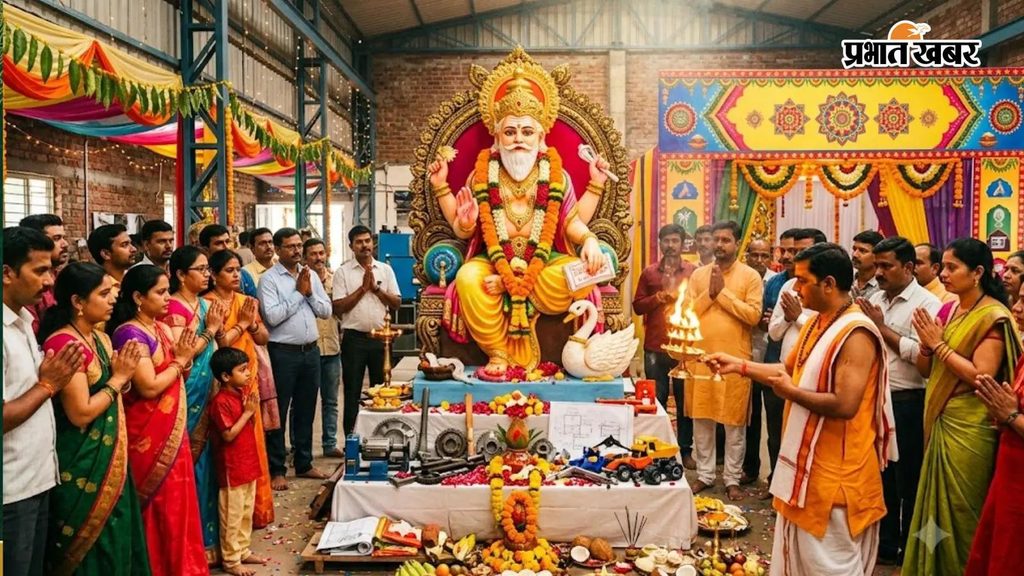
This is why Vishwakarma Puja is celebrated in factories, workshops, construction sites, garages, engineering institutions and other workplaces.
The deeper message is that no profession should be considered inferior. A person’s skill, honesty, dedication and quality of work deserve respect.
10. Vishwakarma Puja: When and Why Is It Celebrated?


Vishwakarma Puja is celebrated every year, traditionally around 17 September, when the Sun enters Virgo (Kanya Sankranti).
However, the exact observance and public holiday arrangements can vary according to the regional calendar.
On this day, people worship Lord Vishwakarma and express gratitude for their tools, machines, workplaces and professional skills.
The festival is particularly popular in:
- West Bengal
- Bihar
- Jharkhand
- Odisha
- Assam
- Uttar Pradesh
- Delhi and other industrial regions
In factories, workers decorate machines and workplaces with flowers, garlands and colourful decorations. Special prayers are offered before machines are used again.
Some businesses also organise meals and community celebrations for their employees.
11. How Is Vishwakarma Puja Performed?
The puja is generally performed at factories, workshops, offices, shops and homes.
A simple traditional method includes:
- Cleaning the workplace: Clean the workshop, factory, machinery and tools.
- Preparing the puja area: Place an image or idol of Lord Vishwakarma in a clean place.
- Decorating: Use flowers, garlands, incense and traditional decorations.
- Offering prayers: Offer flowers, fruits, sweets, water and other customary offerings.
- Worshipping tools and machines: Apply tilak to machines and tools as a symbol of respect and gratitude.
- Performing Aarti: Sing the Vishwakarma Aarti and pray for safety, prosperity and success.
- Sharing Prasad: Distribute prasad among workers, family members and visitors.
The important message is that machines should be maintained properly and workers should always follow safety rules.
12. Which Mantra Is Chanted During Vishwakarma Puja?
Devotees commonly chant the following simple mantra:
ॐ विश्वकर्मणे नमः।
Om Vishwakarmane Namah
Meaning: I offer my respectful salutations to Lord Vishwakarma, the divine architect and creator.
Another traditional prayer is:
ॐ श्री विश्वकर्मणे नमः।
Om Shri Vishwakarmane Namah.
Devotees can chant these mantras while offering flowers and prayers.
There are also longer Vishwakarma mantras, stotras and aartis used by different communities.
13. Why Do People Worship Machines, Tools and Vehicles?
This is one of the most interesting aspects of Vishwakarma Puja.
Normally, people worship God in temples and homes. But during Vishwakarma Puja, people also worship the machines and equipment through which they earn their livelihood.
For example:
- A farmer may worship agricultural equipment and tractors.
- A mechanic may worship tools and machines.
- A factory worker may worship industrial machinery.
- An engineer may worship instruments and technical equipment.
- A carpenter may worship woodworking tools.
- A driver may decorate and worship a vehicle.
The underlying belief is that tools and machines help people earn their living, support their families and contribute to society.
However, worshipping a machine does not mean ignoring its maintenance. Regular servicing, proper training and safety precautions are equally important.
14. Are Schools and Colleges Closed on Vishwakarma Puja?
Yes, some schools and colleges observe a holiday on Vishwakarma Puja, but it is not a compulsory nationwide school holiday throughout India.
The decision depends on state government notifications, education department orders and individual school calendars.
For example:
- In West Bengal, Vishwakarma Puja is an important festival, and school holidays are sometimes officially declared.
- In Bihar, the festival appears in government holiday calendars, sometimes as a restricted holiday.
- In Uttar Pradesh and Delhi, schools may remain open unless a specific holiday is announced.
- Industrial training institutes, polytechnics and engineering institutions may organise special puja programmes.
For 2026, the Bihar government holiday calendar lists 17 September as a restricted holiday. West Bengal also issued a separate notification concerning the observance of its holiday arrangements.
UPYOG+3
Parents and students should check their school’s official holiday calendar rather than assume that every school will be closed.
15. Is There Any Historical Evidence of Vishwakarma’s Palaces?
This is an important question, particularly for people interested in history and archaeology.
Dwarka, Lanka and Indraprastha are famous places in Hindu religious literature. However, their descriptions in religious texts and the archaeological evidence available today are two different kinds of information.
Archaeological investigations around present-day Dwarka and the coastal region have explored ancient settlements and submerged remains.
But it is not scientifically established that these remains are the exact buildings constructed by a divine architect called Vishwakarma.
Similarly, the golden Lanka described in the Ramayana belongs to religious and epic tradition. There is no independently verified archaeological record identifying its golden palace as Vishwakarma’s construction.
We can respect religious traditions while also distinguishing between faith, scriptural descriptions and historical evidence.
16. What Can Modern Engineers Learn from Lord Vishwakarma?
The stories of Vishwakarma have an important message for modern society.
Today, India is developing roads, bridges, airports, railway networks, factories, machines, residential buildings and advanced technology.
Every development requires planning, knowledge, practical skills and hard work.
The traditional image of Vishwakarma reminds us of several important values:
- Creativity: Think of new ways to solve problems.
- Precision: Pay attention to measurements and quality.
- Safety: Build structures and machines that protect human lives.
- Innovation: Improve existing technology.
- Respect for labour: Give equal respect to skilled workers.
- Responsibility: Use knowledge for the benefit of society.
An engineer, carpenter, electrician, mechanic or factory worker who performs their duties honestly contributes to society.
That is perhaps one of the most meaningful lessons of Vishwakarma Puja.
17. Conclusion: Lord Vishwakarma Is a Symbol of Creation, Knowledge and Hard Work
Lord Vishwakarma is remembered in Hindu tradition as the divine architect who created extraordinary palaces, cities, weapons, ornaments and celestial vehicles.
His stories connect him with Swarg Lok, Golden Lanka, Dwarka and Indraprastha. He is also associated with the technical knowledge and craftsmanship that make construction and manufacturing possible.
Although different scriptures provide different accounts of his birth, family and creations, one message remains common: creativity and skilled work are valuable contributions to the world.
We should not remember Vishwakarma only on the day of his puja. We should also respect the people who build our homes, repair our machines, construct our roads, manufacture our products and keep our industries running.
A beautiful building cannot be constructed without the hard work of many people. Behind every machine, bridge, vehicle and factory, there is someone’s knowledge, effort and dedication.
True respect for Lord Vishwakarma also means respecting every honest worker and recognising the importance of knowledge, craftsmanship and responsibility.
Sources and further reading
For readers who want to explore the original religious traditions and references:
- Vishnu Purana references – Story of Vishwakarma
- Mahabharata – Description of Dwarka
- Bhagavata Purana 10.58.24 – Vishwakarma and the Pandavas’ city
- Mahabharata Sabha Parva – Maya Sabha
- Vishwakarma and traditional architecture
Editorial note: The accounts of Vishwakarma’s family and creations vary between scriptures and later traditions. The article distinguishes these religious accounts from independently established historical facts.