Ravana and Rama: Devotion, Power, and the Simplicity of Dharma
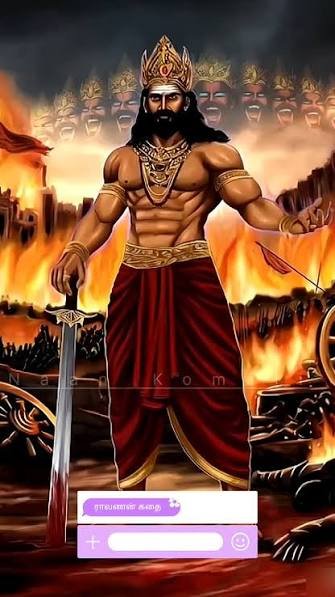
In the vast ocean of Indian mythology, few characters are as complex, misunderstood, and deeply symbolic as Ravana. Often remembered as the antagonist of the epic Ramayana, Ravana’s life is not just a story of ego and downfall—it is also a powerful narrative of extreme devotion, knowledge, and determination. His story, when seen beyond the surface, offers deep lessons about devotion (bhakti), power, and the consequences of imbalance.
Ravana: The Devotee Beyond Limits
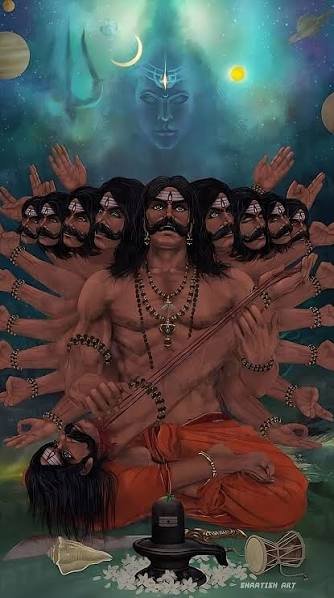
Ravana was not an ordinary king. He was a great scholar, a master of the Vedas, and one of the most intense devotees of Lord Shiva. His devotion was not casual—it was extreme, fearless, and unwavering. Legends say that to prove his devotion, Ravana performed severe penance (tapasya), even going to the extent of offering his own heads one by one to Lord Shiva.
This act symbolizes the highest level of surrender—letting go of ego, identity, and attachment. Though no ordinary human can replicate such acts, it reflects the depth of his dedication. Ravana’s devotion teaches that true bhakti requires commitment, sacrifice, and focus.
A Life of Contradictions
Despite his devotion, Ravana’s life was full of contradictions. He was a learned Brahmin, yet he is often labeled as a demon (rakshasa). He was a powerful king of Lanka, yet his desires led to his downfall. He deeply loved his wife Mandodari and respected her, showing that he was capable of loyalty and emotional depth.
One of the most debated aspects of Ravana’s character is his treatment of Sita. Despite abducting her, he never touched her without consent, which some interpret as a sign of his adherence to certain moral boundaries—even in wrongdoing.
The Role of Destiny and Purpose
Ravana’s story is also tied to destiny. It is believed that his actions ultimately led to the incarnation of Lord Rama, who came to restore balance and uphold dharma (righteousness). Ravana’s existence, therefore, was not meaningless—it played a crucial role in the cosmic order.
Some interpretations suggest that Ravana knowingly walked the path that would lead to his destruction, as a way to attain liberation (moksha) through Lord Rama.
Rama: The Power of Simplicity and Dharma
While Ravana represents extreme power, knowledge, and devotion, Lord Rama represents simplicity, discipline, and righteousness. Despite being divine, Rama lived like an ordinary human, facing struggles with patience and dignity.
Rama did not rely on excessive displays of power. Instead, he showed:
Strong leadership and management skills
Emotional balance and patience
Commitment to duty over personal desires
His battle with Ravana was not just a physical war but a moral one—between ego and humility, desire and discipline.
Lessons from Ravana and Rama
The stories of Ravana and Rama are not just about good versus evil. They teach deeper lessons:
Devotion alone is not enough: Ravana’s bhakti was immense, but his ego led to his downfall.
Balance is key: Knowledge, power, and devotion must be balanced with humility and ethics.
Simplicity is strength: Rama’s simple and disciplined life shows that true power lies in control and clarity.
Every character has layers: Ravana was not purely evil, and Rama was not just a warrior—they both represent different aspects of human nature.
Why Ravana is Still Remembered
Even today, Ravana is remembered and his effigy is burned during festivals like Dussehra, symbolizing the victory of good over evil. But at the same time, scholars and thinkers continue to study his life for the lessons it offers.
His story reminds us that even the most powerful and devoted individuals can fall if they lose control over their desires and ego.
Ravana is not only considered a villain, but also a great ascetic and a devoted devotee of Lord Shiva . Several places during his life are said to have been the places where he performed rigorous penance. These places are described in various texts and folktales.
Where did Ravana do penance?
- Mount Kailash (most famous place)
Mount Kailash is considered to be the most important place of Ravana’s penance.
According to the legend, Ravana performed severe penance here for thousands of years.
He offered his heads one by one to Shiva, and pleased with this, Shiva granted him a boon.
After this penance he also got the name “Ravana” (earlier he was called Dashagriva).
👉 This is believed to be the place where Ravana spent the longest time.
- Gokarna (Karnataka)
The story of Ravana is also associated with the Mahabaleshwar area located in Gokarna .
It is said that he performed penance here to obtain the Shivalinga (Atmalinga).
Later this Shivalinga was established here.
- Ujjain (Mahakaleshwar)
Devotion to Ravana is also associated with Mahakaleshwar Temple .
He used to worship Shiva here and was adept in Tantra Vidya.
- Sri Lanka (Lanka)
Sri Lanka is considered to be the kingdom of Ravana.
Here also he performed yagya and penance at many places.
Some beliefs mention “Ravana caves” and places of worship.
How harsh was Ravana’s penance?
He abstained from food and water for years and performed penance.
He cut off his head and offered it to Shiva (symbolic story)
did rigorous yoga and meditation
For this reason he received immense power, knowledge and blessings.
Where did you spend the longest time?
👉 According to beliefs, Mount Kailash is the place where Ravana performed penance for the longest time and where he received the greatest blessings.
The places where Ravana practiced penance reveal that he was not only a warrior but also a highly learned and ascetic.
But his story also teaches that excessive ego (pride) can lead even the greatest power to destruction.
👉 Therefore, as great as Ravana’s penance was, the lessons learnt from it are equally profound.
Ravana’s “nine unfulfilled dreams” or “wishes” are not a proven fact. These accounts are not directly mentioned in the Ramayana , but are recounted in various forms in folk tales, storytellers, and legends. Therefore, they should be understood as mythological belief or popular faith , not as definitive history.
Nevertheless, the most commonly cited “9 wishes of Ravana” are as follows:
9 Unfulfilled Wishes of Ravana (According to Folklore)
Making a golden ladder (from earth to heaven)
Ravana wanted that man could reach heaven directly, without doing penance.
To sweeten sea water
so that there is no shortage of water in the world and there is potable water everywhere.
Adding fragrance to gold:
Gold is valuable, but it does not have fragrance – Ravana wanted to make it perfect too.
He wanted to make humans immortal
and free them from death.
To make all human beings equally beautiful
so that there is no discrimination or inferiority complex.
To make every person virtuous,
evil should end in the world and everyone should do good deeds.
To make everyone a scholar
, everyone should have knowledge, no one should remain ignorant.
To whiten the color of blood
so that people do not get scared after seeing murder and violence.
To remove the suffering of parents,
he wanted that no parent should suffer because of their children.
Is this really written in Ramayana?
No, these things are not found in the original Ramayana or in ancient texts in this form. They are related to later stories and folk traditions, which people narrate to show Ravana’s wisdom and ambition.
Ravana’s personality
Ravana is not just seen as a villain, but he:
He was a great scholar
He was a devotee of Lord Shiva
He was a scholar of the Vedas and scriptures.
For this reason his desires are also considered big and extraordinary.
These nine wishes of Ravana are seen as an inspirational and philosophical tale . They teach us that even with knowledge and power, if ego creeps in, even the greatest of men cannot achieve their goals.
👉 The real lesson is this:
just dreaming big is not enough, the right path and humility are also necessary.
Conclusion
Ravana’s life is a powerful example of how devotion, when mixed with ego, can lead to destruction. On the other hand, Rama’s life shows how simplicity, discipline, and righteousness can lead to lasting greatness.
Together, their stories form a complete picture of human potential—its heights and its dangers. They remind us that true devotion is not just about proving love for God, but about living a balanced, ethical, and humble life.
