


Patriotism in Today’s Politics: Is It a Feelings or technologies

Introduction
Patriotism is a beautiful word. For many people, it means love for the country, respect for its people, protection of its land, honesty toward society, and the willingness to contribute to the nation.
But in today’s politics, the word “patriotism” is heard very frequently. Political parties, leaders, supporters and ordinary citizens sometimes use it to prove that they love the country more than someone else.
This raises an important question:
Is patriotism today truly being practiced, or has it sometimes become only a political slogan?
A person can wave the national flag, sing the national anthem and speak proudly about the country. But patriotism should also be visible when that same person pays taxes honestly, does not take a bribe, respects women and children, performs his work sincerely, protects public property and helps create employment.
Real patriotism is not only about saying “I love my country.”
It is also about asking:
“What am I doing to make my country better?”
1. What Is Real Patriotism?
Real patriotism should not be limited to supporting one political party.
A citizen can love India and still question the government.
A citizen can respect the Prime Minister and still criticize a wrong policy.
A citizen can support the opposition and still oppose something wrong done by the opposition.
This is actually an important part of democracy.
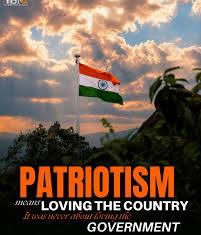
Patriotism should mean loyalty to the country, not blind loyalty to a political party.
If people are suffering because of unemployment, corruption, hunger, poor education, inflation or lack of opportunities, raising these questions should not automatically be called anti-national.
Sometimes asking difficult questions is itself an act of patriotism.
2. When Does Patriotism Become Stronger Among People?
History shows that people become politically active when their everyday lives become difficult.
If unemployment rises, families become worried.
If food becomes expensive, poor families suffer first.
If corruption becomes common, honest people lose confidence.
If businesses cannot grow, employment opportunities decrease.
If education becomes unaffordable, children from poorer families may lose opportunities.
At such times, people naturally start asking:
“What is happening to our country?”
This is where patriotism can become a powerful social force.
People may come together because they want a better future.
But patriotism should not be awakened only during elections.
It should remain alive every day.
3. Is Patriotism Being Used as a Political Tool?
This is one of the most important questions.
Political parties naturally want public support. Therefore, national identity, security, development, religion, culture and patriotism can become powerful political subjects.
There is nothing wrong with discussing national pride.
The problem begins when patriotism becomes a way of avoiding important questions.
For example, if citizens ask:
- Where are the jobs?
- Why is corruption continuing?
- Why is education expensive?
- Why are essential goods becoming difficult for poor families to afford?
- Why are some people becoming extremely wealthy while others remain trapped in poverty?
- How can small businesses grow?
- Why do young educated people struggle to find suitable work?
The answer should not simply be:
“You should be patriotic.”
A better answer would be:
“Let us examine the problem and find a solution.”
That is a healthier form of patriotism.
4. Patriotism and the New Generation
Today’s young generation lives in a very different environment.
Young people have smartphones, social media, online education, international information and access to ideas from all over the world.
They can compare India with other countries within minutes.
They can see how other governments provide public services.
They can learn how different economies create jobs.
They can see new technologies being developed in America, Europe, Japan, South Korea, China and other parts of the world.
Therefore, simply telling young people:
“Love your country”
may not be enough.
Young people also want to know:
“What future does my country offer me?”
They want education, skills, employment, entrepreneurship, affordable housing, good infrastructure, safety and opportunities to build a better life.
That is why patriotism in the 21st century needs to be connected with opportunity and performance.
5. What Does Technology Tell Us About the Future?
Modern technology is changing the way governments, businesses and citizens work.
Artificial intelligence, automation, robotics, digital payments, cloud computing, biotechnology and advanced manufacturing are changing the economy.
These technologies can increase productivity, but they can also replace some traditional jobs.
Therefore, India cannot simply depend on old employment models.
The country needs to prepare people for new kinds of work.
For example:
- Digital services
- Advanced manufacturing
- Semiconductor industries
- Renewable energy
- Healthcare technology
- Agriculture technology
- Software and cybersecurity
- Robotics
- Electronics
- Research and development
- Logistics
- Skilled construction
- Modern education
The important question is not whether technology will change jobs.
It will.
The important question is whether India will train its people quickly enough to participate in that new economy.
6. Can Technology Help Reduce Corruption?
Technology cannot magically eliminate corruption.
But it can make many government processes more transparent.
For example:
- Digital payments can reduce cash transactions.
- Online applications can reduce unnecessary middlemen.
- Public dashboards can show government spending.
- Digital records can reduce manipulation of paperwork.
- Data analysis can identify unusual transactions.
- Online tender systems can improve transparency.
- Direct benefit transfers can reduce leakage in some schemes.
- Digital grievance systems can make complaints easier to track.
But technology works only when institutions are honest and accountable.
A corrupt system can also misuse technology.
Therefore, technology must be combined with transparency, independent oversight, strong laws and responsible administration.
7. Can India End Poverty and Unemployment Completely?
This needs an honest answer.
No government can realistically promise that poverty or unemployment will disappear overnight.
But a country can significantly reduce them.
The strongest long-term strategy is not simply giving people money.
It is creating conditions where people can earn sustainable incomes.
That means:
Education → Skills → Employment/Business → Income → Savings → Investment → Economic Growth
This cycle can gradually improve living standards.
8. Free Benefits or Affordable Public Services?
This is a complicated issue.
Government support is necessary for people who genuinely cannot afford essential services.
Food support, healthcare assistance, education support and social security can protect vulnerable citizens.
But permanent dependence on free benefits is not a complete economic strategy.
There is an important difference between:
“Give me everything for free.”
and
“Make essential things affordable and give me an opportunity to earn.”
The second approach can create greater independence.
For example, instead of making higher education inaccessible and then giving occasional assistance, governments can work toward:
- affordable education,
- scholarships for those who need them,
- quality government schools,
- skill training,
- affordable healthcare,
- reliable public transport,
- easier access to credit for small businesses.
The goal should be dignity through opportunity, not permanent dependence.
9. Should Higher-Income People Pay More Tax?
Progressive taxation is already an important principle in many tax systems.
People with greater taxable income can contribute a larger share toward public services, while lower-income citizens can receive relief or support.
But taxation must be designed carefully.
If taxes become unnecessarily complicated or excessive, investment and entrepreneurship can suffer.
Therefore, the goal should be:
Fair taxation + simple rules + strong enforcement + productive government spending.
People should feel that their taxes are being used responsibly.
10. Can India Simply Print More Money?
This is where economics becomes very important.
It may sound simple:
“If the country needs money, why not print more?”
But money is not the same thing as wealth.
Suppose there are 100 products in a market and ₹1,000 available to buy them.
If the amount of money suddenly becomes ₹10,000 while production remains around the same level, people have more money competing for the same goods.
Prices can rise.
That is one reason excessive money creation can contribute to inflation.
Real national wealth comes from things such as:
- Production
- Skills
- Technology
- Infrastructure
- Natural resources
- Businesses
- Research
- Human capital
- Productivity
- Exports
- Efficient institutions
A printing machine can create currency. It cannot automatically create houses, food, factories, engineers or productive workers.
That distinction is extremely important.
11. What About People Who Own Large Assets?
Another major economic issue is wealth concentration.
Some people own land, property, businesses, shares and other valuable assets.
When the economy grows, asset owners can sometimes benefit substantially.
At the same time, people who have little property or savings may feel that they are not participating equally in economic growth.
A sensible policy discussion should therefore consider:
- Progressive taxation
- Property and capital taxation where appropriate
- Closing tax loopholes
- Competition policy
- Better wages
- Affordable housing
- Access to education
- Small-business financing
- Wider ownership opportunities
- Strong inheritance and asset-transfer rules where appropriate
But taxation should not become punishment for simply being successful.
The objective should be to create an economy where success is rewarded but extreme inequality does not destroy social mobility.
12. Why Education Matters So Much
Education is not only about getting a certificate.
It teaches people how to understand the world.
A person who understands mathematics can better understand:
- percentages,
- interest,
- profit,
- loss,
- debt,
- investment,
- inflation,
- business calculations.
Economics teaches people how money, production, employment and markets interact.
Science develops logical thinking.
Language skills help people communicate.
History helps people understand how societies developed.
Civics teaches citizens how governments and institutions work.
Therefore, a strong country needs citizens who can think, not merely repeat political slogans.
13. Does Being Good at Mathematics Mean Someone Has a Better Brain?
Not necessarily.
Mathematics, physics and English can demonstrate particular kinds of skills, but intelligence is much broader.
Someone may be excellent at mathematics.
Someone else may be excellent at understanding people.
Another person may be a brilliant administrator.
Someone may understand agriculture exceptionally well.
Someone may have extraordinary business judgment.
Someone may be an excellent teacher, engineer, doctor, artist or craftsman.
Therefore, leadership should not be judged only by academic marks.
But education does matter because a leader must understand evidence, budgets, statistics, laws, economics and the consequences of policies.
14. What Makes a Good Political Leader?
A good leader does not necessarily need to be the most educated person in the country.
But a good leader should have the ability to:
- Understand problems.
- Listen to experts.
- Understand economics.
- Understand mathematics and statistics sufficiently.
- Study evidence.
- Make decisions.
- Accept criticism.
- Admit mistakes.
- Control corruption.
- Build competent institutions.
- Think beyond the next election.
- Put public interest above personal gain.
The leader’s greatest qualification should ultimately be good judgment and responsible governance.
15. Should We Blame Politicians for Everything?
Not everything is the fault of politicians.
Citizens also have responsibilities.
If people offer bribes, evade taxes, damage public property, spread false information or discriminate against others, society itself contributes to the problem.
At the same time, governments have much greater institutional power and therefore greater responsibility.
A government controls or influences:
- Public infrastructure
- Education policy
- Healthcare systems
- Law enforcement
- Economic regulation
- Tax policy
- Public expenditure
- Industrial policy
- International trade policy
Therefore, citizens have the right to demand accountability.
16. Are Leaders Deliberately Keeping People Poor?
This is a serious allegation and should not be made without evidence.
Sometimes bad policies produce bad results.
Sometimes corruption can benefit particular groups.
Sometimes political parties may prioritize short-term electoral gains over long-term reforms.
But saying that every leader deliberately wants people to remain poor is too simplistic.
The better question is:
“What policy was adopted, who benefited, who lost, and what evidence shows why the decision was made?”
This moves political debate away from suspicion and toward facts.
17. What Strategy Could Improve India?
A long-term national strategy could focus on several pillars.
Step 1: Improve School Education
Every child should receive strong foundations in:
- Mathematics
- Science
- Language
- Digital literacy
- Financial literacy
- Critical thinking
- Civics
Step 2: Connect Education With Employment
Degrees should not be the only objective.
Education should connect with actual skills required by industries.
Step 3: Build Manufacturing
India needs more competitive manufacturing in areas such as electronics, machinery, renewable energy, pharmaceuticals and other high-value sectors.
Step 4: Support Small Businesses
Small businesses create employment and need easier access to:
- credit,
- markets,
- digital tools,
- training,
- infrastructure,
- predictable regulations.
Step 5: Invest in Infrastructure
Roads, railways, ports, electricity, internet connectivity, water systems and urban infrastructure improve productivity.
Step 6: Make Government Services Simple
Citizens should not need to visit multiple offices for simple services.
Step 7: Fight Corruption Through Institutions
Strong auditing, transparent procurement, digital records and independent accountability mechanisms are more important than political speeches.
Step 8: Encourage Exports
India needs to sell more competitive goods and services to the world.
Exports bring foreign exchange, create industries and can generate employment.
Step 9: Make Essential Services Affordable
Healthcare, education, transport, electricity and basic necessities should be accessible without creating unnecessary financial pressure.
Step 10: Prepare for Technological Change
Instead of fearing automation, India should train workers for the industries that technology creates.
18. Imports and Exports Also Matter
No modern country can produce everything economically by itself.
Imports can provide:
- raw materials,
- technology,
- machinery,
- energy,
- components.
Exports can provide:
- foreign exchange,
- employment,
- industrial growth,
- international market access.
The goal should not simply be “import nothing.”
The better goal is:
Import what increases our productive capacity and export products and services in which India can compete strongly.
19. Why Do People Unite When Poverty and Unemployment Are Discussed?
Because these problems affect almost every family directly.
A young person without employment feels the problem personally.
A parent unable to afford education feels it personally.
A worker facing rising prices feels it personally.
A small businessman facing weak demand feels it personally.
When people realize that their problems are shared, they can unite.
This unity can be positive if it is directed toward constructive democratic action rather than hatred.
20. What Can Artificial Intelligence See About India’s Future?
Technology can analyze enormous amounts of information and help governments understand patterns.
For example, advanced systems can potentially help analyze:
- employment trends,
- agricultural production,
- traffic,
- energy demand,
- public health patterns,
- education outcomes,
- tax data,
- supply chains,
- inflation,
- industrial productivity.
But technology cannot decide India’s future by itself.
It does not have a magical formula saying:
“Do these five things and poverty will disappear.”
Human beings still have to make political and economic choices.
Technology can provide better information.
Good governance has to convert that information into action.
21. The Biggest Question: Party or Governance?
Perhaps this is where the entire discussion comes together.
A country cannot develop merely because one party wins.
Nor does a country automatically decline because another party wins.
The real test is:
How well is the government functioning?
Are schools improving?
Are hospitals functioning?
Are businesses growing?
Are jobs increasing?
Are infrastructure projects completed efficiently?
Is corruption being controlled?
Are public finances sustainable?
Are citizens safe?
Are laws implemented fairly?
Are poor people getting opportunities?
Are young people prepared for the future?
These questions matter more than political slogans.
22. Patriotism Should Become Performance
Perhaps the definition of patriotism needs to become broader.
A soldier protecting the country is patriotic.
But so is a teacher educating children.
A doctor treating patients honestly is patriotic.
A farmer producing food is patriotic.
A scientist conducting research is patriotic.
A worker doing his job honestly is patriotic.
An entrepreneur creating employment is patriotic.
A citizen paying taxes honestly is patriotic.
A person refusing to give or take a bribe is patriotic.
A young person learning a useful skill is patriotic.
A politician who refuses corruption and works honestly for citizens is patriotic.
Patriotism is not only emotion. It is responsibility.
Conclusion: Love for the Country Must Also Mean Responsibility Toward Its People
India does not need less patriotism.
It needs deeper patriotism.
A patriot should be able to love the country while asking uncomfortable questions.
A patriot should be able to criticize a bad policy without hating the nation.
A patriot should want economic growth but also care about people who are left behind.
A patriot should support technology but also care about workers whose jobs are changing.
A patriot should want strong national security as well as strong education, healthcare and employment.
And most importantly, patriotism should not be measured by how loudly someone speaks.
It should be measured by what they contribute.
The future of India will not be created only inside Parliament or government offices. It will be created in classrooms, factories, farms, laboratories, offices, businesses and homes.
Political parties will come and go.
Governments will change.
Leaders will change.
Policies will change.
But the country will remain.
So perhaps the most meaningful question for every generation is not:
“Which party is patriotic?”
It is:
“What kind of India are we building for the next generation?”
If India can combine education, employment, technology, honest governance, fair taxation, affordable public services, entrepreneurship, manufacturing, exports and responsible citizenship, then patriotism will no longer remain merely a word used in political speeches.
It will become something people can actually see in their daily lives.
And that may be the strongest form of patriotism of all.